Robert Sawyer - Frameshift
Здесь есть возможность читать онлайн «Robert Sawyer - Frameshift» весь текст электронной книги совершенно бесплатно (целиком полную версию без сокращений). В некоторых случаях можно слушать аудио, скачать через торрент в формате fb2 и присутствует краткое содержание. Год выпуска: 1998, ISBN: 1998, Издательство: Tor Science Fiction, Жанр: Фантастика и фэнтези, на английском языке. Описание произведения, (предисловие) а так же отзывы посетителей доступны на портале библиотеки ЛибКат.
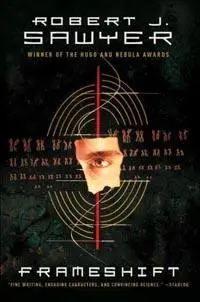
- Название:Frameshift
- Автор:
- Издательство:Tor Science Fiction
- Жанр:
- Год:1998
- ISBN:0-812-57108-8
- Рейтинг книги:4 / 5. Голосов: 1
-
Избранное:Добавить в избранное
- Отзывы:
-
Ваша оценка:
Frameshift: краткое содержание, описание и аннотация
Предлагаем к чтению аннотацию, описание, краткое содержание или предисловие (зависит от того, что написал сам автор книги «Frameshift»). Если вы не нашли необходимую информацию о книге — напишите в комментариях, мы постараемся отыскать её.
Frameshift — читать онлайн бесплатно полную книгу (весь текст) целиком
Ниже представлен текст книги, разбитый по страницам. Система сохранения места последней прочитанной страницы, позволяет с удобством читать онлайн бесплатно книгу «Frameshift», без необходимости каждый раз заново искать на чём Вы остановились. Поставьте закладку, и сможете в любой момент перейти на страницу, на которой закончили чтение.
Интервал:
Закладка:
Pierre gulped air. “Won’t it be awkward, knowing the donor?”
“Oh, it’ll be our secret,” said Klimus, raising his hand again. “You want good DNA, no? I’m a Nobel Prize winner; I have an IQ of one-six-three.
I’m a proven commodity as far as longevity is concerned, and I have excellent eyesight and reflexes. Plus, I don’t carry genes for Alzheimer’s or diabetes or any other serious disorder.” He smiled slightly. “The worst thing programmed into my DNA is baldness, and I do confess I was hit with that at an early age.”
During Klimus’s long statement, Molly had started out by shaking her head slightly back and forth, back and forth, but that had stopped by the time he reached his conclusion. She looked now at Pierre, as if to gauge his reaction.
Klimus, too, turned his eyes on Pierre. “Come on, young man,” he said, and then his face split in a dry, cold grin. “Better the devil you know.”
“But why?” asked Pierre. “Why would you be interested?”
“I’m eighty-four,” said Klimus, “and have no children. I simply wish for the Klimus genes to not disappear from the gene pool.” He looked at each of them in turn. “You’re a young couple, just getting started. I know what you make, Tardivel, and can guess what you make, Molly. Tens of thousands of dollars is a lot of money to you.”
Pierre looked at Molly and shrugged. “I… I suppose it would be okay,” he said slowly, not at all sure of himself.
Klimus brought his hands together in a loud clap that sounded like a gunshot. “Wonderful!” he said. “Molly, we’ll make an appointment for you with Dr. Bacon; she’ll prescribe hormone treatments to get you to develop multiple eggs.” Klimus rose to his feet, cutting off further discussion.
“Congratulations, Mother,” he said to Molly, and then, in an unexpected display of bonhomie, he came over and laid a bony arm on Pierre’s shoulder. “And congratulations to you, too, Father.”
“Big trouble,” said Shari, coming into Pierre’s lab and holding up a photocopy. “I found this note in a back issue of Physical Review Letters .”
She looked upset.
Pierre was spinning down his centrifuge. He left it whirling under inertia and looked up at her. “What’s it say?”
“Some researchers in Boston are contending that although the DNA that codes for protein synthesis is structured like a code — one word wrong and the message is garbled — the junk or intronic DNA is structured like a l anguage , with enough redundancy that small mistakes don’t matter.”
“Like a language?” said Pierre excitedly. “What do they mean?”
“In the active parts of the DNA, they found that the distribution of the various three-letter codons is random. But in the junk DNA, if you look at the distribution of ‘words’ of three, four, five, six, seven, and eight base pairs in length, you find that it’s just like what we have in a human language. If the most common word appears ten thousand times, then the tenth most common appears only one thousand times, and the hundredth most common appears just a hundred times — which is very much like the relative distribution of words in English. ’The‘ is an order of magnitude more common than ’his,‘ and ’his’ is an order of magnitude more common than, say, ‘go.’ Statistically, it’s a very distinctive pattern, diagnostic of a real language.”
“Excellent!” said Pierre. “Excellent.”
Vertical frown lines were marring Shari’s otherwise porcelain-smooth forehead. “It’s terrible. It means other people have been making good progress on this problem, too. That note in Physical Review Letters was published in the December fifth, 1994, issue.”
Pierre shrugged. “Remember Watson and Crick, hunting for the structure of DNA? You recall who else was working on the same problem?”
“Linus Pauling, among others.”
“Pauling, exactly — who’d already won a Nobel for his work on chemical bonding.” He looked at Shari. “But even old Linus couldn’t see the truth; he came up with a Rube Goldberg three-stranded model.” Pierre had learned all about Goldberg since coming to Berkeley; he was a UCB alumnus and an exhibition of his cartoons was on display on campus.
“Sure, some others have been working in the same area we’re pursuing.
But I’d rather you come in here and tell me that there’s good reason to think something meaningful is coded in the non-protein-synthesizing DNA than to say everyone who ever looked at it before has concluded it really is just junk. I know we’re on the right track, Shari. I know it.” He paused. “You’ve done good work. Go home; get a good night’s sleep.”
“You should go home, too,” Shari said.
Pierre smiled. “Actually, tonight the tables are turned. I’m waiting for Molly. She’s got a late departmental meeting. I’ll stay here till she calls.”
“All right. See you tomorrow.”
“Good night, Shari. And be careful — it’s pretty late already.”
Shari left the room and started walking down the corridor. She went outside and waited for the shuttle bus to arrive. It did so, and she rode it down to the campus proper. She wanted to run a few errands on campus before heading home, one of which took her near the psychology building, where Pierre’s wife was apparently still working. Just outside it, Shari was unnerved to collide with a rough-looking young man pacing impatiently back and forth as if he were waiting for someone. He was dressed in a leather jacket and faded jeans, and had closely cropped blond hair and a strange chin that looked like two protruding fists.
Nasty customer, Shari thought as she scurried away into the darkness…
Book Two
The farther back you can look, the farther forward you are likely to see.
—Sir Winston Churchill, winner of the 1953 Nobel Prize in literatureChapter 18
Nighttime. Two police officers, one black, one white. A blood-splattered sidewalk. A man named Chuck Hanratty dead, his body taken away by ambulance. Pierre chilled in the nighttime breeze, his shirt lying in a stiffening wad, soaked with blood.
“Look, it’s after midnight,” said the black cop to Molly, “and, frankly, your friend seems a bit out of it. Why don’t you let Officer Granatstein and me give you a lift? You can come by headquarters tomorrow to make a report.” He handed his card to her.
“Why,” said Pierre, slowly coming out of shock, “would a neo-Nazi want to attack me?”
The cop lifted his broad shoulders. “No big mystery. He was after your wallet and her purse.”
But Molly had read the man’s mind, and knew that this wasn’t a simple mugging — it was a deliberate, premeditated attempt on Pierre’s life. She gently grasped her husband’s hand and took him over to the police car.
Pierre and Molly lay in bed, Molly holding him tightly.
“Why,” said Pierre again, “would a neo-Nazi be after me?” He was still badly shaken. “Hell, why would anyone go to the trouble of trying to kill me? After all…” His voice trailed off, but Molly could read the already formulated English sentence: After all, I’ll probably be dead soon anyway.
Molly shook her head as much as her pillow would allow. “I don’t know why,” she said softly. “But he was after you. You in particular.”
“You’re sure?” asked Pierre, his voice betraying the faint hope that Molly was mistaken.
“As we passed him, Hanratty was thinking, About fucking time that frog showed up.”
Pierre stiffened slightly. “You can’t tell the cops that,” he said.
“Of course not.” She forced a small laugh. “They wouldn’t believe me anyway.” She paused. “But he’d been ordered to kill you, ordered by someone named Grozny — and he’d apparently already killed several other people for this Grozny, too.”
Читать дальшеИнтервал:
Закладка:
Похожие книги на «Frameshift»
Представляем Вашему вниманию похожие книги на «Frameshift» списком для выбора. Мы отобрали схожую по названию и смыслу литературу в надежде предоставить читателям больше вариантов отыскать новые, интересные, ещё непрочитанные произведения.


Обсуждение, отзывы о книге «Frameshift» и просто собственные мнения читателей. Оставьте ваши комментарии, напишите, что Вы думаете о произведении, его смысле или главных героях. Укажите что конкретно понравилось, а что нет, и почему Вы так считаете.