Chris Moriarty - Spin Control
Здесь есть возможность читать онлайн «Chris Moriarty - Spin Control» весь текст электронной книги совершенно бесплатно (целиком полную версию без сокращений). В некоторых случаях можно слушать аудио, скачать через торрент в формате fb2 и присутствует краткое содержание. Год выпуска: 2006, ISBN: 2006, Издательство: Bantam Spectra, Жанр: Фантастика и фэнтези, на английском языке. Описание произведения, (предисловие) а так же отзывы посетителей доступны на портале библиотеки ЛибКат.
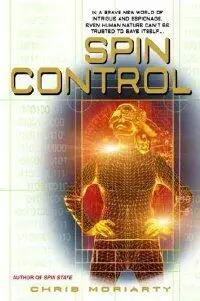
- Название:Spin Control
- Автор:
- Издательство:Bantam Spectra
- Жанр:
- Год:2006
- ISBN:978-0-553-58625-1
- Рейтинг книги:5 / 5. Голосов: 1
-
Избранное:Добавить в избранное
- Отзывы:
-
Ваша оценка:
Spin Control: краткое содержание, описание и аннотация
Предлагаем к чтению аннотацию, описание, краткое содержание или предисловие (зависит от того, что написал сам автор книги «Spin Control»). Если вы не нашли необходимую информацию о книге — напишите в комментариях, мы постараемся отыскать её.
As the auction heats up, the Artificial Life Emancipation Front sends in Major Catherine Li. Drummed out of the Peacekeepers for executing Syndicate prisoners, Li has now literally hooked up with an AI who has lived many lifetimes and shunted through many bodies. But while they have their own conflicting loyalties to contend with, together they’re just one player in a mysterious high-stakes game…
Spin Control — читать онлайн бесплатно полную книгу (весь текст) целиком
Ниже представлен текст книги, разбитый по страницам. Система сохранения места последней прочитанной страницы, позволяет с удобством читать онлайн бесплатно книгу «Spin Control», без необходимости каждый раз заново искать на чём Вы остановились. Поставьте закладку, и сможете в любой момент перейти на страницу, на которой закончили чтение.
Интервал:
Закладка:
They would move forward, agonizingly slowly, trying to stay within the Enders’ data fusion shadow. The Enders would stop—even with his experience of the AzizSyndicate tacticals, Arkady found their abrupt, silent changes of speed and direction unnerving—and everyone else would stop too. Then they would wait. For a few minutes usually. For half an hour or forty minutes. Once for a full hour and a quarter. And then some invisible nonevent would happen in streamspace, and the Enders would move off again, and off they’d all go like rats following the Pied Piper of Hamelin.
At one point they stumbled into the outer penumbra of a Palestinian artillery barrage. The Enders appeared entirely unmoved by the awesome spectacle; they simply coalesced in a nearby shell crater and took cover as if having the earth ripped apart just in front of their feet were no more alarming than spotting a rain cloud on the horizon.
The commandos huddled together in the closest available crater, unfortunately a wet one. They looked only slightly more concerned than the Enderbots, but they kept up a running commentary of flagrantly indecent summations of their current comfort level that had even Li grinning.
“Don’t worry.” Cohen leaned over to shout in Arkady’s ear between two blasts big enough to make the ground ripple under their feet. “The Palestinian Army is a highly professional organization. They have a firm grasp on how to keep the voting public scared and pliable with minimum waste of trained soldiers on both sides. As long as they’re actually trying to hit us we’re perfectly safe. Of course the fact that they don’t actually know we’re here may complicate matters somewhat.”
Arkady looked nervously toward Osnat, trying to gauge whether this was a joke. “Do the, ah…Palestinians fire into the Line often?”
“It goes up and down. At the moment we’re in a pretty hot-and-heavy phase.”
“And the only thing standing between them and the Israelis is the French Foreign Legion?” Arkady said doubtfully. “Why would anyone take that job?”
“Because they’re French,” Osnat said.
“Because they’re idiots,” Cohen said.
“Because they’re the Legion,” Li said. “Ever heard of Camerone?”
Arkady shook his head.
She leaned forward, warming to her subject, and told him the story in a series of rapid-fire, chewed-off half sentences that sounded like they’d been forged on the battlefield.
It had happened on a planet called Mexico. Or in a country called Mexico. Arkady couldn’t tell which from the way Li described it. A battalion of Legionnaires led by the already infamous Colonel Danjou was escorting a supply train when they were attacked by three Mexican battalions. The French retreated to the Hacienda Camerone (“No, Arkady, I don’t know how a hacienda is different from a house. It’s not mission-critical. Let it slide.”) and set up a perimeter around the courtyard of the hacienda under heavy sniper fire. At 9:00 A.M. on the morning of the battle, the Mexican commander offered terms of surrender, which were refused.
Several mixed cavalry and infantry charges were bloodily repelled. But the defenders took deep losses in each of the failed assaults, and Colonel Danjou, fearing for his men’s resolve, gathered them in the hacienda’s courtyard and made them swear on his wooden hand—memento of past battles—that they would fight through to death or victory.
Danjou fell to a sniper’s bullet moments later. His second-in-command died in the afternoon, and by evening the former battalion was being commanded by a second lieutenant named Maudet.
At 6:00 P.M. Maudet and the last four defenders exhausted their ammunition, fixed their bayonets, and charged the Mexican lines. Three of them survived the charge.
The Mexican commander demanded their surrender, and they sent his messenger back across the lines with the message that they would rather die than give up their arms, their flag, or the body of their slain colonel. The messenger relayed the response to the Mexican commander, who then uttered one of the most famous phrases in all of military history: “These are not men. These are devils.”
The next day the three survivors were escorted across the lines, their honor and arms intact and their slain commander’s body on their shoulders. “They took Colonel Danjou’s wooden hand with them,” Li finished, holding up her own left hand, palm forward, so that Arkady could see the bruise-blue outline of her Schengen implant and the silver tracery of ceramsteel. “It was escorted to the Legion’s mother house in Sidi el Abbès with the highest honors, and ever since then Danjou’s hand has been the symbol of the Legion’s code: Never surrender.”
“It wasn’t quite that glorious,” Cohen corrected. “But who’s quibbling? Danjou’s worm-ridden hand remains the shining symbol of the Legion’s august tradition of getting into the military equivalent of stupid barroom brawls and laying down your soldiers’ lives for no damned decent reason.”
“Scoff all you want, Cohen. You know as well as I do that Jerusalem would be in a state of outright all-out civil war if the Peacekeepers were occupying it. The only people worse at Peacekeeping than the Peacekeepers are the fucking Americans.”
“Well at least the Americans have the brains to brag about their victories instead of their suicide missions.”
“The Legion completed its mission in Camerone,” Li protested.
“Thereby allowing the French army to fight on in the name of Liberty, Equality, and Fraternity in order to prop up a hereditary puppet king and save the Mexican people from the grim prospect of Liberty, Equality, and Fraternity. Excuse me. I’m getting all choked up just thinking about it.”
“Ignore the caviar communist commentary,” Li told Arkady. “The point is that the Legion held out to the death, then went down fighting.”
“The point, Arkady, is that Catherine here has a little thing for pointless suicide missions.”
The soldiers all around them were up on their feet now, peering after the Enders in the next shell crater over, gathering their gear and stowing water bottles and nonstandard-issue candy bars.
“If you two are done sniping at each other,” Osnat interrupted, “would you mind terribly if we got our shit together and got the fuck out of here before your friends leave us behind?”
After that things got vague.
Arkady remembered passing reel after reel of the indestructible obsolete fiber optics that littered half the Judean desert. He remembered an entire field of school buses, standing snout to tail, their doors flapping open as if they were still waiting to transport a generation of children who had never shown up for school. He remembered passing through a village whose inhabitants gathered in the dark doors of their hovels to watch the Enders jangle by, and whose hostile faces could have been Jewish or Palestinian or anything in between.
They spent most of the night in another flooded-out crater.
“Know much about cannibalism?” Li asked him sometime well after darkness had fallen.
Even she was lying down by then, though she was still smoking another in her endless succession of cigarettes. How she managed to smoke lying down like that and not end up buried in a mountain of cigarette ash was a mystery to Arkady.
“Uh…no.”
“Some bright bulb did a statistical study of space wrecks. You know, the classic scenario: twenty people stranded in a life pod, food and air for thirty days, going to take ninety for the SOS to ping to the nearest BE relay and back. So who are the eaters, and who are the eatees? No pun intended. Turns out that you can predict who’s going to eat and who’s going to get eaten pretty reliably. Even when they draw straws, believe it or not. Able-bodied human males come last. They don’t generally start eating each other until they’ve run out of everyone else. Before that they go through the human women and children. And before they start on the lesser humans, they eat the posthumans. And before they eat the posthumans, they eat the constructs.”
Читать дальшеИнтервал:
Закладка:
Похожие книги на «Spin Control»
Представляем Вашему вниманию похожие книги на «Spin Control» списком для выбора. Мы отобрали схожую по названию и смыслу литературу в надежде предоставить читателям больше вариантов отыскать новые, интересные, ещё непрочитанные произведения.





Обсуждение, отзывы о книге «Spin Control» и просто собственные мнения читателей. Оставьте ваши комментарии, напишите, что Вы думаете о произведении, его смысле или главных героях. Укажите что конкретно понравилось, а что нет, и почему Вы так считаете.