Chris Moriarty - Spin Control
Здесь есть возможность читать онлайн «Chris Moriarty - Spin Control» весь текст электронной книги совершенно бесплатно (целиком полную версию без сокращений). В некоторых случаях можно слушать аудио, скачать через торрент в формате fb2 и присутствует краткое содержание. Год выпуска: 2006, ISBN: 2006, Издательство: Bantam Spectra, Жанр: Фантастика и фэнтези, на английском языке. Описание произведения, (предисловие) а так же отзывы посетителей доступны на портале библиотеки ЛибКат.
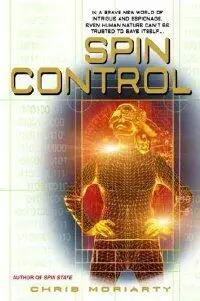
- Название:Spin Control
- Автор:
- Издательство:Bantam Spectra
- Жанр:
- Год:2006
- ISBN:978-0-553-58625-1
- Рейтинг книги:5 / 5. Голосов: 1
-
Избранное:Добавить в избранное
- Отзывы:
-
Ваша оценка:
Spin Control: краткое содержание, описание и аннотация
Предлагаем к чтению аннотацию, описание, краткое содержание или предисловие (зависит от того, что написал сам автор книги «Spin Control»). Если вы не нашли необходимую информацию о книге — напишите в комментариях, мы постараемся отыскать её.
As the auction heats up, the Artificial Life Emancipation Front sends in Major Catherine Li. Drummed out of the Peacekeepers for executing Syndicate prisoners, Li has now literally hooked up with an AI who has lived many lifetimes and shunted through many bodies. But while they have their own conflicting loyalties to contend with, together they’re just one player in a mysterious high-stakes game…
Spin Control — читать онлайн бесплатно полную книгу (весь текст) целиком
Ниже представлен текст книги, разбитый по страницам. Система сохранения места последней прочитанной страницы, позволяет с удобством читать онлайн бесплатно книгу «Spin Control», без необходимости каждый раз заново искать на чём Вы остановились. Поставьте закладку, и сможете в любой момент перейти на страницу, на которой закончили чтение.
Интервал:
Закладка:
The machine wouldn’t tell them where it was taking them.
It met them alone, without the terrifying woman who Arkady still instinctively thought of not as Catherine Li, but as the Butcher of Gilead. But Arkady’s relief at Li’s absence faded as Cohen led them out of the prosperous modern section of Jerusalem and into the bombed-out tangle of empty streets that tumbled down toward the thickness of the Line.
Osnat followed the AI with a docility that Arkady found more frightening than her usual stubbornness. Her eyes flickered restlessly over the passing house fronts and alleyways, but she gave no other sign of being aware of possible danger. Arkady would have liked to believe that it was because she knew they were protected, but he suspected it was because she’d decided that any dangers out there couldn’t be dealt with and would have to be accepted.
Finally, they turned into an empty street whose houses—not all of them empty by any means—bore the blaring orange biohazard signs that Arkady had come to recognize as the emblem of the poisoned border between Israel and Palestine.
“Are you sure this is a good idea?” Arkady whispered to Osnat.
“Too late for that, boychik.”
Something clanked softly, metal on metal, in the shadowy interior of one of the abandoned houses they’d just passed. “Don’t move,” said a woman’s voice from the shadows. “You’re perfect just where you are.”
“Son of a bitch,” Osnat muttered.
The machine shrugged apologetically. “It wasn’t my idea.”
More noises came from inside the house, and from two of the houses on the other side of the empty street. Osnat stood stock-still, her hands held stiffly out away from her body, in plain sight, with the palms showing and the fingers open. On reflection, Arkady decided that it might be a good idea to do the same.
The voice that had spoken out of the shadows had almost certainly been Catherine Li’s, but none of the half dozen hard young bodies that emerged from the surrounding houses was hers.
They were soldiers, but there was something disorientingly drab and ragtag-looking about them, even by Israeli standards. Their uniforms looked at first glance as if they’d been torn and roughly patched. It took a few puzzled minutes for Arkady to work out that the “patches” were tape, and the tape was strategically located to cover all unit insignia.
“Hey, guys,” one of the secret soldiers said when he caught sight of Osnat. “It’s Hoffman! We bagged ourselves a tiger. Here, kitty kitty kitty!”
“Oh grow up,” Osnat snarled.
A second soldier came over to frisk Arkady. As the boy’s hands slid under his arms and along his rib cage, Arkady saw a flash of silver on the breast pocket of his uniform. He looked more closely and saw a small pin depicting a viciously curved saber blossoming from a pair of spread eagle’s wings.
“You forgot to tape over your pin thingy,” he said.
“What are you, IDF quality control? I ran out of fucking tape.”
“It doesn’t matter anyway. I don’t even know what it means.” Not quite true; the paratroopers’ wings told Arkady he was dealing with commandos from one of Israel’s legendary Sayerets, or special units. But which unit this was he couldn’t have begun to say.
“It means I Love Mom,” the soldier quipped. “Now turn around and spread your legs, schlemiel.”
Arkady turned around obediently—and finally caught sight of Li.
There was something about her, even standing in the street doing nothing, that made the Israelis look like toy soldiers. She was dressed much as Osnat usually dressed: in nondescript standard-issue desert-drab gear that looked like it could have come out of any of the army surplus shops Arkady had passed while running Korchow’s little errands the other week. But somehow the mismatched odds and ends hung on her short stocky frame in a configuration that looked anything but haphazard.
Her short hair was pushed back under a pair of sniper’s goggles that must cover her entire face when she pulled them down. The elastic band that held the goggles to her head had once had white lettering on it, perhaps a manufacturer’s logo; it had been scribbled over with a laundry pen so that it was just a dull purple-brown overlay on the black elastic. Her trousers were stained and bagged out at the knees and a knee pad floated around one ankle. Her already-stocky body was encased in a ceramic vest. In addition to the handgun still strapped to her thigh where he’d seen it during that first meeting at the airport, she’d made two new additions to her armory: a long, black, viciously sleek sniper’s rifle and a brutal-looking sawed-off assault weapon with a flashlight duct-taped beneath its trigger guard.
Another person—most other people—would have looked ridiculous in this getup. Li didn’t. And when Arkady asked himself why, he couldn’t come up with a clear answer. Was it the well-worn, hard-used quality of the clothes and weapons? Was it the sense that every strap and buckle and piece of tape had been adjusted with cool precision by hands that had done the job of killing often enough to make it a matter of craft, rather than reflection? Or was it the bulldog set of her jaw and the glint of defiant enjoyment in her dark eyes?
“He’s clean,” the soldier told Li over Arkady’s shoulder as he finished searching him.
“Take him inside then.”
Arkady looked around for Cohen, but the AI was gone. He had a vague idea that he’d seen him fade back into one of the neighboring houses just after the troops had arrived on the scene. And he must have taken Osnat with him because she was nowhere to be seen either.
“Where did Cohen and Osnat go?” he asked Li. It was the first time he’d ever worked up the courage to speak directly to the woman.
She looked at him as if she’d just become aware of his existence and wasn’t particularly pleased by the discovery. “Cohen had to go take care of some things.”
Arkady jerked his head toward the empty houses and the no-man’s-land that he knew must lie just beyond them. “Is he…are we going out there?”
“Probably.”
“Are we going to be out there after dark?” Arkady asked, looking at her flashlight-equipped weapon.
She gave him a lazy smile. “You better hope not.”
Inside the building that seemed to be the unit’s impromptu headquarters, Arkady saw a dozen more soldiers, a tangle of wires and equipment, assorted ominous olive drab cases and boxes—and off in a corner together, bent over a monitor, Cohen and Osnat and a young man whose collar tabs said he was a captain.
Osnat had somehow acquired a ceramic-plated vest and helmet and one of the same snubbed-off flashlight-equipped weapons that Li and the others were all carrying.
“What about him?” Li flicked a thumb at Arkady. “You’re not going to send him in naked as a shelled oyster, are you?”
An awkward silence fell.
“Oh for God’s sake. Don’t tell me no one thought of it?”
“Well…uh…Avi’s about his size,” said a young woman with a first lieutenant’s bar on her collar. “Someone go get Avi.”
“Avi! Get the fuck over here!”
“I said go get him, not scream in my ear. God, kids these days!”
A tall slim soldier materialized from somewhere over Arkady’s left shoulder. Rough hands pushed him against the wall next to Arkady and squared them up next to each other. A brief argument ensued—no surprise in a country where argument appeared to be the national sport. Nonetheless, it was obvious that the willowy Avi was closer to Arkady’s space-born physique than anyone else in the unit.
“Hey, wait a minute,” Avi said when he figured out what was in the cards. “Not my vest! Take someone else’s vest! This isn’t some factory-issue piece of shit. My mother resewed all the inside pockets and—”
Читать дальшеИнтервал:
Закладка:
Похожие книги на «Spin Control»
Представляем Вашему вниманию похожие книги на «Spin Control» списком для выбора. Мы отобрали схожую по названию и смыслу литературу в надежде предоставить читателям больше вариантов отыскать новые, интересные, ещё непрочитанные произведения.









Обсуждение, отзывы о книге «Spin Control» и просто собственные мнения читателей. Оставьте ваши комментарии, напишите, что Вы думаете о произведении, его смысле или главных героях. Укажите что конкретно понравилось, а что нет, и почему Вы так считаете.