Chris Moriarty - Spin Control
Здесь есть возможность читать онлайн «Chris Moriarty - Spin Control» весь текст электронной книги совершенно бесплатно (целиком полную версию без сокращений). В некоторых случаях можно слушать аудио, скачать через торрент в формате fb2 и присутствует краткое содержание. Год выпуска: 2006, ISBN: 2006, Издательство: Bantam Spectra, Жанр: Фантастика и фэнтези, на английском языке. Описание произведения, (предисловие) а так же отзывы посетителей доступны на портале библиотеки ЛибКат.
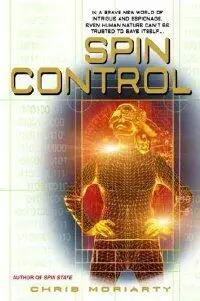
- Название:Spin Control
- Автор:
- Издательство:Bantam Spectra
- Жанр:
- Год:2006
- ISBN:978-0-553-58625-1
- Рейтинг книги:5 / 5. Голосов: 1
-
Избранное:Добавить в избранное
- Отзывы:
-
Ваша оценка:
Spin Control: краткое содержание, описание и аннотация
Предлагаем к чтению аннотацию, описание, краткое содержание или предисловие (зависит от того, что написал сам автор книги «Spin Control»). Если вы не нашли необходимую информацию о книге — напишите в комментариях, мы постараемся отыскать её.
As the auction heats up, the Artificial Life Emancipation Front sends in Major Catherine Li. Drummed out of the Peacekeepers for executing Syndicate prisoners, Li has now literally hooked up with an AI who has lived many lifetimes and shunted through many bodies. But while they have their own conflicting loyalties to contend with, together they’re just one player in a mysterious high-stakes game…
Spin Control — читать онлайн бесплатно полную книгу (весь текст) целиком
Ниже представлен текст книги, разбитый по страницам. Система сохранения места последней прочитанной страницы, позволяет с удобством читать онлайн бесплатно книгу «Spin Control», без необходимости каждый раз заново искать на чём Вы остановились. Поставьте закладку, и сможете в любой момент перейти на страницу, на которой закончили чтение.
Интервал:
Закладка:
They were in their cabin, sprawled across the lower bunk, drinking more of the Aurelias’ vile vodka, stealing a few moments away from the insanity that was rapidly consuming the rest of the crew.
“Has Aurelia showed you any results on those assays yet?”
“Don’t change the subject on me. I’ve never seen hair that out of control. No wonder you’re obsessed with the adaptive value of dissent!”
Arkady brushed ineffectually at the offending locks. “They’re ugly.”
“They’re extraordinary.”
“They’re a deviation.”
“They’re an oversight. Some poor designer was too busy thinking about next week’s production quotas, or his digestive troubles, or his unrequited love for whatever norm-conforming certifiably A-equivalent piece of tail he happened to be chasing at the moment. His mind strayed”—Arkasha’s free hand slid down Arkady’s chest and across his belly—“unforgivably from the all-important work at hand. An error crept into the D1746 gene at site forty-two of chromosome eighteen. That’s the frizzy D site to you and the rest of the hoi polloi. Our poor designer failed to notice the error. It began to replicate. The control team, perhaps similarly distracted by work, lust, or digestion, also failed to notice the error. Which continued to replicate. Which resulted in your spectacular cowlicks. Which resulted in my falling in love with you. Which is about to result in…here, hold this.”
“You’re drunk.” Arkady took the beaker Arkasha handed him and realized belatedly that there was nowhere on the narrow bunk to put it down—and that that was exactly what Arkasha had intended.
“True, too true,” Arkasha admitted, busy with the drawstring of Arkady’s pants. “I’m also a shirker, and a malingerer, and an unregenerate deviant. None of which detracts from the blinding moral import of the revelation I’m about to bestow upon you.”
“Which is?”
“That I love you—have I mentioned, by the way, that you entirely fail to appreciate my brilliance and originality?—that I love you because of their mistake.”
Arkady made a rude noise. “At least my cowlick is outside my skull, not inside it.”
“Yep,” Arkasha announced at about the same moment as he finally succeeded in making Arkady spill his drink all over the floor. “That’s me. A Cowlick on the Brain of a Perfect Society.”
The arena was perhaps a meter across. At the moment its perfectly white and featureless surface contained perhaps five hundred army ants, racing around in a swirling, slightly irregular circle that resembled nothing so much as a satellite’s eye view of a hurricane. It also resembled, to Arkady’s naturalist’s eye, a dozen or so other examples of self-organized criticality in action: the delicate spiral structures that so many leafy plants evolved to maximize sun exposure and minimize self-shading; the intricate whorls in the pelts of fur-bearing mammals, of which the single whorl on the crown of each human and posthuman head was a vestigial remnant; the complex interlocking networks formed by communities of people, ants, or songbirds.
But there was one difference of course: all those other patterns were adaptive, whereas the milling, panicked circle of ants was suicidally dysfunctional.
“Under unique circumstances in nature (and rather ordinary ones in the laboratory), army ants can be induced to form a tight circular column, a myrmecological merry-go-round, in which they ‘march themselves to death.’” Gotwald, of course, quoting Piels and Schnierla.
And the great Schnierla had established that the diameter of the circular column represented “the sum of the vector of the individual ant’s centrifugal impulse to resume the march and the centripetal force of trophallaxis which binds it to its group”…an equation that never failed to cross Arkady’s mind when he saw large groups of people all making the same stupid mistake at the same moment.
Trophallaxis—the following instinct—was so strong that if you dropped ants from two different swarms into the arena together, they would actually follow each other perfectly peacefully for ten or twenty minutes before they came to their senses and locked mandibles in a last mortal battle.
“You’d think that sometime, somewhere, some of them would just snap out of it and turn the other way,” Arkasha said beside him.
“You have to remember that the following instinct is perfectly adaptive in the environment it evolved in.” As usual Arkady felt an obscure need to defend his ants. “If these ants were on the forest floor instead of in the lab, they would circle around until they found their swarm’s scent and just follow it back to the main column. Or even if the scent trail was gone, washed away in a flood for example, they’d run into sticks and stones and leaves and be deflected little by little until they eventually worked their way back to the rest of the swarm. It’s just here, where there’s no external noise to counterbalance the circling instinct, that it becomes maladaptive. The ants and their environment are an integrated system, just like the brain and its environment. Change the environment and you’re left with half a system. You might as well rip half the wires out of a computer, then blame it for not working.”
“It’s really kind of awful when you put it that way,” Arkasha said. “Actually…why are you doing this to the poor ants?”
“I’m not going to follow through with it,” Arkady confessed. “I just wanted to see a circular mill in action. I’m going to aspirate them back into their nest before they get too tired. To tell you the truth, I never could do any really nasty experiments on ants. I can’t stand the sight of their little faces when they’re frightened.”
“Their little faces ?” Arkasha sounded amused. “Do ants even have faces?”
“Sure. Well, mandibles. And they have this panic-stricken way of antennating that’s just heartbreakin—”
Ranjipur poked his head into the lab, looking thoroughly panic-stricken himself despite his lamentable absence of antennae. “Have you two seen Aurelia?” he asked. “Oh. Arkasha. Thank God. We need you. Bella’s had some kind of relapse.”
Bella was in the bathroom slumped over the toilet when they reached her. Her dark hair was plastered against her skull, and Arkady could see the pale skin of her scalp showing between the damp locks.
“How long has this been going on?” Arkasha asked.
It turned out that it had been going on for a week, and that Bella had somehow managed to hide it from everyone. Shocking. But not as shocking as the look on Aurelia’s face when she finally arrived and got a handle on the situation.
“Come down to the lab and help me run this?” she asked Arkasha after she’d pulled blood from the Motai B.
Arkady tagged along, following Aurelia’s glance at him rather than an explicit invitation.
“What the hell is going on down here?” Arkasha said as soon as the door closed behind them.
Aurelia still had that stunned, bloodless look on her face. “I don’t know. I have no data, no physiological baselines, no standard procedures to follow. I mean, for the ship cat, sure. But this…”
Arkasha flopped weakly onto the stool next to Arkady. He and Aurelia seemed to have reached some basic unspoken agreement about the nature of Bella’s changeling sickness that eluded Arkady.
“Is Bella in danger?” he asked hesitantly. “Can you cure her?”
“She’s in a lot of danger,” Aurelia said shortly. “And I can’t cure her because there’s nothing to cure. She’s not sick, Arkady. She’s pregnant.”
A UNIVERSAL GRAMMAR OF COMBAT
Military conflicts, particularly land combat, possess the key characteristics of complex adaptive systems (CASs): combat forces are composed of a large number of nonlinearly interacting parts…local action, which often appears disordered, induces long-range order (i.e., combat is self-organized); military conflicts, by their nature, proceed far from equilibrium; military forces, in order to survive, must continually adapt to a changing combat environment; there is no master “voice” that dictates the actions of each and every combatant… Finally, what lies at the heart of an artificial-life approach to simulating combat, is the hope of discovering…whether there exists—and, if so, what the properties are, of—a universal grammar of combat.
Интервал:
Закладка:
Похожие книги на «Spin Control»
Представляем Вашему вниманию похожие книги на «Spin Control» списком для выбора. Мы отобрали схожую по названию и смыслу литературу в надежде предоставить читателям больше вариантов отыскать новые, интересные, ещё непрочитанные произведения.









Обсуждение, отзывы о книге «Spin Control» и просто собственные мнения читателей. Оставьте ваши комментарии, напишите, что Вы думаете о произведении, его смысле или главных героях. Укажите что конкретно понравилось, а что нет, и почему Вы так считаете.