Chris Moriarty - Spin Control
Здесь есть возможность читать онлайн «Chris Moriarty - Spin Control» весь текст электронной книги совершенно бесплатно (целиком полную версию без сокращений). В некоторых случаях можно слушать аудио, скачать через торрент в формате fb2 и присутствует краткое содержание. Год выпуска: 2006, ISBN: 2006, Издательство: Bantam Spectra, Жанр: Фантастика и фэнтези, на английском языке. Описание произведения, (предисловие) а так же отзывы посетителей доступны на портале библиотеки ЛибКат.
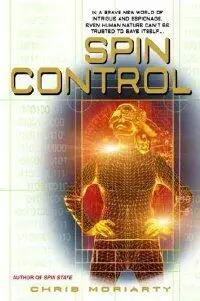
- Название:Spin Control
- Автор:
- Издательство:Bantam Spectra
- Жанр:
- Год:2006
- ISBN:978-0-553-58625-1
- Рейтинг книги:5 / 5. Голосов: 1
-
Избранное:Добавить в избранное
- Отзывы:
-
Ваша оценка:
Spin Control: краткое содержание, описание и аннотация
Предлагаем к чтению аннотацию, описание, краткое содержание или предисловие (зависит от того, что написал сам автор книги «Spin Control»). Если вы не нашли необходимую информацию о книге — напишите в комментариях, мы постараемся отыскать её.
As the auction heats up, the Artificial Life Emancipation Front sends in Major Catherine Li. Drummed out of the Peacekeepers for executing Syndicate prisoners, Li has now literally hooked up with an AI who has lived many lifetimes and shunted through many bodies. But while they have their own conflicting loyalties to contend with, together they’re just one player in a mysterious high-stakes game…
Spin Control — читать онлайн бесплатно полную книгу (весь текст) целиком
Ниже представлен текст книги, разбитый по страницам. Система сохранения места последней прочитанной страницы, позволяет с удобством читать онлайн бесплатно книгу «Spin Control», без необходимости каждый раз заново искать на чём Вы остановились. Поставьте закладку, и сможете в любой момент перейти на страницу, на которой закончили чтение.
Интервал:
Закладка:
“What a beautiful girl!” Cohen exclaimed, kneeling to bring his face within licking range.
She was beautiful. Arkady knew theoretically that she must be no bigger than average size for a dog, but she was so much larger than the tiny, petted, cosseted canines that he’d seen in the Syndicates that he could barely believe they were the same species. And this was no pet either, he suspected. He didn’t know what job she’d been bred to do, but not even the most casual observer could miss the honed, streamlined, powerful purposefulness of her.
“What is she?” Cohen asked. He was now thumping energetically at her ribs, whipping her into a delighted frenzy. “She’s too big to be pure border collie.”
“I don’t think the breed has a name. The shepherds in the Line bred them from whatever was left after the die-offs. Tough on sheep, easy on the eye.” He cleared his throat and made a formal gesture. “Ah. I’ve been remiss. Cohen, meet Dibbuk. Dibbuk, meet Cohen.”
Cohen laughed and buried his face in the dog’s thick fur. Then he stood up, and after the briefest of hesitations, stepped forward and embraced the stranger. They kissed each other elaborately in the Arab manner. Then Cohen took the human’s face between his hands and held him out at arm’s length in a way that made Arkady realize suddenly that the AI must be very old, and that even the humans he called friends must seem like mere children to him.
“You didn’t have to roll in with the cavalry,” the human said. “You could have just asked me to meet you at your hotel. Uh…right…well, I guess I should try to check my mail more often.”
“Oh Gavi,” the machine said, caressing the man with the same open, uncomplicated, unshadowed affection he’d shown to the dog just a few moments ago, “what on earth am I supposed to do with you?”
They followed Gavi between the tall trees to a building buried in the hillside like a knife blade. He stopped in front of a plate glass door sized to accommodate busloads of tourists and smiled his sweet, wounded, self-deprecating smile. “We all know what the spider said to the fly and how that ended up,” he told them. “But come in anyway.”
The vast lobby ran away on all sides into dust and shadows. Gavi struck off across the echoing expanse of marble and dove through a sagging fire door into an ill-lit warren of maintenance corridors and administrative offices.
Arkady felt as if he’d walked into a theater, stepped onto the stage, and slipped through the wings to the cramped back passages and dressing rooms where the actors really lived. This part of the building looked at once abandoned and cluttered. Gavi seemed to be camping in it as much as living in it, and the whiff of kerosene on the air hinted at more than occasional power outages.
At one point they passed an entire room full of dirty laundry. Gavi pulled the door closed, grinned sheepishly, and muttered something about the maid’s day off. “I would have put shoes on when I saw you coming,” he said in an apparent non sequitur, “but I forgot to buy socks last time I was in town. And I meant to wash the ones I have. But somehow the whole laundry thing just never quite got off the ground this month.”
Li snorted.
“I have Superhuman Powers of Procrastination,” Gavi announced. He could do the same capital letters trick that Osnat did, Arkady noticed. Maybe it was something about Hebrew. “But the problem with powers of procrastination,” he continued wistfully, “is that you can’t Use Them for Evil. You can only use them for Nothing.”
Osnat stared for a moment, perplexed, then burst out laughing.
“It’s nice to see you,” Gavi told her. “How are you? Well, I hope?”
She frowned and looked away. “So what are we here for, anyway? I don’t want to walk home after dark in this neighborhood.”
Gavi turned to Cohen, a look of alarm spreading across his mobile features. “You’re not thinking of going back tonight? That would be terribly dangerous. I don’t want to get my neighbors in trouble, but I happen to know that at least four EMET patrols have been rolled for their tech in the last six months.”
“You happen to know?” Osnat asked in a voice as hard as her eyes.
“I have to live out here,” Gavi said simply.
Osnat turned away, her mouth twitching as if she wanted to spit.
Gavi looked after her for a moment before turning back to Cohen. “You are staying, though? Aren’t you?”
“We’re staying,” Li broke in. “I just cleared it with EMET.”
“Good. Excellent. Then shall we get down to business? Um…what is business, by the way?”
Cohen cleared his throat. “Would you kids mind terribly going off and playing on your own while I have a private word with Gavi?”
Gavi moved around the room, piling clothes, books, and data cubes on one surface; moving them to another; rearranging and consolidating and buttressing sedimentary layers of computer printouts in a comical attempt to free up space for Cohen’s cup, Cohen’s knees, Cohen himself.
Watching him, Cohen felt at once relieved and disoriented. He had expected to see a broken man, or at least a changed one. But this was Gavi as he’d always been. The body blessed with the spare, tendon-on-bone grace of the born long-distance runner. The face that had far too much of the intellectual in it to be what most people called handsome. The black, black eyes whose liquid brilliance you couldn’t imagine until you’d been subjected to one of Gavi’s tell-me-no-lies stares.
And a right leg that ended just below the knee and had been replaced by a prosthesis that, if Cohen knew Gavi, was one of the most obsessively babied, upgraded, optimized, and tinkered-with pieces of hardware on the planet.
“How’s your mother?” Cohen asked.
“Oh, you know, the usual. Finding fascists under the furniture. Predicting the fall of the free world before lunch every morning. For her, happy.”
Gavi’s mother had been an old kibbutznik and a prominent Labor Party politician known for her fierce intelligence and her ability to sniff out and stamp on even the subtlest manifestations of bullshit. His father had been her diametric opposite: a dreamer, an intellectual, a minor Palestinian poet whose elegantly crafted poems were turning out to be not nearly as minor as everyone had at first thought they were.
Gavi’s father had died of an early heart attack before the war started, which Cohen couldn’t help thinking had been a mercy. His mother had resigned from the Knesset and left Earth permanently the day the first appropriations bill for EMET went through. And since she’d been berating her only son over his “fascist” career for decades, neither Gavi’s dismissal from the Mossad nor the swirling rumors of treason had clouded their affectionate but extremely long-distance relationship.
In Cohen’s opinion, each of Gavi’s parents had represented the best their respective cultures had to offer. And Gavi in turn had gotten the best parts of both of them. But that was Cohen’s opinion. And at the moment his idea of the n- optimal human being didn’t seem to be very popular in either the new Israel or the new Palestine.
“I like your tough girl,” Gavi said when he’d finally consolidated things sufficiently to clear knee and elbow room for the two of them. “And you finally got her to marry you too, I hear. How’s happily ever after going?”
Cohen shrugged.
“I’m sorry. And here I’d been getting so much enjoyment out of staring up at the stars thinking of all the fun you were having.”
“Fun, my friend, is seriously overrated.”
“So what’s the problem exactly?”
“If I knew, I’d fix it and there wouldn’t be one.”
Читать дальшеИнтервал:
Закладка:
Похожие книги на «Spin Control»
Представляем Вашему вниманию похожие книги на «Spin Control» списком для выбора. Мы отобрали схожую по названию и смыслу литературу в надежде предоставить читателям больше вариантов отыскать новые, интересные, ещё непрочитанные произведения.









Обсуждение, отзывы о книге «Spin Control» и просто собственные мнения читателей. Оставьте ваши комментарии, напишите, что Вы думаете о произведении, его смысле или главных героях. Укажите что конкретно понравилось, а что нет, и почему Вы так считаете.