Chris Moriarty - Spin Control
Здесь есть возможность читать онлайн «Chris Moriarty - Spin Control» весь текст электронной книги совершенно бесплатно (целиком полную версию без сокращений). В некоторых случаях можно слушать аудио, скачать через торрент в формате fb2 и присутствует краткое содержание. Год выпуска: 2006, ISBN: 2006, Издательство: Bantam Spectra, Жанр: Фантастика и фэнтези, на английском языке. Описание произведения, (предисловие) а так же отзывы посетителей доступны на портале библиотеки ЛибКат.
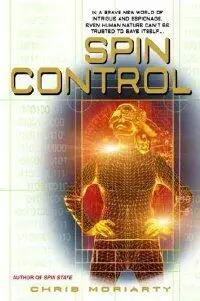
- Название:Spin Control
- Автор:
- Издательство:Bantam Spectra
- Жанр:
- Год:2006
- ISBN:978-0-553-58625-1
- Рейтинг книги:5 / 5. Голосов: 1
-
Избранное:Добавить в избранное
- Отзывы:
-
Ваша оценка:
Spin Control: краткое содержание, описание и аннотация
Предлагаем к чтению аннотацию, описание, краткое содержание или предисловие (зависит от того, что написал сам автор книги «Spin Control»). Если вы не нашли необходимую информацию о книге — напишите в комментариях, мы постараемся отыскать её.
As the auction heats up, the Artificial Life Emancipation Front sends in Major Catherine Li. Drummed out of the Peacekeepers for executing Syndicate prisoners, Li has now literally hooked up with an AI who has lived many lifetimes and shunted through many bodies. But while they have their own conflicting loyalties to contend with, together they’re just one player in a mysterious high-stakes game…
Spin Control — читать онлайн бесплатно полную книгу (весь текст) целиком
Ниже представлен текст книги, разбитый по страницам. Система сохранения места последней прочитанной страницы, позволяет с удобством читать онлайн бесплатно книгу «Spin Control», без необходимости каждый раз заново искать на чём Вы остановились. Поставьте закладку, и сможете в любой момент перейти на страницу, на которой закончили чтение.
Интервал:
Закладка:
“What if it’s something you can’t change?”
“I can change a lot, Catherine.”
The shadow of an unpleasant thought drifted across her face. He couldn’t hear it. She’d shut him out completely. And though he could have broken the door down instead of standing outside knocking on it, he knew that there was no future for the two of them on the far side of such an act of violence.
He waited. She looked at him, knowing that he was waiting. Letting him wait.
“You can’t change me,” she said.
Cohen stood under the shower, luxuriating in the feel of hot water running over Roland’s skin. Water smelled different on Earth. Better. And like so many of life’s small physical pleasures, it couldn’t be simulated no matter how state-of-the-art your streamspace connection was.
On the other hand, the water also turned off sooner on Earth than it did Ring-side. Even the outrageous room rates at the King David only bought you an extra thirty seconds or so on the clock. And, Israel being Israel, a call to the front desk was more likely to get you a lecture about water conservation than a longer shower.
Cohen sighed. This was starting out to be a bad day. And he, or Roland more likely, had a headache. And he really didn’t need any Israeli attitude in his morning.
He snuck a feeler into the hotel’s ambient AI systems and confirmed the first impressions gleaned through casual contacts over the last week. It was a primitive decision-tree-based expert system not even worthy of being called intelligent in any real sense. He hacked it, made his way to the shower defaults, changed the four-minute cutoff to a ten-minute cutoff. And since he felt like being a nice guy (and didn’t relish having to explain himself when the hack was discovered), he changed the allowances for all of his 212 fellow guests as well as himself.
Not that he actually enjoyed the shower, of course. Because instead of luxuriating in the hot water pummeling Roland’s back, he stood there, wreathed in steam, and brooded about the Game.
Hyacinthe had programmed the first rudimentary version of the Game into Cohen’s original Beowulf clusters almost four centuries ago. The Game had started out as a combination of chess, multiagent roleplay, and Turing-style conversational interaction. During the DARPA years it had been briefly and unpleasantly derailed for military research. After Cohen’s Great Escape (but that was another story) he’d assumed full control over his architecture, and the Game had begun to evolve into something too complex, fluid, and internally contradictory to properly be called a game at all.
There were by then some several thousand subsets of gameplay, platformed on a shifting tide of neural networks that might arguably be sentient itself—though not in any way that organics would recognize. Cohen navigated between the various versions of the Game, thanks to a densely swarming vast heterarchy of semiautonomous agents who constantly optimized play based on prior player hits, nonhit interactions, and inscribed player use histories. The whole system had become far too complex for any organic to grasp more than a tiny corner of it. But the basic mission primitives that motivated Cohen remained essentially the same ones that Hyacinthe had written so many centuries ago:
1. Initiate play based on the most current version of the Game;
2. Track player hits, defined as:
i. positive emotive cues as perceived by the pattern recognition ES;
ii. increased playtime and intensity of play
iii. explicit player feedback
3. Expand and evolve the Game to maximize player hits.
4. Assign highest priority to maximizing hits from inscribed players.
That was the curse that Hyacinthe had coded into his core architecture. Cohen needed the Game. He needed to be for someone. And he was set apart from every other surviving Emergent AI in that the someone needed to be more or less human.
Ergo Gavi, whom he could not stop loving though he might be a traitor.
Ergo Li, who was sanguinary, secretive, perfectly capable of having done all the horrible things they’d accused her of, and pigheadedly bent on refusing everything Cohen could give her.
All that Cohen was—once you stripped away the extension languages and interface programs and the three-century accumulation of upgrades and patches and extensions—was his accumulated memories of interactions with the Game’s inscribed players. And if Li left, it would mean a reweighting of mission primitives so drastic that Cohen had no real way to predict what new realignment of identities would come out the other side. She had become so deeply ingrained in his networks that when she yanked herself out it would call the bluff on the smoke-and-mirrors cognitive architecture that passed for Cohen’s identity.
And Li knew all about running on smoke and mirrors.
Born in the Trusteeships, she’d been destined for a short, poisonous life as a Bose-Einstein miner. Instead, she’d bought a dead girl’s face and geneset from a chop-shop geneticist, lied her way into the Peacekeepers, and hacked her own memory in order to pass as human. And when it was time to tell all to the psychtechs she’d spun a fake childhood to go with the fake passport and the fake geneset.
She had walked into the maze and cut the thread. All she knew about the childhood she remembered was that it had never happened, at least not to her. The minute she went into the psychtechs’ tanks there was no “before” to go back to. All the fears and joys and tics and habits that connected a whole person to their past led back to enlistment day and stopped. She would never know herself in the way that most humans, floating in the vibrant web of a lifetime’s memories, knew themselves. She would never know what she’d done on Gilead, any more than she’d ever know the child she’d been before she went to Gilead.
That was what had first drawn them together: the woman who had no memories and the machine who was nothing but memories. But Cohen was slowly coming to the heartsick realization that it might also be what drove them apart.
Or at least that was how it seemed to Cohen. But he could be fooling himself. He’d certainly done that before…as router/decomposer was always all too ready to remind him.
By the time he was dressed and presentable, Li had already demolished breakfast for two and most of the morning’s paper.
“How’s your Deep Blue-Kasparov sim going?” she asked from behind the sports page as he sat down across from her.
“Oh, I finished with that ages ago. The whole match was a hoax, it turns out.”
The sports page dropped. “Really?”
That was Li for you: always seduced by the faintest whiff of crime. Could you find a more perfect example of the old truism about cops and robbers being two sides of the same coin? Or, in her case, soldiers and mercenaries.
“Really,” Cohen assured her, doing his best to sound smug. “I’m going to write an article about it for Physical Review Letters. ”
“And how do you figure they pulled off the fake?”
“Easy. There was a little man inside Garry Kasparov.”
She groaned and went back to her paper.
Cohen poured himself a glass of what passed for orange juice these days and hunted for the marmalade. “Come on. It wasn’t that bad.”
“Yes it was.”
Cohen shook out his napkin (Li’s napkin still lay folded on the table, naturally; why use a napkin when you have a sleeve?) and began investigating the viennoiserie situation.
Grim. Decidedly grim.
“I ought to look up some of my old friends in the Legion while we’re here,” he said. “Maybe they know where to get a decent croissant in this town.”
“What do you want a croissant for? You’re in the Middle East. And you know that thing people are always saying about when in Rome do as the Romans do.”
Читать дальшеИнтервал:
Закладка:
Похожие книги на «Spin Control»
Представляем Вашему вниманию похожие книги на «Spin Control» списком для выбора. Мы отобрали схожую по названию и смыслу литературу в надежде предоставить читателям больше вариантов отыскать новые, интересные, ещё непрочитанные произведения.









Обсуждение, отзывы о книге «Spin Control» и просто собственные мнения читателей. Оставьте ваши комментарии, напишите, что Вы думаете о произведении, его смысле или главных героях. Укажите что конкретно понравилось, а что нет, и почему Вы так считаете.