Chris Moriarty - Spin Control
Здесь есть возможность читать онлайн «Chris Moriarty - Spin Control» весь текст электронной книги совершенно бесплатно (целиком полную версию без сокращений). В некоторых случаях можно слушать аудио, скачать через торрент в формате fb2 и присутствует краткое содержание. Год выпуска: 2006, ISBN: 2006, Издательство: Bantam Spectra, Жанр: Фантастика и фэнтези, на английском языке. Описание произведения, (предисловие) а так же отзывы посетителей доступны на портале библиотеки ЛибКат.
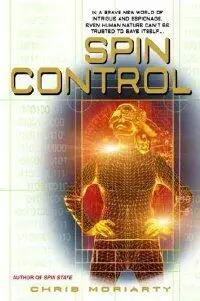
- Название:Spin Control
- Автор:
- Издательство:Bantam Spectra
- Жанр:
- Год:2006
- ISBN:978-0-553-58625-1
- Рейтинг книги:5 / 5. Голосов: 1
-
Избранное:Добавить в избранное
- Отзывы:
-
Ваша оценка:
Spin Control: краткое содержание, описание и аннотация
Предлагаем к чтению аннотацию, описание, краткое содержание или предисловие (зависит от того, что написал сам автор книги «Spin Control»). Если вы не нашли необходимую информацию о книге — напишите в комментариях, мы постараемся отыскать её.
As the auction heats up, the Artificial Life Emancipation Front sends in Major Catherine Li. Drummed out of the Peacekeepers for executing Syndicate prisoners, Li has now literally hooked up with an AI who has lived many lifetimes and shunted through many bodies. But while they have their own conflicting loyalties to contend with, together they’re just one player in a mysterious high-stakes game…
Spin Control — читать онлайн бесплатно полную книгу (весь текст) целиком
Ниже представлен текст книги, разбитый по страницам. Система сохранения места последней прочитанной страницы, позволяет с удобством читать онлайн бесплатно книгу «Spin Control», без необходимости каждый раз заново искать на чём Вы остановились. Поставьте закладку, и сможете в любой момент перейти на страницу, на которой закончили чтение.
Интервал:
Закладка:
Things naturally got a bit more complicated after Warovski’s death. At that point, however, the Chessplayer fell into the hands of one of the great con men of all time: a certain Johann Maelzel.
And then things began to get really interesting.
Maelzel concocted and managed to keep a more or less firm grasp on one of the longest-lived conspiracies in the history of the game of chess. Half the chess masters of Europe (the shorter half) conspired with Maelzel to build up the Turk’s legend. The Chessplayer beat Benjamin Franklin, Napoleon, and a short list of Europe’s best-known kings, emperors, and celebrities.
But the conspiracy succeeded at a price. For the collaboration between man and automaton was plagued by misfortune, death, and insanity. Several of the directors died or went crazy or developed catastrophic claustrophobia. The one woman (never named) who operated the automaton was rumored to have become barren, for reasons that the most respected Parisian surgeons were ghoulishly eager to speculate about. And the machine’s most famous director, Jacques Mouret, was completely paralyzed: struck down, as the broadsheets of the day put it, by the Curse of the Turk.
It was Mouret who finally unmasked the automaton in a tell-all newspaper interview given from his deathbed in exchange for the fleeting solace of a few bottles of high-proof liquor. By then, however, the Chessplayer, Maelzel, and Maelzel’s debts had already lit out for America.
The Curse of the Turk finally caught up with Maelzel in Cuba. During an exhibition game in Havana he contracted yellow fever. He died on the ship home to Philadelphia, and the Chessplayer was purchased at auction by a glorified curiosity shop called Peale’s Museum, or in some historical sources, the Chinese Museum. Whatever it was called, the place was no match for the Curse of the Turk. It burned down in the Great Fire of 1878, giving rise to the widespread assumption that “Maelzel’s dead chessplayer” (as it was by then called) was permanently, and not merely circumstantially, deceased.
Until Cohen rediscovered it—and rescued it and put it in the great ballroom of the house from rue du Poids de l’Huile so that Li’s subconscious could hang all her fears on its broad shoulders.
The Turk was playing the Qf3 Nc6 gambit at the moment: the same strategy that had checkmated Napoleon in just twenty-four moves during the bloody campaign of Wagram. It slid the pieces across the board with a long stick, its mechanical arm whirring and chuttering as the ancient gears grabbed and slipped and slid against each other. But Cohen noticed this with only a tiny fraction of his currently integrated consciousnesses. Because mostly what they were noticing was that Li was utterly, shatteringly terrified.
And as he looked up at the massive cloaked torso of the Turk, at the turbaned head, he understood why. He knew the face around those dead glass eyes. It was his face…Roland’s face…
“Cohen!”
Li was staring down at him, her lips pursed, the smooth curve of her forehead furrowed with a fine network of curving parallel wrinkles.
“You okay?” she asked in a light, carefully neutral tone that told him just how bad he must look.
He mustered a smile, feeling Roland’s skin itch in one of those neural feedback loops that he’d long ago given up trying to track through the vast labyrinth of patched and rewritten and expanded source code that ran his shunt subroutines.
“You gave me a nightmare,” he told Li.
“I don’t have nightmares.”
“Maybe you have them and just don’t remember them.”
“What’s the difference?”
A shofar blew somewhere nearby, some lone musician practicing for Rosh Hashanah.
“What is that?” Li asked.
“The shofar. A ceremonial ram’s horn. They blow it during the Yamim Noraim, the High Holy Days. This is when every Jew is supposed to review his actions over the past year—they call it the Arithmetic of the Soul in Hebrew—and do penance. They blow the shofar to symbolize that the Book of Life will stand open for ten days and even the worst sinner can be entered into it as long as he repents before nightfall on Yom Kippur.”
“I thought only Catholics did guilt.”
He snorted. “And where do you think you people got it from?”
“Listen,” she said. “I’m sorry about yesterday.” He didn’t have to ask what part of yesterday she was sorry about; the memory of the nasty fight they’d had on the way home from Didi’s house was still fresh enough to have both of them on edge. “I shouldn’t have gotten personal. It’s just that I think you’re letting Didi use you.”
“Last time I checked, letting the Mossad use you was the dictionary definition of a sayan.”
“But you let him manipulate you.”
“Everyone lets people manipulate them, Catherine. It’s called having friends.”
“You know what I’m talking about.” She dropped her voice, the way she always did when she couldn’t avoid this particular topic. “The Game. Didi’s not an inscribed player, is he?”
“No! You think I wouldn’t have told you? I can’t believe you think I wouldn’t tell you that!”
“Okay, okay. Calm down. I just…but Gavi is, right?”
“What’s your point?”
“That you’re not thinking straight.”
“You’ve been talking to router/decomposer too much.”
“Well, sometimes he’s easier to talk to than you are.”
“That’s because he agrees with you.”
“No. He’s just less…conflicted.”
“That’s because there’s less of him to be conflicted.”
“You don’t have to be condescending,” she said sharply.
“I’m not being condescending!” Cohen stopped and forced himself to continue in a more reasonable tone of voice. “That’s as ridiculous as you being condescending to your big toe.”
“Last time I checked my big toe didn’t have a Ph.D. in applied mathematics.”
“Excuse me, Catherine, but what are we actually fighting about?”
Li crossed her arms, set her jaw, and stared stoically into the middle distance. He’d clearly struck a nerve. But why? And what did it have to do with “condescending” to router/decomposer?
“Do you think,” Cohen said, “that maybe, I don’t know, this is something we should, uh, talk about sometime?”
She gave him a wry look. “Yes, I do think maybe, I don’t know, this is something we should, uh, talk about sometime. But if we talk about it now, it’s only going to go one way. And I don’t want that. Necessarily.”
Relief trickled through Cohen like snowmelt, freeing systems that had been frozen in a holding pattern of anxiety. “And just when do you think you’ll be ready to talk about it?” he asked.
She sat up and looked intently at him. “That’s not like you. You’re usually the first one to put off till tomorrow what we could fight about today.”
But despite all his good intentions, Cohen couldn’t keep from pushing.
“The thing is,” he said, “I’m rapidly approaching achievement of the convergence criteria indicating termination of this particular iterative process.”
Every other person he’d ever been married to (except the mathematician, whose failings had gone far beyond the merely syntactical) would have asked what the hell he meant by that. Li just looked at him, her eyes level and calm, and said, “Are you asking for a divorce?”
“No! God!” He sat up, the room spinning around him. “You’re so far beyond paranoid there isn’t even a word for it! I’m just asking you to talk to me about whatever it is you’re so”—he backed carefully away from the inflammatory word afraid—“ whatever it is that’s making you shut me out.”
Читать дальшеИнтервал:
Закладка:
Похожие книги на «Spin Control»
Представляем Вашему вниманию похожие книги на «Spin Control» списком для выбора. Мы отобрали схожую по названию и смыслу литературу в надежде предоставить читателям больше вариантов отыскать новые, интересные, ещё непрочитанные произведения.







Обсуждение, отзывы о книге «Spin Control» и просто собственные мнения читателей. Оставьте ваши комментарии, напишите, что Вы думаете о произведении, его смысле или главных героях. Укажите что конкретно понравилось, а что нет, и почему Вы так считаете.