Chris Moriarty - Spin Control
Здесь есть возможность читать онлайн «Chris Moriarty - Spin Control» весь текст электронной книги совершенно бесплатно (целиком полную версию без сокращений). В некоторых случаях можно слушать аудио, скачать через торрент в формате fb2 и присутствует краткое содержание. Год выпуска: 2006, ISBN: 2006, Издательство: Bantam Spectra, Жанр: Фантастика и фэнтези, на английском языке. Описание произведения, (предисловие) а так же отзывы посетителей доступны на портале библиотеки ЛибКат.
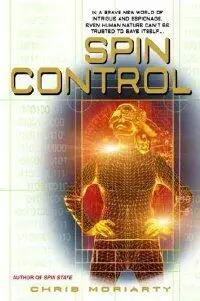
- Название:Spin Control
- Автор:
- Издательство:Bantam Spectra
- Жанр:
- Год:2006
- ISBN:978-0-553-58625-1
- Рейтинг книги:5 / 5. Голосов: 1
-
Избранное:Добавить в избранное
- Отзывы:
-
Ваша оценка:
Spin Control: краткое содержание, описание и аннотация
Предлагаем к чтению аннотацию, описание, краткое содержание или предисловие (зависит от того, что написал сам автор книги «Spin Control»). Если вы не нашли необходимую информацию о книге — напишите в комментариях, мы постараемся отыскать её.
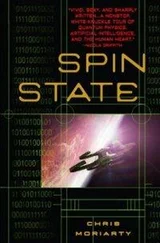
As the auction heats up, the Artificial Life Emancipation Front sends in Major Catherine Li. Drummed out of the Peacekeepers for executing Syndicate prisoners, Li has now literally hooked up with an AI who has lived many lifetimes and shunted through many bodies. But while they have their own conflicting loyalties to contend with, together they’re just one player in a mysterious high-stakes game…
Spin Control — читать онлайн бесплатно полную книгу (весь текст) целиком
Ниже представлен текст книги, разбитый по страницам. Система сохранения места последней прочитанной страницы, позволяет с удобством читать онлайн бесплатно книгу «Spin Control», без необходимости каждый раз заново искать на чём Вы остановились. Поставьте закладку, и сможете в любой момент перейти на страницу, на которой закончили чтение.
Интервал:
Закладка:
He blinked. He tried to remember the last time he’d blinked and couldn’t. He started to worry in a lackluster kind of way about whether forgetting to blink could damage Roland’s eyes in some way that wouldn’t be covered by the medical rider on the time-share contract.
He felt hollow, as if an invisible hand had reached in through his eyes in the eternity between one blink and the next and carved out whatever passed for his insides. Something was wrong with the shunt, obviously. But it wasn’t anything he could put a finger on, even if he’d had fingers. His myriad active systems still flowed smoothly through optimization subroutines, evaluating spinfeed, performing parity checks, refining his still-sketchy AP maps, ticking through the weak encryption of a half dozen vulnerable protected access points. But it was happening so far away that it seemed like someone else’s life.
It had been a long week. A long night. A hell of a long time in-body.
For the first time in three years, twelve weeks, and fourteen hours, he “lost” certain critical parts of what passed for “his” consciousness…
He woke into Li’s dream.
She stood in a dark hallway. The cool breath of a ceiling fan whispered along her skin, and below the whir of the fan there was another noise: a throaty ticking that made Cohen think, for some reason his associative memory programs could not immediately retrieve, of Garry Kasparov.
It could not be a place Li had ever been in her impossibly brief lifetime. He suspected that her memory was simply recycling footage of some ancient flat film set in Morocco or Alexandria or Arabia. Yet she’d somehow associated a smell with the image: a smell of spice and sandalwood and the genteel decay of rooms waiting out the midday heat behind slatted shutters.
But where had that smell come from? Random spinfeed? Some fragmentary record of a wartime combat jump, its spins decohered by repeated Bose-Einstein jumps until all she remembered was the smell of whatever forgotten desert she had fought and bled in? A piece of her lost childhood that had somehow managed to survive the slash-and-burn deletions that kept her one step ahead of the UNSec psychtechs for the fifteen years when she’d passed as human?
No matter. Though the vision was canned, the smell was real. And if it wasn’t quite the smell of Earth’s deserts as Cohen knew them, it was close enough to fool anyone who hadn’t lived it.
A harsh knife’s edge of sunlight slashed through an ill-hung shutter at the end of the corridor. Li walked to the window, opened it, and looked out over a blazing cityscape that incorporated the more famous bits and pieces of old Jerusalem. For a brief moment, Cohen wondered why her internals didn’t pick up the dream image and supply a current and factually accurate view of the city. Surely they could do that. Was there some patch or cutout that prevented her hard memory from being activated by dreamed images? Or was it in the nature of dreams not to be visible to machines unless the machines knew, at least in the half-light of borrowed memories, what it was to dream?
Then she turned away from the window, and they were in the last place Cohen would ever have expected this particular dream to take them. Home. His home, in one of the AI enclaves of the Orbital Ring. And, for the last three years, her home as well.
They were in the great ballroom. Like the rest of the house it had been boosted up, brick by brick, marble by marble, floorboard by floorboard, from rue du Poids de l’Huile in Toulouse. A lot of beautiful things had vanished in the chaos of the Evacuation, and not even Cohen could begin to save them all. But he’d saved Hyacinthe’s childhood home. And though the tourists were a bit of a pain, it gave him real pleasure to know that people traveled from every far-flung zone of the Orbital Ring to gaze at the formal eighteenth-century façade and the Renaissance staircase and the Roman bricks weathered to the soft pink of a summer sunset, and remember the ville rose and the glories of his beloved lost Gascony. Balls had gone out of style even before the original Hyacinthe was born, and the ballroom now housed Cohen’s automata collection.
Li walked down the long hall, under the refracted sunlight that rippled through the old glass like water curving over rocks. Her eyes brushed over the polished ivory of the Napier’s Bones, the finger-stained manila of an original Hollerith card from the 1890 census, the boxy control panel of one of the few priceless surviving Altair-8800s.
Not for the first time, Cohen wondered what it was like for Li to live in a neighborhood where the only organic life-forms were expensive purebred house pets and the aesthetically impeccable eternally youthful bodies-for-rent through which the more human AIs preferred to conduct their necessary commerce with organics. He’d always known she must feel something about it, in that shadowy part of her psyche that hovered always a little beyond his reach. Now, in her unguarded dream state, he experienced those feelings as if they were his own.
Fear. Affection. Confusion. Powerlessness. All the creeping horror of the DARPA years. But why? She wasn’t a prisoner. And he certainly wasn’t her jailer. Surely he wasn’t responsible for this?
The ticking was louder now, far louder than it had been when the dream started. Cohen felt like a dust mote trapped inside a giant’s pocket watch.
What are they waiting for? Li asked. Cohen realized with a shock that the they Li was so afraid of was him. And suddenly he knew, because he had felt that same terror in her dreams before, where she was taking him.
The Automatic Chessplayer was the most famous automaton ever built, and most certainly one of the most famous scientific hoaxes ever inflicted on a gullible public. Baptized Von Kempelen’s Turk because of its spectacular gown and turban (no one ever accused Von Kempelen of good taste), the chessplayer had toured all the royal courts of Europe and swiftly become the stuff of legend. Rumors abounded that the Turk was controlled by a demon. Spectators crossed themselves upon entering its presence. Ladies had been known to faint.
The greatest feat of engineering involved in the machine, the thing that made it an automaton in fact as well as fiction, was its left arm. It was undoubtedly the most advanced prosthesis of the premodern era, for it could perform all the complex fine motor movements necessary to move chess pieces across the playing board. As the pamphleteer Carl-Gottlieb Windisch pronounced in 1773, “The invention of a mechanical arm whose movements are so natural, which grasps, lifts, and sets down all with such grace, even if this arm were directed by the two hands of the inventor himself, it alone is so complicated that it would ensure the reputation of many an artist.”
But behind the ingenious arm, Von Kempelen’s Turk was pure flimflam. The trick of the thing lay in the curious construction of the table (more like a cabinet, really) that supported the chessboard and contained the Turk’s machinery. Before each game Von Kempelen would open the three doors in the table’s front panel and hold a candle behind the cabinetry to show there was nothing inside but gears and pulleys and to prove that there was no room for a grown man to hide inside the table.
But there was room. Because the machine with the miraculous arm had been built for a man with no legs.
The first “director” of the Automatic Chessplayer was an otherwise obscure Pole named Joseph Warovski. He lost both legs to a cannonball during some obscure central European land war. He was also, though probably the two things were not related, one of the best chess players on the Continent. Before each exhibition Warovski would remove his artificial legs and seat himself on a cleverly constructed sliding tray inside the cabinet. As Von Kempelen opened the doors, Warovski would slide into the concealed portion of the cabinet and slide the “machinery” into whatever section was currently visible to the befuddled audience.
Читать дальшеИнтервал:
Закладка:
Похожие книги на «Spin Control»
Представляем Вашему вниманию похожие книги на «Spin Control» списком для выбора. Мы отобрали схожую по названию и смыслу литературу в надежде предоставить читателям больше вариантов отыскать новые, интересные, ещё непрочитанные произведения.





Обсуждение, отзывы о книге «Spin Control» и просто собственные мнения читателей. Оставьте ваши комментарии, напишите, что Вы думаете о произведении, его смысле или главных героях. Укажите что конкретно понравилось, а что нет, и почему Вы так считаете.