Chris Moriarty - Spin Control
Здесь есть возможность читать онлайн «Chris Moriarty - Spin Control» весь текст электронной книги совершенно бесплатно (целиком полную версию без сокращений). В некоторых случаях можно слушать аудио, скачать через торрент в формате fb2 и присутствует краткое содержание. Год выпуска: 2006, ISBN: 2006, Издательство: Bantam Spectra, Жанр: Фантастика и фэнтези, на английском языке. Описание произведения, (предисловие) а так же отзывы посетителей доступны на портале библиотеки ЛибКат.
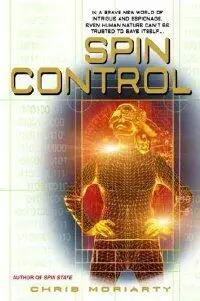
- Название:Spin Control
- Автор:
- Издательство:Bantam Spectra
- Жанр:
- Год:2006
- ISBN:978-0-553-58625-1
- Рейтинг книги:5 / 5. Голосов: 1
-
Избранное:Добавить в избранное
- Отзывы:
-
Ваша оценка:
Spin Control: краткое содержание, описание и аннотация
Предлагаем к чтению аннотацию, описание, краткое содержание или предисловие (зависит от того, что написал сам автор книги «Spin Control»). Если вы не нашли необходимую информацию о книге — напишите в комментариях, мы постараемся отыскать её.
As the auction heats up, the Artificial Life Emancipation Front sends in Major Catherine Li. Drummed out of the Peacekeepers for executing Syndicate prisoners, Li has now literally hooked up with an AI who has lived many lifetimes and shunted through many bodies. But while they have their own conflicting loyalties to contend with, together they’re just one player in a mysterious high-stakes game…
Spin Control — читать онлайн бесплатно полную книгу (весь текст) целиком
Ниже представлен текст книги, разбитый по страницам. Система сохранения места последней прочитанной страницы, позволяет с удобством читать онлайн бесплатно книгу «Spin Control», без необходимости каждый раз заново искать на чём Вы остановились. Поставьте закладку, и сможете в любой момент перейти на страницу, на которой закончили чтение.
Интервал:
Закладка:
She felt she was seeing a new Jerusalem—and not the one she’d sung about in church when she was a kid, either.
Before, Jerusalem had always been mediated for her by Cohen. Now, alone, it took on a new and vaguely menacing aspect. The narrow streets seemed airless and claustrophobic. The men passed her by with averted eyes as if she were an abomination, and the few women on the street were so thoroughly wrapped up against the rain and cold that they hardly seemed human, let alone female.
All the conversations she overheard seemed to be arguments, and the one time she caught a sentence of English it came from an irate young woman who stood in a street-level window shouting, “What am I, a professor?” in answer to an unseen questioner.
Even the graffiti raged apocalyptically. A lurid poster informed all passersby that
and followed up with a helpful swastika in case anyone missed the point. A second poster proclaimed
Someone (a Zionist Hitlerite? There couldn’t actually be such a thing, even on Earth, could there?) had tried to tear that poster down, but, defeated by the apparent superiority of anti-Zionist Hitlerite glue technology, had settled for defacing it with the words
The more Li saw of Jerusalem, the more convinced she became that the people who thought Earth needed to be protected from the Ring had it all completely ass backwards. It was the rest of the universe that needed to be protected. And it needed to be protected from the maniacs that passed for human beings inside the Embargo line.
To her relief the neighborhood seemed to be getting less crazy as she got closer to the address Ash had given her. She passed a coffee shop called the Up/Spin. A streamspace access point? She’d been offstream since she left the King David; after all, you never knew who was watching. But now she reached out cautiously and felt the familiar comfort of the uplink.
‹Oh. There you are.›
Shit.
‹What are you doing, router/decomposer? Following me?›
‹No! No! I’m not here! He told me not to tell you I was here!›
Li froze in midstride, and an evening shopper slammed into her from behind and passed by, cursing her.
You’re not that incompetent, she started to say. And then she stopped herself.
Of course he wasn’t that incompetent. He was acting on instructions. Instructions that he was following to the letter…and completely violating in spirit. She looked back at the affective fuzzy set that had accompanied his confession. Sure enough, it was an almost vaudevillian parody of dismay, embarrassment, self-recrimination. And it was definitely canned; the syntax was far too polished not to have been prepared in advance.
‹Why don’t you go home before you get yourself into bigger trouble than you already have,› she told him.
‹I need to make sure you’re safe, and…›
‹Well, don’t worry. It’ll be the last time you need to spy on me. I’m going to have a little talk with our mutual friend when he climbs out of his pod tonight.›
‹Even though I personally loathe shunting, I have to tell you I find the bodysnatcher jokes demeaning. So where are you going? You can tell me. I can keep a secret.›
Li snorted, and was amused to see several nearby pedestrians dive sideways in an attempt to avoid the crazy woman. Talk about hicksville. ‹You actually expect me to believe that?›
‹Check my code if you don’t believe me.›
She checked. Unbelievable. He had more cutouts than a chain of paper dolls. He was squirreling all kinds of data away that Cohen had no idea about. Including data that Li had thought she was successfully hiding under her own steam.
‹Why are you doing this?› she asked warily.
‹I’m interested in you. Not like Cohen is. In a more theoretical way. I want to see what you turn into.›
‹Right now I’m afraid I’m turning into a bad person.›
He appeared to pause and consider this. The pause was faked, of course; designed to make the exchange feel natural at organic processing speeds. But it was the thought that counted. ‹You’re falling into the identity myth. That’s the problem with nonfunctional nomenclature. Names encourage people to harbor the illusion that there’s identity beyond interface. That you can be good or bad apart from the effect of your actions on the world.›
‹Good intentions have to count for something,› Li protested.
‹Good intentions are just a fairy tale humans tell themselves so they can sleep at night.›
‹But some actions have unpredictable effects.›
‹What do you expect? Life is an intervention in a complex adaptive system.›
‹So you’re saying you can’t know whether you’re a good or bad person?›
‹Not once you exceed the CAS’s Lyapunov time. At that point you have to wait until you can take a final measurement of the end state of the entire universe.› A note of impatience slipped into his affective sets. ‹What do you want from me, a physics lesson?›
It was half an hour shy of sunset, but the elevator in Ash’s building had already been switched over to its Sabbath rhythm. It would travel up and down its appointed route, one floor at a time, stopping long enough for even the slowest of the orthodox to board without breaking the Sabbath by operating a mechanical device.
When Li arrived, the light claimed that the car was on the sixth floor. After watching it sit there for a good minute and a half, she got tired of waiting, located the stairwell behind a door that looked like it led to a broom closet, and climbed five flights. She didn’t lose her breath, she was pleased to note, but behind the smooth push of the wires she could feel her almost middle-aged joints complaining under the relentless assault of Earth’s gravity.
“What?” she asked before Ash had even fully opened the door to her impatient knocking. “What’s so private and important you have to drag me halfway across the city to tell me about it?”
“Say hello to Auntie Li,” Ash crooned.
The child on Ash’s hip looked to be a little over a year old. Li guessed uncertainly that it was a boy; she hadn’t seen many babies in her life, and she’d been only minimally interested in the ones she’d seen.
“Yours?” she asked.
Ash smiled and gave a little shrug that looked like she’d practiced it in front of the mirror a hell of a lot more than once.
Li followed the mother and child into a living room full of just the kind of sleekly forbidding glass and steel surfaces Li would have expected to find in Ash’s home. The stark white and chrome of the decor made an incongruous backdrop to the trail of bright plush and plastic toys strewn across the carpet, into the tiled kitchen beyond the dining area, and across every flat surface the furniture offered.
“Sorry.” Ash pulled a wry face. “Can’t keep up with the little guy these days.”
She bent, the child still over her hip, to pluck a red-and-purple squishy cube off the one relatively free chair so Li could sit down. As her shirt rode up with the movement, Li saw the faint silver fishtails of stretch marks riding her hips like notches on a gun barrel.
“So why am I here?” Li asked.
Instead of answering, Ash crouched down between the vat leather couch and a lethal-looking glass coffee table and carefully settled the baby on a beach towel already spread out for that purpose. This took several minutes and involved the kinds of noises Li had last heard from Cohen’s Italian greyhound puppies.
Читать дальшеИнтервал:
Закладка:
Похожие книги на «Spin Control»
Представляем Вашему вниманию похожие книги на «Spin Control» списком для выбора. Мы отобрали схожую по названию и смыслу литературу в надежде предоставить читателям больше вариантов отыскать новые, интересные, ещё непрочитанные произведения.









Обсуждение, отзывы о книге «Spin Control» и просто собственные мнения читателей. Оставьте ваши комментарии, напишите, что Вы думаете о произведении, его смысле или главных героях. Укажите что конкретно понравилось, а что нет, и почему Вы так считаете.