Robert Reed - Marrow
Здесь есть возможность читать онлайн «Robert Reed - Marrow» весь текст электронной книги совершенно бесплатно (целиком полную версию без сокращений). В некоторых случаях можно слушать аудио, скачать через торрент в формате fb2 и присутствует краткое содержание. Год выпуска: 2000, ISBN: 2000, Издательство: Tor Books, Жанр: Фантастика и фэнтези, на английском языке. Описание произведения, (предисловие) а так же отзывы посетителей доступны на портале библиотеки ЛибКат.
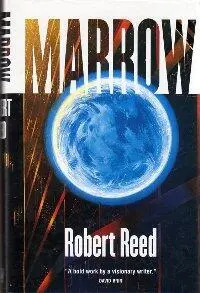
- Название:Marrow
- Автор:
- Издательство:Tor Books
- Жанр:
- Год:2000
- ISBN:0-312-86801-4
- Рейтинг книги:5 / 5. Голосов: 1
-
Избранное:Добавить в избранное
- Отзывы:
-
Ваша оценка:
Marrow: краткое содержание, описание и аннотация
Предлагаем к чтению аннотацию, описание, краткое содержание или предисловие (зависит от того, что написал сам автор книги «Marrow»). Если вы не нашли необходимую информацию о книге — напишите в комментариях, мы постараемся отыскать её.
Marrow — читать онлайн бесплатно полную книгу (весь текст) целиком
Ниже представлен текст книги, разбитый по страницам. Система сохранения места последней прочитанной страницы, позволяет с удобством читать онлайн бесплатно книгу «Marrow», без необходимости каждый раз заново искать на чём Вы остановились. Поставьте закладку, и сможете в любой момент перейти на страницу, на которой закончили чтение.
Интервал:
Закладка:
In many species, perhaps even in ancient humans, language evolved as a tool to speak with the dead. Since the living world can read your face and body, only ghosts require those simple first words.
Whose theory was it?
Pamir was trying to remember, thinking of nothing else when he knelt beside the scuttlebug and tapped into its data. Buried deep in the wall—closer to the cold vacuum than to him—was a single metal object. It was round and smooth, and as far as he could see, it couldn’t be more simple.
It’s nothing, thought Pamir. Nothing.
But he used a laser, carving a narrow hole, then widening it enough for the bug to scramble in, then scramble out again.
The artifact was fashioned from dirty silver, and the laser had left it too hot to hold. Pamir set it on top of the bug and ate a small meal of dried whiskey and sweetened coelacanth. Then he examined the artifacts hinge and its crude latch, using his eyes and fingers. Whatever happened here, the object had been damaged. X-rays showed him a primitive network of gears and empty space. Removing one of the bug’s limbs, he used it as a prick, finally triggering the battered latch. Then as Pamir carefully lifted the lid, the hinge shattered and the lid fell between his long feet, and he stared at the clock’s face, archaic and very simple and wondrously strange.
A crude battery had run itself dry.
The elegant black hands were frozen in place. A dial showed what might be a date. 4611.330, Pamir read. And his heart paused for a long, long moment.
Was it some sort of luddite prop?
Or a child’s toy?
Whatever it was, it had delicate, carefully forged metal workings. Pamir could see the wear of fingers on the bottom and edges of the silver case. As an experiment, he held the clock in his hand, trying to imagine its vanished owner. Then he turned and started toward the wall, and by accident, he kicked the broken lid across the slick gray floor.
The lid lodged beneath one of the hard pillows.
To the ghosts, Pamir said, “It’s mine.”
He knelt and reached under the pillow, pulling out that heavy piece of silver and stronger, more enduring metals, and for a moment, he stared at the top of it, the lid polished and gray as the floor, yet anything but bland. Then as an afterthought, he flipped it over and saw the scratches. No, they were too regular to be scratches. Turning the lid like the hands of a clock, he brought the marks around until they revealed themselves to be letters engraved into the silver by means that humans hadn’t used for aeons.
He read the words to himself.
Then to the ghosts, he read them aloud.
“A piece of the sky. To Washen. From your devoted grandchildren.”
And for a long, long moment, it seemed to Pamir as if the vastness of the room were filled with the echoing beats of his heart.
Thirty-two
The Master whispered a secret command, and an armada of sensor-encrusted robots were dispatched to the leech habitat, hunting for Washen and the other missing captains along every reasonable avenue.
The robots found nothing, and Pamir realized that nothing about this search would ever be obvious or easy.
After his urging, the Master allowed various specialists to sign security pacts, then join his mission. The leech habitat was studied on site by every available means, then samples were delivered to competing laboratories and examined in nanoscopic detail.The giant fuel tank’s shaped-vacuum wall was scanned for flaws and secret doorways. Bursts of sharp sound probed the vast hydrogen ocean, from its surface to its slushy middle depths, and targets that were human-sized or larger were carefully snagged and brought to the surface—a painstaking, time-rich chore made worse by the profound cold and the need for perfect secrecy. Even the mission engineers were given no clear picture of what they were hunting, their genius severely diluted as a consequence. After three hard years of bringing up sunken ships and frozen robots, they rebelled. En masse, they confronted Pamir, explaining what he already knew full well: hundreds of thousands of cubic kilometers of hydrogen remained unexplored; and worse still, the fuel had been tapped over the last few years. Some of it was burned. More cubic kilometers were split between half a hundred auxiliary fuel tanks. And worst of all, strong and highly chaotic currents had flowed through this cold ocean, if only briefly.
“We don’t know what we’re chasing here,” they complained. “Give us an exact shape size and composition, and we can build some reliable models. But until you tell us something useful, we can’t even make better guesses. Do you understand?”
Pamir nodded, one hand grasping the primitive clock, opening the repaired lid and staring at the slow black hands.
In principle, he was the mission’s leader. But the Master demanded instantaneous briefings and made almost every decision, including the routine ones. The two of them had anticipated this very issue; Pamir knew what to tell his staff. “As you’ve probably guessed,” he remarked, “we’re looking for the leech. Dead or otherwise, we think that the aliens are still nearby, and there are some good security reasons for this bit of news to go no farther than here!
He hated to lie, and he did it with a discomforting skill.
“You are a species of paranoid exophobes,” Pamir continued, “and there are several hundred of you, and you want to hide. Perhaps you’re somewhere nearby. Which is the only sort of clue I can give away. Now what new ideas can you give me?”
The engineers dreamed up a secret city. Thermally and acoustically buffered, the city could be buried deep inside the fuel tank, down where the hydrogen was a rigid and pure and nearly impenetrable solid. But that kind of technology meant power, which implied fusion power, which meant a detectable stream of neutrinos. A large array of state-of-the-art detectors were built, then floated on the ocean’s surface. Even though he believed that this was a very, very, very unlikely answer, Pamir was nervously hopeful, activating the detection system with the Master on his shoulder, watching the data flow, the machinery’s soft, insistent alarm telling him and the Master, “I see something. Something. Down there!
But the ship was laced with fusion reactors, each producing its own radiant stream of neutrinos, and every stream was deflected and diluted whenever it passed through the megabonds of hyperfiber. Separating the important from the superfluous was hard, slow work. Six months of meticulous drudgery followed; ninety-eight-plus percent of the neutrinos were excluded from consideration, leaving a trickle that might or might not be important.
Then with a delicious abruptness, the detectors were forgotten.
Two of Pamir’s engineers had gone off by themselves, wanting more than a little privacy. Like a thousand robots before, they followed an obscure fuel line, moving deeper into the ship, finally reaching a point where for no apparent reason, the hyperfiber wall looked younger. Fresher. Wrong.
Robots would have dismissed such data as unimpressive. Obviously, the fuel line had been patched. But that sort of work was common in the early days of the voyage, and much of it was accomplished without records being kept. And since there were no seams or signs of traffic—nothing here but a good strong wall—the robots had lingered for only a few microseconds, then continued their plunge.
But the lovers were intrigued.
They lingered for a full hour, making sensitive probes before returning to their cramped car for another round of clumsy sex. Then in the afterglow, one of them said, “Wait. I know what this is.”
“What’s what?” said his lover.
“It’s a hatch. A nice big hatch.”
Читать дальшеИнтервал:
Закладка:
Похожие книги на «Marrow»
Представляем Вашему вниманию похожие книги на «Marrow» списком для выбора. Мы отобрали схожую по названию и смыслу литературу в надежде предоставить читателям больше вариантов отыскать новые, интересные, ещё непрочитанные произведения.








Обсуждение, отзывы о книге «Marrow» и просто собственные мнения читателей. Оставьте ваши комментарии, напишите, что Вы думаете о произведении, его смысле или главных героях. Укажите что конкретно понравилось, а что нет, и почему Вы так считаете.