Charles Stross - Singularity Sky
Здесь есть возможность читать онлайн «Charles Stross - Singularity Sky» весь текст электронной книги совершенно бесплатно (целиком полную версию без сокращений). В некоторых случаях можно слушать аудио, скачать через торрент в формате fb2 и присутствует краткое содержание. ISBN: , Жанр: Фантастика и фэнтези, на английском языке. Описание произведения, (предисловие) а так же отзывы посетителей доступны на портале библиотеки ЛибКат.
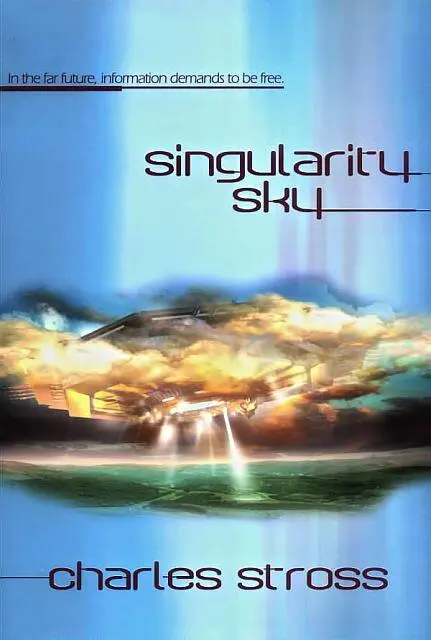
- Название:Singularity Sky
- Автор:
- Жанр:
- Год:неизвестен
- ISBN:9788495024121
- Рейтинг книги:5 / 5. Голосов: 1
-
Избранное:Добавить в избранное
- Отзывы:
-
Ваша оценка:
Singularity Sky: краткое содержание, описание и аннотация
Предлагаем к чтению аннотацию, описание, краткое содержание или предисловие (зависит от того, что написал сам автор книги «Singularity Sky»). Если вы не нашли необходимую информацию о книге — напишите в комментариях, мы постараемся отыскать её.
Singularity Sky
Singularity Sky — читать онлайн бесплатно полную книгу (весь текст) целиком
Ниже представлен текст книги, разбитый по страницам. Система сохранения места последней прочитанной страницы, позволяет с удобством читать онлайн бесплатно книгу «Singularity Sky», без необходимости каждый раз заново искать на чём Вы остановились. Поставьте закладку, и сможете в любой момент перейти на страницу, на которой закончили чтение.
Интервал:
Закладка:
“Four-zero seconds. Kernel spin-down in progress; negative mass dump proceeding.” Far beneath their feet, the massive singularity at the core of the drive system was spooling down, releasing angular momentum into the energetic vacuum underlying space-time. There was no vibration, no sense of motion: nor could there be. Spin, in the context of a space drive, was a property of warped patches of space, nothing to do with matter as most people understood it.
“Commander Murametz, proceed.” The Captain stood back, hands clasped behind his back.
“Commodore, by your leave?”
Bauer nodded. “Proceed on your initiative.”
‘Transition in progress … we’re clear. Reference frame locked.“
“No obstructions,” called Radar One. “Um, looks like we’re on the nail.”
“One-zero gees, straight in on the primary,” said Ilya. He looked almost bored; they’d rehearsed this a dozen times in the past three days alone. “Confirm positional fix, then give me a passive scan. Standard profile.”
“Aye aye, sir. Nav confirmation; we have a star fix. Yes, we’re a good bit closer to the bucket than last time. I see a waste heat dump from Chancellor Romanoff; they’re through.” That cheered them up; even at ten gees constant acceleration, a miss of a couple of astronomical units could take hours or days to make up. “Nothing else in view.”
“Give me a lidar shout, then. Chirped, if you please, frontal nine-zero degrees.”
“Emission starting — now. Profile steady.” The main screen of the simulation showed megawatts of laser light pouring out into the depths of space, mostly hard ultraviolet tagged with the sawtooth timing pulses of the ship’s clock. “Scan closure. Lidar shutdown.”
Radar Two: “I’ve got backscatter! Range — Holy father! Sir, we’re right on top of them! Range six-zero K-kilometers, looks like metal!”
Bauer smiled like a shark.
“Helm: take us to full military power in one-zero seconds. Course plus one-zero, minus four-zero.”
“Aye aye, sir, bringing course to plus one-zero minus four-zero. Two-one one gees coming up in five …
three … now.” Like most regional powers, the New Republican Navy had adopted the Terran standard gee — ten meters per second squared. At full military power, Lord Vanek could go from a standing start to planetary escape velocity in less than sixty seconds; without a delicate balancing act, trading off the drive kernel’s spin against the curvature of space around the ship, the crew would be squashed flat and broken on the floor. But carrying a drive kernel had its price — a non-FTL, fission-powered missile could, at short range, outrun or out-turn a warship hobbled by the mass of a mountain.
“Radar, get me some details on that bounce.” Mirsky leaned forward.
“Aye aye, sir.” A plot came up on the forward display. Rachel focused on the readouts, looking over the razor-scarred rolls at the base of Petty Officer Borisovitch’s skull. “Confirming …” Radar Two: “More contacts! Repeat, I have multiple contacts!”
“How far?” demanded the captain.
“They’re — too close! Sir, they’re very faint. Took a few seconds for the analysis grid to resolve them, in fact. They’ve got to be black body emitters with stealth characteristics. Range nine-zero K, one-point-three M, seven M, another at two-five-zero K … we’re in the middle of it!” Rachel closed her eyes. A chill ran up her spine as she thought about small robot factories, replicators, the swarm of self-replicating weapons breeding in low orbit around a distant gas giant moon. She breathed deeply and opened her eyes.
Radar Two interrupted her reverie: ‘Target! Range six-point-nine M-klicks, big emission profile. Course minus five-five, plus two-zero.“
Mirsky turned to his executive officer: “Ilya, your call.”
“Yes, sir. Designate the new contact as target alpha. Adopt convergent course for alpha, closest pass at three-zero K, full military power.”
“Aye aye, targeting alpha.”
“You expect something, sir,” Ilya said quietly. Rachel tilted her head slightly, to let her boosted hearing focus on the two senior officers at the back of the room.
“Damn right I do. Something wiped out the system defense flotilla,” Mirsky murmured. “Something that was sitting there, waiting for them. I don’t expect anything except hostile contacts as soon as we come out of jump.”
“I didn’t expect them to be this close, though.” Murametz looked troubled.
“I had to do some digging, but thanks to Inspector Mansour”—the Captain nodded in her direction—“we know a bit about their capabilities, which are somewhat alarming. It’s not in the standard intelligence digest because the fools didn’t think it worth mentioning. We’re up against cornucopiae, you see, and nobody back at Naval Intel bothered asking what a robot factory can do tactically.” Commander Murametz shook his head. “I don’t know. Sir? Does it have any military bearing?”
“Yes. You see, robots can breed . And spawn starwisps.”
“Starwisps—” Enlightenment dawned. Ilya looked shocked. “How big would they be?” he asked the captain.
“About half a kilogram mass. You can cram a lot of guidance circuitry into a gram of diamond-substrate nanomachinery. The launchers that fire them probably mass a quarter of a tonne each — but a large chunk of that is stored antimatter to power the neutral particle beam generators. At a guess, there could be a couple of thousand out here; that’s probably what those low aspect contacts are. If you trip-wire one of them, and it launches on you, expect the starwisp riding the beam to come out at upward of ten thousand gees. But of course, you probably won’t even see it unless it gets lock-on and you get some sidescattered radiation from the beam. Basically, we’re in the middle of a minefield, and the mines can shoot relativistic missiles at us.”
“But—” Ilya looked horrified. “I thought this was a standard firing setup!”
“It is, Commander,” Bauer said drily.
“Ah.” Ilya looked slightly green at the edges.
“Backscatter!” It was Radar Three. “I have backscatter! Something is launching from target alpha, acceleration one-point-three — no, one-point-five gees. Cooking off gammas at one-point-four MeV.”
“Log as candidate one,” said Ilya. Urgently: “Sir, humbly request permission to resume immediate control?”
“Granted,” snapped the Captain.
Rachel glanced around at the ops room stations. Officers hunched over their workstations, quietly talking into headset microphones and adjusting brass-handled dials and switches. Mirsky walked over to the command station and stood at Ilya’s shoulder. “Get radar looking for energy spikes,” he commented.
“This is going to be difficult. If I’m right, we’re in the middle of a minefield controlled by a central command platform; if we leak again, we’re not getting out of here.” Rachel leaned forward too, focusing on the main screen. It was, she thought, remarkable: if this was typical of their teamwork, then with a bit of luck they might even make it into low orbit around Rochard’s World.
The tension rose over the next ten minutes, as the Lord Vanek accelerated toward the target. Its singularity drive was virtually undetectable, even at close range (spotting the mass of a mountain at a million kilometers defied even the most sensitive gravity-wave detectors), but all the enemy strongpoint had to do was switch on a pulse-doppler radar sweep and the battlecruiser would show up like a sore thumb. The first rule of space warfare — and the ancient submarine warfare that preceded it — was, “If they can see you, they can kill you.”
Читать дальшеИнтервал:
Закладка:
Похожие книги на «Singularity Sky»
Представляем Вашему вниманию похожие книги на «Singularity Sky» списком для выбора. Мы отобрали схожую по названию и смыслу литературу в надежде предоставить читателям больше вариантов отыскать новые, интересные, ещё непрочитанные произведения.









Обсуждение, отзывы о книге «Singularity Sky» и просто собственные мнения читателей. Оставьте ваши комментарии, напишите, что Вы думаете о произведении, его смысле или главных героях. Укажите что конкретно понравилось, а что нет, и почему Вы так считаете.