Charles Stross - Singularity Sky
Здесь есть возможность читать онлайн «Charles Stross - Singularity Sky» весь текст электронной книги совершенно бесплатно (целиком полную версию без сокращений). В некоторых случаях можно слушать аудио, скачать через торрент в формате fb2 и присутствует краткое содержание. ISBN: , Жанр: Фантастика и фэнтези, на английском языке. Описание произведения, (предисловие) а так же отзывы посетителей доступны на портале библиотеки ЛибКат.
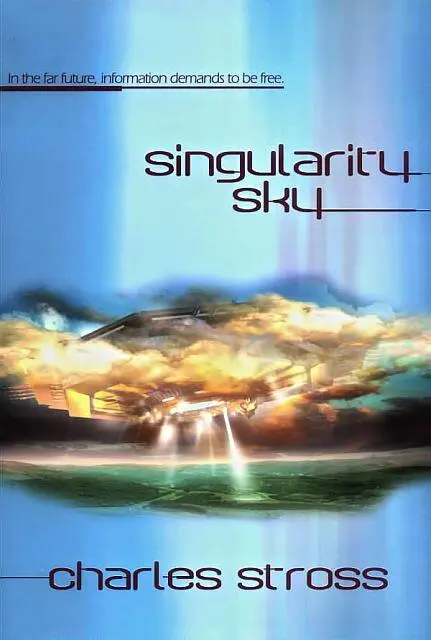
- Название:Singularity Sky
- Автор:
- Жанр:
- Год:неизвестен
- ISBN:9788495024121
- Рейтинг книги:5 / 5. Голосов: 1
-
Избранное:Добавить в избранное
- Отзывы:
-
Ваша оценка:
Singularity Sky: краткое содержание, описание и аннотация
Предлагаем к чтению аннотацию, описание, краткое содержание или предисловие (зависит от того, что написал сам автор книги «Singularity Sky»). Если вы не нашли необходимую информацию о книге — напишите в комментариях, мы постараемся отыскать её.
Singularity Sky
Singularity Sky — читать онлайн бесплатно полную книгу (весь текст) целиком
Ниже представлен текст книги, разбитый по страницам. Система сохранения места последней прочитанной страницы, позволяет с удобством читать онлайн бесплатно книгу «Singularity Sky», без необходимости каждый раз заново искать на чём Вы остановились. Поставьте закладку, и сможете в любой момент перейти на страницу, на которой закончили чтение.
Интервал:
Закладка:
“I’ve pumped the forward birds right up, sir, maximum acceleration the warheads will take. MECO is in one-five seconds. Soon as that happens I’ll divert power to our trailers. Ah, bird one burnout in one-zero seconds.”
Rachel nodded to herself. Remembering lectures on the basics of relativistic physics, strategy in the post-Einsteinian universe, and the implications of a light cone expanding across an evenly spaced grid of points. Any moment now the fossil light from the next shell of interceptors should reach us …
“Holy Father!” shouted Radar Three. “I have beam spillover on all sides! We’re boxed!”
“Control yourself,” snapped Mirsky. “How many sources?”
“They — they—” radar punched buttons. Red lines appeared on the forward screen. “One-six of ’em, coming in from all points!”
“I see.” Mirsky stroked his moustache. “Helm, are you ready with that microjump?”
“Yes, sir.”
“Good.” Mirsky smiled, tight-lipped. “Guns, status.”
“Bird one burnout. Boosting bird four. Bird two, bird three, burnout. I’m diverting all propulsion beam power to the second salvo. Salvo time to target, one-five seconds. Ah, we have one-seven inbound aggressors. Three outbound antimissiles.”
“Hold further fire,” ordered the Captain. “How long until the first hostile is in range?”
“Should happen at — oh. Two seconds postcontact, sir.”
“Nav! Pull the jump forward five seconds. We’ll not stay around to count coup.”
“Aye aye.”
Radar One: “More scattering! Sir, I have … no, they’re not going to get us in time.”
“How many, Lieutenant?”
“We’re boxed. Incoming beamriders in all directions, at long range. I count—”
“Bird one detonating now! Bird two, detonating. Bird three gone. Sir, three detonations on target.”
“Jump in five. Four—”
“One-eight-point-nine K — no, one-nine K beamriders incoming!”
“Incoming number one, range one-two K and closing—”
“Confirmed kill on target alpha, oxygen, nitrogen in emission spectra.”
“Two.”
“Nine K.”
“Three-two K incoming hostiles! No, three-two and—”
“One. Jump commit.”
The red emergency lights dimmed as the main overhead lights came up. There was silence on the bridge for a moment, then Commodore Bauer cleared his throat. “Congratulations, gentlemen,” he announced to Mirsky and his stunned ops crew. “Of all the ships in the squadron who have run that tape so far, you are the only one to have escaped at all, much less to have taken any of the enemy down. There will be a meeting in my office at 1600 to discuss the assumptions underlying this exercise and explain our new tactical doctrine for dealing with situations like this — massively ramified robot defense networks with fire control mediated by causal channel. Then we’ll run it again tomorrow and see how well you do with your eyes open …”
Diplomatic Behavior
Meanwhile, two thousand years away, a small boy lay curled in darkness, whimpering in the grip of a dream of empire.
Felix moaned and shivered and dragged the tattered blanket closer around his shoulders. The abandoned hayloft was unheated, and the gaps between the log walls admitted a furious draft, but at least it was a roof over his head. It was warmer than the stony ground. Wolves roamed the untamed wilderness, and for a lad to sleep beneath the stars at this time of year was hazardous even in normal times.
Raven roosted on the thick oak beam above Felix’s head, his long black beak tucked under one wing.
Occasionally, he would wake for a moment, shake his feathers out, shuffle from one foot to the other, and glance around. But as long as the door stayed barred, nothing could reach them that he couldn’t deal with; and so he would rejoin his master in sleep.
Rain battered on the roof, occasionally leaking through the sods that covered the rough-cut timber, dripping to the floor in thin cold streams. The smell of half-decayed hay hung heavy in the air. Felix hadn’t dared light a fire after Mr. Rabbit pointed out how dangerous that could be. There were things out there that could see heat, silent things without mouths. Things that liked to eat little boys’ brains.
Felix dreamed of Imperial orders, men in shiny uniforms, and women in silky gowns; of starships and cavalry parades and ceremonies and rituals. But his dreams were invaded by a tired and pervasive cynicism. The nobles and officers were corrupt hangers-on, their women grasping harpies searching for security. The ceremonies and rituals were meaningless and empty, a charade concealing a ghastly system of institutional injustices orchestrated to support the excesses of the rulers. Dreaming of New Prague, he felt himself to be a duke or prince, mired in a dung heap, chained down by responsibility and bureaucracy, unable to move despite the juggernaut of decaying corruption bearing down on him.
When he twitched and cried out in his dream, Mr. Rabbit crawled closer and sprawled against him, damp fur rising and falling with his breath. Presently Felix eased deeper into sleep, and Mr. Rabbit rolled away, curling nose to tail to resume his nightly regurgitation and cud-chewing. If it was hard being a small boy in a time of rapid change, it was a doubly hard burden to be a meter-tall rabbit cursed with human sentience and cunicular instincts.
In the early-morning light, Felix yawned, rubbed his eyes, and stretched stiffly, shivering with cold.
“Rabbit?”
“Caaaw!” Raven flapped down from overhead and hopped closer, head cocked to one side. “Rabbit gone to vill-lage.”
Felix blinked, slowly. “I wish he’d waited.” He shivered, feeling a sense of loneliness very alien to a nine-year-old. He stood up and began to pack his possessions into a battered-looking haversack; a blanket, a small tin can, a half-empty box of matches, and one of the curious metal phones by which the Festival communicated with people. He paused over the phone for a moment, but eventually his sense of urgency won, and he shoved it into the pack. “Let’s play hunt the wabbit ,” he said, and opened the door.
It was a cold, bright morning, and the ground in the abandoned farmyard was ankle deep in squelching mud. The blackened ruin of the house squatted on the other side of the quagmire like the stump of a tree struck by lightning, the Holy Father’s fire. Behind it, a patch of dusty gray mud showed the depletion layer where the Festival’s nanosystems had sucked the soil dry of trace elements, building something huge; it was almost certainly connected with the disappearance of the farmer and his family.
The village lay about two kilometers downhill from the farmhouse, around a bend in the narrow dirt track, past a copse of tall pine trees. Felix shrugged on his backpack and, after a brief pause to piss against the fire-blackened wall of the house, slowly headed down the road. He felt like whistling or singing, but kept his voice to himself; there was no telling what lived in the woods hereabouts, and he wasn’t inclined to ignore Mr. Rabbit’s warnings. He was a very serious little boy, very grown-up.
Raven hopped after him, then flapped forward heavily and landed in the ditch some way down the path.
His head ducked repeatedly. “Brrrreak-fast!” he cawed.
“Oh, good!” Felix hurried to catch up, but when he saw what Raven had found to eat he turned away abruptly and pinched the bridge of his nose until the tears came, trying not to gag. Tears came hard; a long time ago, a very long distance away, Nurse had told him, “Big boys don’t cry.” But he knew better now. He’d seen much bigger boys crying, men even, as they were stood up against the bullet-pocked wall. (Some of them didn’t cry, some of them held themselves stiffly upright, but it made no difference in the end.) “Sometimes I hate you, Raven.”
Читать дальшеИнтервал:
Закладка:
Похожие книги на «Singularity Sky»
Представляем Вашему вниманию похожие книги на «Singularity Sky» списком для выбора. Мы отобрали схожую по названию и смыслу литературу в надежде предоставить читателям больше вариантов отыскать новые, интересные, ещё непрочитанные произведения.




Обсуждение, отзывы о книге «Singularity Sky» и просто собственные мнения читателей. Оставьте ваши комментарии, напишите, что Вы думаете о произведении, его смысле или главных героях. Укажите что конкретно понравилось, а что нет, и почему Вы так считаете.