Charles Stross - Singularity Sky
Здесь есть возможность читать онлайн «Charles Stross - Singularity Sky» весь текст электронной книги совершенно бесплатно (целиком полную версию без сокращений). В некоторых случаях можно слушать аудио, скачать через торрент в формате fb2 и присутствует краткое содержание. ISBN: , Жанр: Фантастика и фэнтези, на английском языке. Описание произведения, (предисловие) а так же отзывы посетителей доступны на портале библиотеки ЛибКат.
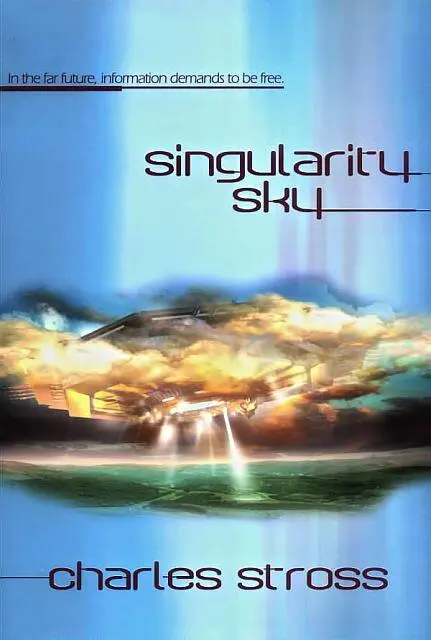
- Название:Singularity Sky
- Автор:
- Жанр:
- Год:неизвестен
- ISBN:9788495024121
- Рейтинг книги:5 / 5. Голосов: 1
-
Избранное:Добавить в избранное
- Отзывы:
-
Ваша оценка:
Singularity Sky: краткое содержание, описание и аннотация
Предлагаем к чтению аннотацию, описание, краткое содержание или предисловие (зависит от того, что написал сам автор книги «Singularity Sky»). Если вы не нашли необходимую информацию о книге — напишите в комментариях, мы постараемся отыскать её.
Singularity Sky
Singularity Sky — читать онлайн бесплатно полную книгу (весь текст) целиком
Ниже представлен текст книги, разбитый по страницам. Система сохранения места последней прочитанной страницы, позволяет с удобством читать онлайн бесплатно книгу «Singularity Sky», без необходимости каждый раз заново искать на чём Вы остановились. Поставьте закладку, и сможете в любой момент перейти на страницу, на которой закончили чтение.
Интервал:
Закладка:
“Yes,” he agreed. “Like you.”
“Like me.” She made a croaking noise that sounded as if it might have been intended as a laugh. “Shit, Martin, that is not what I was expecting to hear.”
“I wish this hadn’t happened. Especially with — well, us. In the middle.”
“Me too, with brass knobs on,” she said shakily. “Was that all there was?”
“All there was? That’s all I was holding out on you, honest.” A long pause. “Alright. It was, uh, purely professional?”
He nodded. “Yes.” He looked at her. “I don’t like lying. And I haven’t been lying, or withholding the truth, about anything else. I promise.”
“Oh. Okay.” She took a deep breath and grinned tiredly, simultaneously looking amused and relieved.
“It’s really been eating you, hasn’t it?” he asked.
“Oh, you could say that,” she said, with heavy irony.
“Um.” He held out a hand. “I’m sorry. Truly.”
“Apology accepted — conditionally.” She squeezed his hand, briefly, then let go. “Now, are you going to tell me what the Eschaton has in mind for us?”
Martin sighed. “Yes, inasmuch as I know. But I’ve got to warn you, it’s not good. If we can’t get off this ship before it arrives, we’re probably going to die …”
Time travel destabilises history.
History is a child of contingency; so many events depend on critical misunderstandings or transient encounters that even the apocryphal butterfly’s wing is apt to stir up a storm in short order. A single misunderstood telegram in June of 1917 permitted the Bolshevik revolution to become a possibility; a single spy in 1958 extended the Cold War by a decade. And without both such events, could a being like the Eschaton ever have come to exist?
Of course, in a universe which permits time travel, history itself becomes unstable — and the equilibrium can only be restored when the diabolical mechanism edits itself out of the picture. But that’s scant comfort for the trillions of entities who silently cease to exist in the wake of a full-blown time storm.
It’s hardly surprising that, whenever intelligent beings arise in such a universe, they will seek to use closed timelike curves to prevent their own extinction. Faster-than-light travel being possible, general relativity tells us that it is indistinguishable from time travel; and this similarity makes the technologies of total annihilation dreadfully accessible. In the small, stupid little organizations like the New Republic seek to gain advantage over their contemporaries and rivals. In the large, vast, cool intellects seek to stabilize their universe in the form most suitable to them. Their tampering may be as simple as preventing rivals from editing them out of the stable historical record — or it may be as sophisticated as meddling with the early epochs of the big bang, back before the Higgs field decayed into the separate fundamental forces that bind the universe together to ensure just the right ratio of physical constants to support life.
This is not the only universe; far from it. It isn’t even the only universe in which life exists. Like living organisms, universes exist balanced on the edge of chaos, little bubbles of twisted urspace that pinch off and bloat outward, expanding and cooling, presently giving birth to further bubbles of condensed space-time; a hyperdimensional crystal garden full of strange trees bearing stranger fruit.
But the other universes are not much use to us. There are too many variables in the mix. As the initial burst of energy that signals the birth of a universe cools, the surging force field that drives its initial expansion becomes tenuous, then breaks down into a complex mess of other forces. The constants that determine their relative strengths are set casually, randomly. There are universes with only two forces; others, with thousands. (Ours has five.) There are universes where the electron is massive: nuclear fusion is so easy there that the era of star formation ends less than a million of our years after the big bang.
Chemistry is difficult there, and long before life can evolve, such universes contain nothing but cooling pulsars and black holes, the debris of creation brought to a premature end.
There are universes where photons have mass — others where there is too little mass in the universe for it to achieve closure and collapse in a big crunch at the end of time. There are, in fact, an infinity of universes out there, and they are all uninhabitable. There is a smaller infinitude of possibly habitable ones, and in some of them, intelligent life evolves; but more than that we may never know. Travel between universes is nearly impossible; materials that exist in one may be unstable in another. So, trapped in our little fishbowl of space we drift through the crystal garden of universes — and our own neighborly intelligences, beings like the Eschaton, do their best to prevent the less-clever inmates from smashing the glass from within.
The man in gray had explained all this to Martin at length, eighteen years ago. “The Eschaton has a strong interest in maintaining the integrity of the world line,” he had said. “It’s in your interest, too. Once people begin meddling with the more obscure causal paradoxes, all sorts of lethal side-effects can happen. The Eschaton is as vulnerable to this as any other being in the universe — it didn’t create this place, you know, it just gets to live in it with the rest of us. It may be a massively superhuman intelligence or cluster of intelligences, it may have resources we can barely comprehend, but it could probably be snuffed out quite easily; just a few nuclear weapons in the right place before it bootstrapped into consciousness, out of the preSingularity networks of the twenty-first century. Without the Eschaton, the human species would probably be extinct by now.”
“Epistemology pays no bills,” Martin remarked drily. “If you’re expecting me to do something risky …”
“We appreciate that.” The gray man nodded. “We need errands run, and not all of them are entirely safe.
Most of the time it will amount to little more than making note of certain things and telling us about them — but occasionally, if there is a serious threat, you may be asked to act. Usually in subtle, undetectable ways, but always at your peril. But there are compensations.”
“Describe them.” Martin put his unfinished drink down at that point.
“My sponsor is prepared to pay you very well indeed. And part of the pay — we can smooth the path if you apply for prolongation and continued residency.” Life-extension technology, allowing effectively unlimited life expectancy beyond 160 years, was eminently practical, and available on most developed worlds. It was also as tightly controlled as any medical procedure could be. The controls and licensing were a relic of the Overshoot, the brief period in the twenty-first century when Earth’s population blipped over the ten-billion mark (before the Singularity, when the Eschaton bootstrapped its way past merely human intelligence and promptly rewrote the rule book). The aftereffects of overpopulation still scarred the planet, and the response was an ironclad rule — if you want to live beyond your natural span, you must either demonstrate some particular merit, some reason why you should be allowed to stay around, or you could take the treatment and emigrate. There were few rules that all of Earth’s fractured tribes and cultures and companies obeyed, but out of common interest, this was one of them. To be offered exemption by the covert intervention of the Eschaton—
“How long do I have to think about it?” asked Martin.
“Until tomorrow.” The gray man consulted his notepad. ‘Ten-thousand-a-year retainer. Ten thousand or more as a bonus if you are asked to do anything. And an essential status exemption from the population committee. On top of which, you will be helping to protect humanity as a whole from the actions of some of its more intemperate — not to say stupid— members. Would you care for another drink?“
Читать дальшеИнтервал:
Закладка:
Похожие книги на «Singularity Sky»
Представляем Вашему вниманию похожие книги на «Singularity Sky» списком для выбора. Мы отобрали схожую по названию и смыслу литературу в надежде предоставить читателям больше вариантов отыскать новые, интересные, ещё непрочитанные произведения.







Обсуждение, отзывы о книге «Singularity Sky» и просто собственные мнения читателей. Оставьте ваши комментарии, напишите, что Вы думаете о произведении, его смысле или главных героях. Укажите что конкретно понравилось, а что нет, и почему Вы так считаете.