Charles Stross - Singularity Sky
Здесь есть возможность читать онлайн «Charles Stross - Singularity Sky» весь текст электронной книги совершенно бесплатно (целиком полную версию без сокращений). В некоторых случаях можно слушать аудио, скачать через торрент в формате fb2 и присутствует краткое содержание. ISBN: , Жанр: Фантастика и фэнтези, на английском языке. Описание произведения, (предисловие) а так же отзывы посетителей доступны на портале библиотеки ЛибКат.
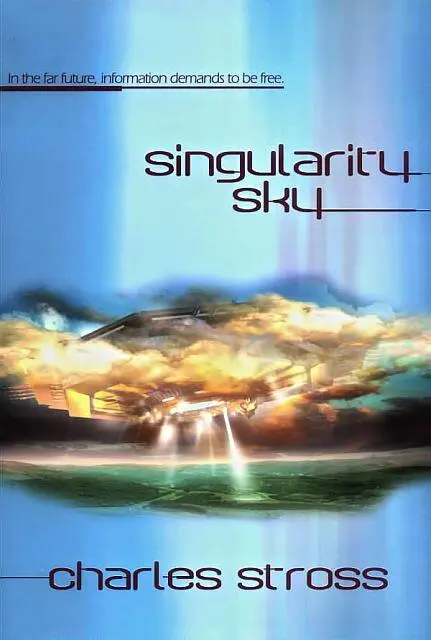
- Название:Singularity Sky
- Автор:
- Жанр:
- Год:неизвестен
- ISBN:9788495024121
- Рейтинг книги:5 / 5. Голосов: 1
-
Избранное:Добавить в избранное
- Отзывы:
-
Ваша оценка:
Singularity Sky: краткое содержание, описание и аннотация
Предлагаем к чтению аннотацию, описание, краткое содержание или предисловие (зависит от того, что написал сам автор книги «Singularity Sky»). Если вы не нашли необходимую информацию о книге — напишите в комментариях, мы постараемся отыскать её.
Singularity Sky
Singularity Sky — читать онлайн бесплатно полную книгу (весь текст) целиком
Ниже представлен текст книги, разбитый по страницам. Система сохранения места последней прочитанной страницы, позволяет с удобством читать онлайн бесплатно книгу «Singularity Sky», без необходимости каждый раз заново искать на чём Вы остановились. Поставьте закладку, и сможете в любой момент перейти на страницу, на которой закончили чтение.
Интервал:
Закладка:
As they cruised between jumps, the warships exercised continually. Tentative lidar pulses strobed at the deep vacuum beyond the heliopause as officers sought firing solutions on the ships of the other squadrons; missile and torpedo trajectories were plotted, laser firing solutions entered into the tireless gear mills of the analytical engines. Tracking ships at long range was difficult, for they didn’t emit much detectable radiation. Radar was hopeless: to pump out sufficient energy to get a return, the Lord Vanek would have produced enough waste heat to broil her crew alive. As it was, only her vast radiator panels, spread to the stars and now glowing a dull red, allowed them to run the lidar at high intensity for short periods of time. (Vacuum is a most effective insulator — and active sensors capable of reaching out across billions of kilometers run hot.)
Martin Springfield knew nothing of this. Lying in his cell he’d spent the past two days in despondent boredom, alternating between depression and guarded optimism by turns. Still alive , he thought. Then: Not for long . If only there was something he could do! But on board a starship, there was nowhere to run. He was enough of a realist to understand this: if they ran out of options here, he was dead. He’d simply have to hope that they hadn’t worked out what he’d done, and would release him rather than antagonizing the shipyard.
He was sitting on the bunk one evening when the door opened. He looked up at once, expecting Sauer or the Curator’s kid spook. His eyes widened. “What are you doing here?”
“Just visiting. Mind if I sit down?”
He nodded uneasily. Rachel sat on the edge of the bunk. She was wearing a plain black jumpsuit and had tied her hair back severely; her manner was different, almost relaxed. It wasn’t a disguise, he realized; she wasn’t acting the part of a woman of easy virtue or a diplomat posted to a banana republic, or anyone else, for that matter. She was being herself — a formidable figure. “I thought they’d have locked you up, too,” he said.
“Yes, well …” She looked distracted. “One moment.” She glanced at her pocket watch. “ Ah .” She leaned over toward the head end of his bunk and placed something small and metallic on it.
“I already spiked the bugs,” he said. “They won’t hear much.” She glared at him. “Thanks for nothing.”
“What—”
“I want the truth,” she said flatly. “You’ve been lying to me. I want to know why.”
“Oh.” He tried not to cringe. Her expression was unnaturally controlled, the calm before a storm.
“You’ve got only one chance to tell the truth,” she said, pitching her voice in conversational tones that were belied by a brittle edge in it. “I don’t think they know you’re lying yet, but when we get back — well, they’re not dummies and you’re digging yourself in deeper. The Curator’s Office will be watching. If you act guilty, the boy wonder will draw the only available conclusion.” He sighed. “And what if the conclusion is right? What if I am guilty?” he asked.
“I trusted you,” she said flatly. “As yourself. Not as a player. I don’t like being lied to, Martin. In business or my personal life, whichever.”
“Well.” He contemplated the shiny jammer she’d placed on his pillow. It was easier than facing her anger and hurt. “If I said they told me they were the shipyard, would that satisfy you?”
“No.” She shook her head. “You’re not dumb enough to fall for a cover story, anyway.” She looked away. “I don’t like being lied to,” she said bitterly.
He looked at her. Rachel was an up-to-date professional, unlike the bumbling amateurs of the New Republic; she’d have speech analysis reflexes, lie detectors, any number of other gadgets trained on him, if this was business, and if she hadn’t completely lost it. If she had — well, he could hardly blame her for being mad at him. In her place, he’d be angry, too. And hurt. “I don’t like telling lies,” he said, which was true enough. “Not without an overriding reason,” he admitted.
She took a deep breath, visibly steeling herself. “I’m the nearest thing to a lawyer you’re going to get here, Martin. I’m the nearest representative of your government — what they think is your government — within four thousand years and a two-hundred-light-year radius. They have a legalistic system of government, for all that they’re medieval throwbacks, and they let me visit you as your advocate. I can plead your case if it comes up to a court-martial because you’re a civilian, and I might be able to deflect things short of that. But only if you tell me everything, so I know what I’m defending.”
“I can’t talk about it,” he said uncomfortably. He picked up his book, half trying to shelter his guilty conscience behind it. “I’m not allowed to. I thought you of all people would be able to understand that?”
“Listen.” Rachel glared at him. “Remember what I told you about trust? I’m really disappointed. Because I did trust you, and it seems to me that you betrayed that trust. As it is, I’m going to have to do a lot of fast talking if I’m going to try to get your ass off the hook you’re caught on, or at least get you out of here alive. And before I do that, I want to know what you’ve been lying to me about .” She stood up. “I’m a fool. And a damned fool for trusting you, and a worse fool for getting involved with you. Hell, I’m an unprofessional fool! But I’m going to ask you again, and you’d better answer truthfully.
There are a lot of lives at stake this time, Martin, because this is not a game. Who the fuck are you working for?”
Martin paused a moment, dizzy with a sense of events moving out of control. Can’t tell her, can’t not tell her —he looked up, meeting her eyes for the first time. It was the hurt expression that made his mind up for him: no amount of rationalization would help him sleep that night if he left her feeling like this.
Feeling betrayed by the only person she’d been able to trust within a radius of light-years. One moment of unprofessionalism deserved to be answered by another. His mouth felt dry and clumsy as he spoke: “I work for the Eschaton.”
Rachel sat down heavily, her eyes wide with disbelief. “ What ?” He shrugged. “You think the E’s only way of dealing with problems is to drop a rock on them?” he asked.
“Are you kidding?”
“Nope.” He could taste bile in the back of his throat. “And I believe in what I’m doing, else I wouldn’t be here now, would I? Because truly, the alternative is to drop a planet-buster on the problem. The Eschaton finds that easier. And it makes the appropriate noises. It scares people. But really— most of the time, the E likes to solve problems more quietly through people like me.”
“How long?”
“About twenty years.” He shrugged again. “That’s all there is to it.”
“Why?” She buried her hands between her knees, holding them together tightly, looking at him with a miserably confused expression on her face.
“Because—” He tried to drag his scattered thoughts together. “Believe me, the Eschaton prefers it when people like you do the job first. It saves a lot of pain all around. But once the fleet moved, and you lost the argument with them, there was no alternative. You didn’t really think they’d set up the prerequisites for a closed timelike path and not follow it through to the logical end?” He took a deep breath. “That’s the sort of job I do. I’m a plumber, for when the Eschaton wants to fix a leak quietly.”
“You’re an agent, you mean.”
Читать дальшеИнтервал:
Закладка:
Похожие книги на «Singularity Sky»
Представляем Вашему вниманию похожие книги на «Singularity Sky» списком для выбора. Мы отобрали схожую по названию и смыслу литературу в надежде предоставить читателям больше вариантов отыскать новые, интересные, ещё непрочитанные произведения.


Обсуждение, отзывы о книге «Singularity Sky» и просто собственные мнения читателей. Оставьте ваши комментарии, напишите, что Вы думаете о произведении, его смысле или главных героях. Укажите что конкретно понравилось, а что нет, и почему Вы так считаете.