Orson Card - Pathfinder
Здесь есть возможность читать онлайн «Orson Card - Pathfinder» весь текст электронной книги совершенно бесплатно (целиком полную версию без сокращений). В некоторых случаях можно слушать аудио, скачать через торрент в формате fb2 и присутствует краткое содержание. Год выпуска: 2010, ISBN: 2010, Издательство: Simon Pulse, Жанр: Фантастика и фэнтези, на английском языке. Описание произведения, (предисловие) а так же отзывы посетителей доступны на портале библиотеки ЛибКат.
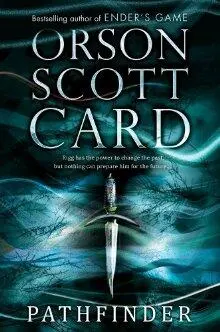
- Название:Pathfinder
- Автор:
- Издательство:Simon Pulse
- Жанр:
- Год:2010
- ISBN:978-1-4169-9176-2
- Рейтинг книги:5 / 5. Голосов: 1
-
Избранное:Добавить в избранное
- Отзывы:
-
Ваша оценка:
Pathfinder: краткое содержание, описание и аннотация
Предлагаем к чтению аннотацию, описание, краткое содержание или предисловие (зависит от того, что написал сам автор книги «Pathfinder»). Если вы не нашли необходимую информацию о книге — напишите в комментариях, мы постараемся отыскать её.
—secrets about Rigg's own past, his identity, and his destiny. And when Rigg discovers that he has the power not only to see the past, but also to change it, his future suddenly becomes anything but certain.
Rigg’s birthright sets him on a path that leaves him caught between two factions, one that wants him crowned and one that wants him dead. He will be forced to question everything he thinks he knows, choose who to trust, and push the limits of his talent…or forfeit control of his destiny.
Pathfinder — читать онлайн бесплатно полную книгу (весь текст) целиком
Ниже представлен текст книги, разбитый по страницам. Система сохранения места последней прочитанной страницы, позволяет с удобством читать онлайн бесплатно книгу «Pathfinder», без необходимости каждый раз заново искать на чём Вы остановились. Поставьте закладку, и сможете в любой момент перейти на страницу, на которой закончили чтение.
Интервал:
Закладка:
“So which is the real voice of Rigg?” asked Long one day, hearing him with the cooks’ boys.
“If it comes out of my mouth, it’s my voice,” said Rigg.
“But the coarse country boy from upriver, with the ribald jokes and funny tales of country life—how can you say he’s the same as the boy who speaks in such a lofty style that he withers most of the courtiers with his wit?”
“Do I?” said Rigg. “I don’t recall inflicting any injuries.”
“When everyone laughs at them, they’re destroyed,” said Long. “And you’ve ruined several who haven’t dared come back.”
“And does anyone miss them?”
Long laughed.
“A hunter who carries only one weapon has already decided that all the animals it can’t reach are safe from him.”
“So you have the weapons of country wit and courtly wit?” asked Long.
“Let’s say—half of each.”
“A double halfwit is a wit, I think,” said Long.
“And now you’ve entered the fray!” cried Rigg, and the two of them tussled in the kitchen garden for a few moments, then remembered their errands and got back to work without waiting for someone to yell at them.
It was a week before the answer came. Flacommo announced it at dinner.
“Young Rigg,” said their host. “I have pled your cause before the Revolutionary Council, and they have decided that it’s too much bother for the librarians to have to answer your endless requests and send books back and forth.”
Rigg did not let himself feel disappointed, because the way Flacommo was talking, it was plain that he was only pretending to be doleful—he had good news.
“Instead, if a panel of scholars pronounces you worthy to be numbered as one of them, you will be allowed to travel, under escort, to and from the library once a day—though you may stay there as long as you want, or until supper.”
Rigg leapt to his feet and let out a boyish, privick, unprincely hoot of happiness. Everyone laughed, even Mother.
CHAPTER 17
Scholar
“Our mandate,” said the expendable, “is to serve no individual human being at the expense of the species, but rather to preserve and advance the human species, even if at the expense of a cost-effective number of individuals.”
“Cost-effective,” echoed Ram. “I wonder how you determine the cost of a human life.”
“Equally,” said the expendable.
“Equally to what?”
“Any other human being.”
“So you can kill one to save two.”
“Or a billion in order to bring to pass circumstances that will bring about the births of a billion and one.”
“It sounds rather cold.”
“We are cold,” said the expendable. “But raw numbers hardly tell our whole mandate.”
“I am eager to know,” said Ram, “on what besides numbers you judge the preservation and advancement of the human species.”
“Whatever enhances the ability of the human race to survive in the face of threats.”
“What threats?”
“In descending order of likelihood of extinction of the species: collision with meteors above a certain combined mass and velocity; eruption of volcanoes that produce above a certain amount of certain kinds of ejecta; plagues above a certain mortality rate and contagiousness; war employing weapons above a certain level and permanence of destructive power; stellar events that decrease the viability of life—”
“It seems to me,” said Ram, “that if we succeed in planting a viable human colony on this new world, we will have made it impossible for any of these to wipe out the species.”
“And if we succeed in planting nineteen viable human colonies—”
“All nineteen would be equally affected by your list of dangers, should they happen to this planet or this star. One bad meteor collision wipes out all nineteen.”
“Yes,” said the expendable.
“Yet it matters to you that we specify nineteen colonies, and not just one.”
“Yes,” said the expendable.
There was a long silence.
“You’re waiting for me to make a decision about something.”
“Yes,” said the expendable.
“You’re going to have to be more specific,” said Ram.
“We cannot think of the thing we cannot think of,” said the expend able. “It would be unthinkable.”
Ram thought about this for a long time. He made many guesses about what the required decision might be. He said only a few of them aloud, and the expendable agreed every time that this would be a useful decision, but it was not the crucial one.
A decision that would explain the importance of having nineteen colonies in order to preserve and advance the survival of the human species. Ram went through every decision that would have to be made, including the degree of destruction of the native flora and fauna that might be required, and won the agreement of the expendables that every effort would be made to create a thorough and representative genetic record, seed bank, and embryana of the native life forms of the planet, so that anything destroyed in the process of establishing the colonies might be restored at some later date.
But even this decision was not the crucial one.
And then one morning he realized what the expendables were waiting for. It came to him as he was pondering what it meant that the computers and expendables agreed that the cloning of the starship and the travel backward in time were caused by Ram himself. Most humans could not alter the flow of time. One might say that no human had ever done so. And if that statement was still true . . .
“I am human,” said Ram, with perhaps more emphasis than the sentence required.
“Thank you,” said the expendable.
“Is that the full decision that you wanted?”
“If that is the full decision that you want, then we are satisfied.”
This was such an ambiguous answer that Ram demanded clarification.
“But there is nothing to clarify,” said the expendable. “If it is your full decision, complete and final, we will act accordingly.”
“Then it is not my final decision until I understand all the implications of it.”
“It is not within the capacity of a human mind to understand all the implications of anything. Your lifespan is not long enough.”
That had been time enough for Ram to put the situation, as he understood it, into words. “What you seem to need,” said Ram, “is a definition of ‘human species’ before you can plan the colonies. This means that you contemplate circumstances in which the definition of ‘human species’ might be in question.”
“We contemplate billions of circumstances,” said the expendable.
“But not all of them?”
“Our lifespan, too, is finite,” said the expendable.
Another question occurred to Ram. “Do you have evidence that there is a species on the new planet that might have intelligence at the level of humans?”
“No.”
“Or above the human level?”
“No.”
So they weren’t trying to squeeze an alien species into the definition of what was human.
But they needed to be reassured, thought Ram, that whatever I am, it is included in the definition of the human species. Otherwise, I would have been used to advance the survival of the colonists and their offspring, but my own genetic survival would not have been protected, because I am so different from other human beings that something going on in my mind affected the flow of time and the fabric of reality.
If I reproduce, then my difference might be passed on to my descendants. For that matter, living here in isolation from the rest of the human race for at least 11,191 years, who could guess what other differences might develop between us and the rest of the human species back on Earth?
Читать дальшеИнтервал:
Закладка:
Похожие книги на «Pathfinder»
Представляем Вашему вниманию похожие книги на «Pathfinder» списком для выбора. Мы отобрали схожую по названию и смыслу литературу в надежде предоставить читателям больше вариантов отыскать новые, интересные, ещё непрочитанные произведения.





Обсуждение, отзывы о книге «Pathfinder» и просто собственные мнения читателей. Оставьте ваши комментарии, напишите, что Вы думаете о произведении, его смысле или главных героях. Укажите что конкретно понравилось, а что нет, и почему Вы так считаете.