Orson Card - Pathfinder
Здесь есть возможность читать онлайн «Orson Card - Pathfinder» весь текст электронной книги совершенно бесплатно (целиком полную версию без сокращений). В некоторых случаях можно слушать аудио, скачать через торрент в формате fb2 и присутствует краткое содержание. Год выпуска: 2010, ISBN: 2010, Издательство: Simon Pulse, Жанр: Фантастика и фэнтези, на английском языке. Описание произведения, (предисловие) а так же отзывы посетителей доступны на портале библиотеки ЛибКат.
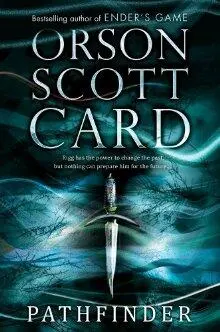
- Название:Pathfinder
- Автор:
- Издательство:Simon Pulse
- Жанр:
- Год:2010
- ISBN:978-1-4169-9176-2
- Рейтинг книги:5 / 5. Голосов: 1
-
Избранное:Добавить в избранное
- Отзывы:
-
Ваша оценка:
Pathfinder: краткое содержание, описание и аннотация
Предлагаем к чтению аннотацию, описание, краткое содержание или предисловие (зависит от того, что написал сам автор книги «Pathfinder»). Если вы не нашли необходимую информацию о книге — напишите в комментариях, мы постараемся отыскать её.
—secrets about Rigg's own past, his identity, and his destiny. And when Rigg discovers that he has the power not only to see the past, but also to change it, his future suddenly becomes anything but certain.
Rigg’s birthright sets him on a path that leaves him caught between two factions, one that wants him crowned and one that wants him dead. He will be forced to question everything he thinks he knows, choose who to trust, and push the limits of his talent…or forfeit control of his destiny.
Pathfinder — читать онлайн бесплатно полную книгу (весь текст) целиком
Ниже представлен текст книги, разбитый по страницам. Система сохранения места последней прочитанной страницы, позволяет с удобством читать онлайн бесплатно книгу «Pathfinder», без необходимости каждый раз заново искать на чём Вы остановились. Поставьте закладку, и сможете в любой момент перейти на страницу, на которой закончили чтение.
Интервал:
Закладка:
“For what purpose?”
“To know why the Tower of O was built,” said Rigg, and he did not have to fake his passion. “To know what is known about the lands outside the wallfold. Are there people in the other folds? Why was the Wall built at all? How does it work? It can’t be a natural artifact—someone made the Wall. Do you see?”
“And what will you do with these answers when you find them?”
“I’ll know them!” said Rigg. “And if the Council thinks the knowledge I find out might be useful to others, then I’ll publish them. Don’t you see? Don’t they see? As long as they don’t let us do anything, then the only thing we are is the former royal family. But if I can become a credible scholar, publishing papers that only a scientist would want to read, then I’m not royal any more, am I? I’m a scholar!”
“A royal scholar.”
“Of course. But in time, in years, I’ll be an old man who is known for his publications far more than for my parentage. No one will fear me, or put some idiotic revolutionary hopes in me, or any of our family, because we’ll be something else .”
“They won’t let you go to the library anyway.”
“But perhaps your dear friend Flacommo will send a servant to carry my letters to the librarians and help me find the books I need.”
“You aren’t a scholar,” said Mother. “I’m just telling you what I know Flacommo will say.”
“Then why not invite scholars to come and examine me, to see if I’m scholar enough to be worth giving access to the library? I’m not suggesting that we actually talk face to face—the last thing I want is for some scholar who cares nothing for politics to get dragged into contact with us. But let them sit in one room, and send me written questions. Then I’ll answer them aloud, so they can hear my voice and know that someone else is not writing my answers for me. I’ll submit myself completely to their judgment.”
“It sounds complicated, and I can’t think why any scholars would bother to do it.”
“I can’t either. But what if they were willing?”
“It’s worth suggesting to Flacommo.”
“Tell him that my father was a remarkable man. Being educated by him was like attending the finest college in the wallfold.”
“You mean the finest college in the Republic,” said Mother.
“The borders are identical.”
“But someone might think you were saying ‘wallfold’ to avoid saying ‘the Republic.’”
Rigg suddenly grew grave. “Oh, I never thought—yes, I will always say ‘the Republic’ from now on. Let no one think I wish to forget or show disrespect to the Revolutionary Council. I think of the Council and the Wall as being equally everlasting.”
“I have one other concern,” said Mother. “Your father—your real father, my husband, my beloved Knosso Sissamik—was obsessed with the Wall, with the science around the Wall. He spent his life in pursuit of a theoretical way through the Wall. He died in an attempt to cross it.”
“I never heard of the Wall killing anybody,” said Rigg.
“He thought of passing through the Wall in a boat.”
“Surely that’s been tried a thousand times—by accident, if no other way—as fishermen got carried off in a storm.”
“You know the Wall puts a madness on people who try to pass through. The nearer they get to the Wall, the madder, until they either flee from it screaming, or completely lose their minds and wander around in a stupor from which they never emerge. Fishermen who get swept through the Wall are almost certainly madmen when their boat reaches the other side—none have returned.”
“You shared my father Knosso’s interest?”
“Not at all,” said Mother. “But I loved him, and so I listened to all his theories and tried to serve him as I’m serving you now—by raising objections.”
“Then tell me how Father Knosso thought he might solve the problem?”
“His idea was to pass through the Wall unconscious,” said Mother. “There are herbs known to the surgeons. They create distillations and concentrations of them, and then inject them into their patients before cutting them. They can’t be aroused by any pain. And yet in a few hours they wake up, remembering nothing of the surgery.”
“I heard that such things were possible in the past,” said Rigg. “But I also heard that the secrets of those herbs had been lost.”
“Found again,” said Mother.
“In the Great Library?” asked Rigg.
“By your father Knosso,” said Mother. “You see, you weren’t the first royal to think of becoming a scholar.”
“Well, there it is!” cried Rigg. “Did they let Father Knosso have access to the library?”
“They did,” said Mother. “In person. He would walk there—it wasn’t far.”
“And now the surgeons of Aressa Sessamo—and the wallfold, too—I mean, the Republic—have benefitted!”
“Your father lay down in a boat, which was placed in a swift current that moved through the Wall in the north, far beyond the western coast. He injected himself with a dose that the surgeons agreed was right to keep a man of his weight deeply asleep for three hours. There were floats rigged on the boat so it couldn’t capsize, even if it ran into shore breakers before he could wake up. And he brought along more doses, so he could row himself to an inflowing current and repeat the process and return to us.”
“Did he make it through?” asked Rigg.
“Yes—though we have no way of knowing if he was made insane by the passage through the Wall. Because he died without waking.”
“And you know this because he never returned?”
“We know this because no sooner was he beyond the Wall on the far side than his boat sank into the water.”
“Sank!”
“Trusted scientists watched through spyglasses, though he was three miles away. The floats came off and drifted away. Then the boat simply sank straight down into the water. Knosso bobbed on the surface for a few moments, and then he, too, sank.”
“Why would a boat sink like that?” asked Rigg.
“There are those who say the boat was tampered with—that the floats were designed to come loose, and a hole was deliberately placed in the boat with a plug in it that was soluble in salt water.”
“So he was murdered,” said Rigg.
“There are those who say that,” said Mother. “But one of the scholars who was observing it—Tokwire the astronomer—was using a glass of his own making, which was filled with mirrors, so the other scholars did not trust his observations. But he swears it let him see the sinking of your father’s boat much more clearly than anyone else, and he says he saw hands rising up out of the water, first to tear the floats away, and then to pull straight down on the boat.”
“Hands? Human hands?”
“No one believed him. And he quickly dropped the matter, for fear that insisting on the point would ruin his reputation among scholars.”
“You believe him.”
“I believe we don’t know what’s on the other side of the Wall,” said Mother.
“You think there are people there who live in the water? Who can breathe underwater?” asked Rigg.
“I don’t think anything. I neither say ‘possible’ nor ‘impossible’ to anything,” said Mother.
“But he passed through the Wall.”
“And never woke up.”
“Why is the story not known throughout . . . the Republic?”
“Because we didn’t want a thousand idiots making the attempt and meeting the same fate,” said Mother.
“What if there are water people in the next wallfold?” asked Rigg. “They’ve never crossed the Wall, either! Would they even understand what our boats were? What kind of creature Father Knosso was? They might think that because he’s shaped like them, he could breathe underwater as they did.”
Читать дальшеИнтервал:
Закладка:
Похожие книги на «Pathfinder»
Представляем Вашему вниманию похожие книги на «Pathfinder» списком для выбора. Мы отобрали схожую по названию и смыслу литературу в надежде предоставить читателям больше вариантов отыскать новые, интересные, ещё непрочитанные произведения.





Обсуждение, отзывы о книге «Pathfinder» и просто собственные мнения читателей. Оставьте ваши комментарии, напишите, что Вы думаете о произведении, его смысле или главных героях. Укажите что конкретно понравилось, а что нет, и почему Вы так считаете.