Orson Card - Pathfinder
Здесь есть возможность читать онлайн «Orson Card - Pathfinder» весь текст электронной книги совершенно бесплатно (целиком полную версию без сокращений). В некоторых случаях можно слушать аудио, скачать через торрент в формате fb2 и присутствует краткое содержание. Год выпуска: 2010, ISBN: 2010, Издательство: Simon Pulse, Жанр: Фантастика и фэнтези, на английском языке. Описание произведения, (предисловие) а так же отзывы посетителей доступны на портале библиотеки ЛибКат.
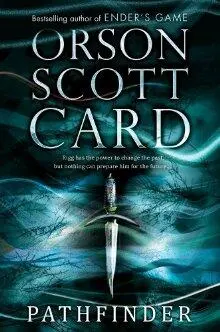
- Название:Pathfinder
- Автор:
- Издательство:Simon Pulse
- Жанр:
- Год:2010
- ISBN:978-1-4169-9176-2
- Рейтинг книги:5 / 5. Голосов: 1
-
Избранное:Добавить в избранное
- Отзывы:
-
Ваша оценка:
Pathfinder: краткое содержание, описание и аннотация
Предлагаем к чтению аннотацию, описание, краткое содержание или предисловие (зависит от того, что написал сам автор книги «Pathfinder»). Если вы не нашли необходимую информацию о книге — напишите в комментариях, мы постараемся отыскать её.
—secrets about Rigg's own past, his identity, and his destiny. And when Rigg discovers that he has the power not only to see the past, but also to change it, his future suddenly becomes anything but certain.
Rigg’s birthright sets him on a path that leaves him caught between two factions, one that wants him crowned and one that wants him dead. He will be forced to question everything he thinks he knows, choose who to trust, and push the limits of his talent…or forfeit control of his destiny.
Pathfinder — читать онлайн бесплатно полную книгу (весь текст) целиком
Ниже представлен текст книги, разбитый по страницам. Система сохранения места последней прочитанной страницы, позволяет с удобством читать онлайн бесплатно книгу «Pathfinder», без необходимости каждый раз заново искать на чём Вы остановились. Поставьте закладку, и сможете в любой момент перейти на страницу, на которой закончили чтение.
Интервал:
Закладка:
Ram did his best to be precise, to speak like a scientist or lawyer. “The definition of ‘human species’ shall include the existing range of genetic variability and all variations of it that might come to be, as long as the variations are not likely to be harmful to the survival of the human species in general.”
“Vague,” said the expendable.
“On this world or any other,” Ram added.
The expendable said nothing.
Ram thought a moment and tried again. “‘Human species’ means the interreproducing gene pool now understood to be human, plus all future variations on the human genome even if they cannot interreproduce with the existing gene pool, provided that the future variants do not threaten to destroy or weaken the survival chances of the existing gene pool, either deliberately or inadvertently.”
The expendable was silent for a long five seconds.
“We have discussed your definition, analyzed its ramifications to a reasonable depth, and accept it,” said the expendable.
“Meaning that I gave you what you wanted?”
“Ambition and desire are human traits. You gave us what we lacked.”
While Rigg had the ability to perceive paths without regard to walls or distance, in the confusion of Aressa Sessamo there was a practical limit to how far he could follow any path that wove in and out among all the threads of the city. Here inside the walls of Flacommo’s house, Rigg could track everyone who had ever lived here, though most of them weren’t interesting. Rigg mostly cared about people who came in and out of the house for the past year or so—and the paths that revealed to him the secret passages of the house.
He also tried tracing the paths of the spies who watched from peepholes in the walls, but once they left the house, they took convoluted paths through the busiest streets, like fugitives walking up or down a stream in order to confuse the dogs tracking them by scent. He wondered if they had some idea of what he could do, but then saw that they followed this pattern long before Rigg came here—before anyone here knew he was still alive. Perhaps the spies simply walked on the main streets like anyone else, and it was mere chance that it made it impossible for Rigg to keep them clearly in view far enough to know whom they reported to. Or perhaps they were choosing evasive routes in order to avoid observation by ordinary agents of some other faction or power.
They definitely did not report to Flacommo. As far as Rigg could tell, nobody did—not even the servants. The cooks and bakers cooked what they wanted; the housekeeper made up whatever schedule she pleased. Flacommo simply wandered around the house, talking to whomever he happened to meet. He was like a toddler, wandering to wherever something interesting was going on and then getting underfoot.
Rigg wasn’t sure whether going to the library would help him solve this problem—he could see the paths that wound through the buildings of the library, which weren’t far away, and while they were clear and orderly in a way the paths of the city streets were not, neither did any of the spies ever go there.
So if he got to the library, Rigg’s research would be exactly what he said it would be—an attempt to duplicate everything that his real father, Knosso, had studied in order to discover whatever it was he knew. Which might be nothing at all—it didn’t take a deep knowledge of theoretical physics to figure out that you might be able to make it through the Wall in a state of drug-induced unconsciousness.
But Father Knosso had studied the human brain in order to develop the sedatives he used. And if there was anything Rigg desperately needed to understand, it was the workings of the human brain. His own in particular, but a nice working knowledge of Umbo’s and Param’s and even Nox’s would be very useful, too.
At the same time, he couldn’t think of any reason why the Revolutionary Council would want to let him go anywhere or do anything—particularly something that he wanted to do. It might be a simple matter of policy that if the royal son, whose very existence is an affront both to the Revolutionary Council and to the matriarchal royal line, wants to do something, it must not be permitted.
Apparently, though, there were enough partisans of the male line—or enough people who thought it might be easier to kill him outside the walls of Flacommo’s house—that a bevy of scholars descended upon the house early one morning, without any kind of warning. “Because, you see,” said the elderly botanist who seemed to be in charge, “we didn’t want you to have any chance to prepare.”
“Beyond my lifetime of preparation,” said Rigg.
“That goes without saying,” said the botanist.
“I’m curious about the standard of judgment that you’ll use. Do I have to have the same level of knowledge as you? Aren’t there younger scholars who know less than you do, who are still scholars?”
“We are much less interested in the quantity or even the quality of your knowledge,” said the botanist, “than we are in the quality and quickness of your mind.”
“And are there no slow scholars among you?”
“Many are slow to remember the things that most people consider to be essentials of life,” said the botanist, “but all are quick enough to reason, to recognize illogic and error and unlikelihood. And in case you’re wondering, the test has already begun, and I’m not sure I like the cautious way you are trying to influence the ground rules in advance.”
“You leap to the conclusion that my goal is to influence them rather than merely discover them,” said Rigg.
“Discovering the rules will do you no good,” said the botanist, “because you will either think like a scholar or not, and if you don’t, it will be because you can’t, and if you can’t, no advance information will help you.”
“Fair enough,” said Rigg. “One point against me.”
“We are not keeping score,” said the botanist. “We are forming an impression.”
“Then I will stop trying to control things and surrender to your questioning.”
“Even with that statement you are trying to explain yourself, when silence would have been wiser.”
Rigg kept his silence.
The scholars went into the most comfortable parlor. Rigg sat on a backless stool in the next room, where he could not see any of them, but could hear anything they said loudly.
Rigg also noticed that two of the spies-in-the-walls were there to watch him and his examiners.
The questions began innocuously enough. They were so easy, in fact, that Rigg kept trying to find overcomplicated answers, fearing some kind of trick or trap. Until the botanist sighed and said, “If you keep answering like this we’ll never finish before some of us—including, probably, me—have died of old age. We aren’t trying to trick you, we’re trying get to know you. If a question seems simple, it is simple.”
“Oh,” said Rigg.
Now things moved very quickly. Often he could answer in a few words. They checked his general knowledge of history, botany, zoology, grammar, languages, physics, astronomy, chemistry, anatomy, and engineering. They asked him nothing about music or any of the arts; they steered clear of any history that involved the glorious Revolution or any events since.
Rigg confessed ignorance more frequently the farther they went. He stayed right with the zoologists—he had spent most of his life tracking, trapping, skinning, dissecting, cooking, and eating the fauna of the highlands to the south, and he enjoyed answering those questions in greater detail than was probably necessary. He enjoyed showing off.
But even in the areas where he didn’t have anywhere near as much experience, he held his own. Father had quizzed him constantly, and Rigg responded to these examiners exactly as he would have responded to Father, though with less flippancy. When he didn’t know the answer, he would say so; when he had a guess, he would identify it as speculation and explain why he thought it might be so.
Читать дальшеИнтервал:
Закладка:
Похожие книги на «Pathfinder»
Представляем Вашему вниманию похожие книги на «Pathfinder» списком для выбора. Мы отобрали схожую по названию и смыслу литературу в надежде предоставить читателям больше вариантов отыскать новые, интересные, ещё непрочитанные произведения.





Обсуждение, отзывы о книге «Pathfinder» и просто собственные мнения читателей. Оставьте ваши комментарии, напишите, что Вы думаете о произведении, его смысле или главных героях. Укажите что конкретно понравилось, а что нет, и почему Вы так считаете.