Orson Card - Pathfinder
Здесь есть возможность читать онлайн «Orson Card - Pathfinder» весь текст электронной книги совершенно бесплатно (целиком полную версию без сокращений). В некоторых случаях можно слушать аудио, скачать через торрент в формате fb2 и присутствует краткое содержание. Год выпуска: 2010, ISBN: 2010, Издательство: Simon Pulse, Жанр: Фантастика и фэнтези, на английском языке. Описание произведения, (предисловие) а так же отзывы посетителей доступны на портале библиотеки ЛибКат.
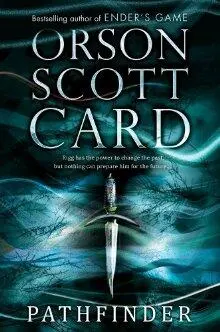
- Название:Pathfinder
- Автор:
- Издательство:Simon Pulse
- Жанр:
- Год:2010
- ISBN:978-1-4169-9176-2
- Рейтинг книги:5 / 5. Голосов: 1
-
Избранное:Добавить в избранное
- Отзывы:
-
Ваша оценка:
Pathfinder: краткое содержание, описание и аннотация
Предлагаем к чтению аннотацию, описание, краткое содержание или предисловие (зависит от того, что написал сам автор книги «Pathfinder»). Если вы не нашли необходимую информацию о книге — напишите в комментариях, мы постараемся отыскать её.
—secrets about Rigg's own past, his identity, and his destiny. And when Rigg discovers that he has the power not only to see the past, but also to change it, his future suddenly becomes anything but certain.
Rigg’s birthright sets him on a path that leaves him caught between two factions, one that wants him crowned and one that wants him dead. He will be forced to question everything he thinks he knows, choose who to trust, and push the limits of his talent…or forfeit control of his destiny.
Pathfinder — читать онлайн бесплатно полную книгу (весь текст) целиком
Ниже представлен текст книги, разбитый по страницам. Система сохранения места последней прочитанной страницы, позволяет с удобством читать онлайн бесплатно книгу «Pathfinder», без необходимости каждый раз заново искать на чём Вы остановились. Поставьте закладку, и сможете в любой момент перейти на страницу, на которой закончили чтение.
Интервал:
Закладка:
He soon realized that they were actually more interested in his guesses than in his knowledge. Once they knew he had a deep and wide knowledge of the vertebrates, they left zoology alone; whatever he knew little about, but still made guesses, they would pursue sharply. Always they brought him to a point where he had to say, “I just don’t know enough about it to make any kind of answer.”
“Where would you look, then?” the physicist finally asked. “Where within the library?”
“I don’t know,” said Rigg.
“If you don’t know where to look for the answer, then what good will the library do you?” the physicist demanded.
Rigg allowed his voice to reveal a little impatience. “I’m from upriver. I’ve never been in a library in my life. That’s why I want to be allowed to study in the Great Library here—so I can begin to find out where I would look for answers to questions like these.”
“There was a library in O,” said the botanist. “Why didn’t you go there to pursue your studies?”
“I was not planning to be a scholar then,” said Rigg. “I was still following what I thought was my father’s plan—that is, the man I thought was my father. By the time I got here , I realized either my father had no plan, or his plan simply didn’t work. So now I can choose for myself what I want to do. Only I don’t have enough information to make an intelligent decision about anything. So I thought I might attempt to add to what my father taught me, since his teachings were obviously incomplete.”
“All teachings are incomplete,” said the historian impatiently.
“And yet a wise man tries to add to his knowledge before making crucial decisions,” said Rigg.
“What sorts of decisions are you hoping to make?” asked the botanist.
“I don’t know enough to know what I need to know in order to decide what I need to decide,” said Rigg.
Rigg could sense that one of the scholars in the next room had stood up and was now pacing. Her voice was old-sounding. “There might be those who think your position here—as a member of the discredited royal family—”
Several of the other scholars got up, and one started toward her.
“I’m not speaking treason, I’m saying what everyone in this room knows, so sit down and let’s see how he answers!”
Rigg tried to remember who the speaker was, but finally concluded it was someone who had not spoken before.
“As I was saying, there might be those who think that it doesn’t matter in the slightest what you decide about anything. For the rest of your life, other people will decide everything that matters, including whether you live or die.”
She sat back down. Again there were murmurs of protest, but Rigg spoke loudly to cut them off. “I’m not afraid to face the situation I’m in. I’m quite aware that my power to decide is limited right now, and might be ended completely at any time. There have already been two attempts on my life since I was arrested—two that I know of, that is. In both cases, I managed to be alert enough to stay alive, but how long can I keep that up? One of you will have to write about that after the answer is known.”
There were a few nervous chuckles.
“But there’s always the chance that I might not die young. How will I occupy the long years of a very limited kind of life? My choice is to pursue scholarship. To do that I need to find out what I’m good at. To do that I need to have access to the library. Eventually I may be able to contribute to the sum of human knowledge. If I don’t, then at least I will have had an interesting life. A larger life than is possible in this house, with so few books.”
More murmuring, and then someone started to speak. Rigg didn’t even let him get a whole word out. “Please! Learned doctors and philosophers like you certainly have enough answers from me to make your decision. Let me ask you a question.”
“We are not here to be examined,” said the botanist stiffly. “And you do not decide when the—”
“Of course you’re here to be examined,” said Rigg. “All of you have carefully phrased your questions so as to impress each other with your profundity. I know you’ve impressed me . So I want to ask you all: What do you expect of a child my age? I am all potential, without accomplishments. If I were your student, would you find me promising? Would you trust me with a book in my hands? Is mine a mind worth teaching? My father thought so, because he spent every waking moment doing it, and then testing me on it—including the very kinds of tests that you’ve been putting me through here, taking me beyond the boundaries of my education, seeing what I could figure out for myself. He died without telling me whether I was meeting his standards or not. He never said or implied that I had learned enough about anything. But he also never stopped teaching me. Was my father right? Am I worth teaching? And if I’m not, why in the world have you spent all these hours pressing me further? Is there some great wisdom to be gained by calibrating exactly how worthless a mind I have?”
“This examination is over,” said the botanist.
Gratefully Rigg rose from his stool. His back was as tired as if he’d slept on cold hard ground. He had probably offended everyone by his final question, but there was a point where continuing the examination was a waste of everyone’s time.
To his surprise, the scholars did not go out the door leading into the garden. Instead, most of them came immediately into the room where Rigg was stretching himself. Some of them walked with great dignity, but others rushed in, hands extended. They said nothing at first. But each in turn held out a hand to him. Rigg took each hand, held it for a moment between his, and looked into their eyes.
The message in every face was the same, if he could dare to believe it. All the men and women who came into the room looked at him with warmth. With—or so it seemed to him—affection.
As he held their hands, and they held his, each one said his or her area of specialty. Not the general subject matter, like botany or physics, but the particular study that had made their reputation. “Mutation of plants through interspecies pollination.” “Propulsion of machinery through the controlled release of steam.” “The redevelopment of noun declensions through the accretion of particles in the transition from Middle to Late Umik.” “The tails of comets considered as ice boiled off by the heat of the sun.”
Each one, after letting go of his hand, stepped back to let the next approach. In the end, they formed two lines, and it was into the space between them that the last two from the other room finally came. The botanist was one, and the other was the woman who had asked him the practical and dangerous question near the end. Her face was set and hard—it was quite possible the botanist had been telling her off. Even now, she hung back and let the botanist come to Rigg ahead of her.
The botanist took his hands and said, “Alteration of a species through direct injection of cell nuclei from a species with a desired trait.” Then he stepped back.
The old woman came last. She took his hands as the others had, but said nothing.
“Go ahead,” the botanist said.
The old woman cocked her head slightly and got a touch of a smile. “The likelihood of two separate origins for the flora and fauna of this wallfold.”
This was something Rigg had never heard of—something Father had never touched on. “How could they be separate?” he asked. “Did life begin twice?”
She winked, even as a few of the other scholars groaned.
“That’s not the subject of her master piece,” said the botanist. “This is the scab she picks whenever she can find someone willing to listen to her. Her paper on that topic was never published.”
Читать дальшеИнтервал:
Закладка:
Похожие книги на «Pathfinder»
Представляем Вашему вниманию похожие книги на «Pathfinder» списком для выбора. Мы отобрали схожую по названию и смыслу литературу в надежде предоставить читателям больше вариантов отыскать новые, интересные, ещё непрочитанные произведения.





Обсуждение, отзывы о книге «Pathfinder» и просто собственные мнения читателей. Оставьте ваши комментарии, напишите, что Вы думаете о произведении, его смысле или главных героях. Укажите что конкретно понравилось, а что нет, и почему Вы так считаете.