Orson Card - Pathfinder
Здесь есть возможность читать онлайн «Orson Card - Pathfinder» весь текст электронной книги совершенно бесплатно (целиком полную версию без сокращений). В некоторых случаях можно слушать аудио, скачать через торрент в формате fb2 и присутствует краткое содержание. Год выпуска: 2010, ISBN: 2010, Издательство: Simon Pulse, Жанр: Фантастика и фэнтези, на английском языке. Описание произведения, (предисловие) а так же отзывы посетителей доступны на портале библиотеки ЛибКат.
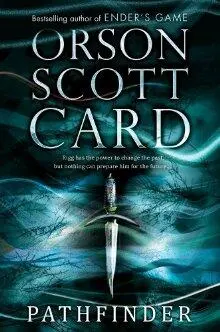
- Название:Pathfinder
- Автор:
- Издательство:Simon Pulse
- Жанр:
- Год:2010
- ISBN:978-1-4169-9176-2
- Рейтинг книги:5 / 5. Голосов: 1
-
Избранное:Добавить в избранное
- Отзывы:
-
Ваша оценка:
Pathfinder: краткое содержание, описание и аннотация
Предлагаем к чтению аннотацию, описание, краткое содержание или предисловие (зависит от того, что написал сам автор книги «Pathfinder»). Если вы не нашли необходимую информацию о книге — напишите в комментариях, мы постараемся отыскать её.
—secrets about Rigg's own past, his identity, and his destiny. And when Rigg discovers that he has the power not only to see the past, but also to change it, his future suddenly becomes anything but certain.
Rigg’s birthright sets him on a path that leaves him caught between two factions, one that wants him crowned and one that wants him dead. He will be forced to question everything he thinks he knows, choose who to trust, and push the limits of his talent…or forfeit control of his destiny.
Pathfinder — читать онлайн бесплатно полную книгу (весь текст) целиком
Ниже представлен текст книги, разбитый по страницам. Система сохранения места последней прочитанной страницы, позволяет с удобством читать онлайн бесплатно книгу «Pathfinder», без необходимости каждый раз заново искать на чём Вы остановились. Поставьте закладку, и сможете в любой момент перейти на страницу, на которой закончили чтение.
Интервал:
Закладка:
When he pulled away from Mother, smiling his most genuine, affectionate smile, he said. “I know that privacy must be priceless to you, you have so little of it. Thank you for taking me to your safest place.”
She looked ashen. His revelation that she and Param were watched at all times seemed to be devastating—but had she really imagined that the Revolutionary Council would leave her unobserved? And when the royal daughter seemed to disappear, did Mother really think that the Council would accept her explanation and not search for the girl?
Am I better at this than she is, after having spent her whole life in this prison?
Not better, he decided. It is my gift to sense what she could not possibly see; knowing hidden information is not the same thing as being wiser.
As they approached Mother’s room, Rigg could see all her walks up and down the corridor leading to her door. Thousands of times she had taken this walk. Always watched, always mistrusted, hated by many, disdained by more. How had she borne it all these years?
Perhaps she could also feel the pull of the hopes and yearnings of the many others in this land who hated the Council and yearned for a restoration of the monarchy. Perhaps in her heart she was queen after all, bearing what must be borne for the sake of her people.
Perhaps in her heart, as she walked with Rigg toward the room he had just revealed to be no sanctuary at all for her, she was planning his death.
No, he told himself. I have determined to trust her, and to honestly earn her trust in return. No doubts, no second-guessing. Either I will love my mother or I will not, but no halfway measures.
He could hear Father’s voice: “For children love is a feeling; for adults, it is a decision. Children wait to learn if their love is true by seeing how long it lasts; adults make their love true by never wavering from their commitment.”
Yes, well, Rigg knew enough of the world by now to suspect that by that definition, adults were rare and children could be found at any age. Still, that did not change the fact that Rigg could not help but judge himself by that standard. I will love this woman as long as she allows me to.
Mother opened the door—in semi-obedience to law, it was not locked. Full obedience would have had no door at all, but Rigg imagined it was more useful to the Revolutionary Council for the royals to think they had privacy.
Rigg came inside and closed the door behind him. He made a show of looking at the walls, though he knew exactly where the spy on duty crouched, eye to peephole. “Did they find the very worst art to hang in here?”
“You were rich for how long, three weeks?”
“I got used to it very quickly.”
“And in that time you became an expert on the quality of art?” Mother was only slightly sarcastic.
“I’m an expert on what I like,” said Rigg. “No one paints accurately—it’s always flat and the colors are never quite right. They never catch the thickness of the air. So I learned—as a temporarily rich young man in O—that the paintings that pleased me most were those that did not pretend to be depicting reality. My favorites were the very old ones from the age when O was capital of its own little empire, though it was nothing compared to . . . the lands ruled by the Revolutionary Council.” He had almost said “Stashiland,” but that was the name before the Sessamoto came, and he did not yet know how Mother would feel about that.
“There can’t possibly be any paintings left from the golden age of O,” said Mother. “Those are only copies.”
“Copies of copies of copies,” said Rigg. “But each copy was pronounced a faithful reproduction of the one before.”
“But by the time some artist copied it, the copy he copied from was already deteriorated. For all you know, the original was every bit as pseudo-realistic as the ones you say that you disdain, and it’s only the copying through generations that resulted in the lack of reality that you admire.”
“And yet I admire it no less for being unintentional,” said Rigg. He was now standing directly in front of the peephole where the spy had bent to see. “ Now ,” he said, “is where the vision is clearest.”
Mother nodded and frowned. No doubt she was remembering what activities had taken place within plain view of that spot.
Meanwhile, the spy was moving, and soon Rigg could see that new path had stopped forming. The spy must be standing on something, for now the peephole was higher than Rigg could block with his body. Instead, he pressed himself against the wall directly under the second peephole, and said, “ You could never look at it my way, I know, for some people see from a much loftier position.” Meanwhile, he pointed upward.
Mother was alert enough to heed his warning—“ you could never look”—and not stare right at the second peephole. She knew now where the blind spot in the room was—at least as far as these two peepholes were concerned—because Rigg was standing in it.
He could see from the paths Param had walked in this room that she was almost never in the blind spot. Meaning that whenever she became visible—to eat, to sleep, to wash, to change clothes, to use the chamber pot—she was under observation. So much for privacy. So much for the secret of her ability to become invisible.
To Mother’s great credit, she showed no emotion except what would be appropriate in response to her son’s words. Of course she understood the importance of giving the spies no indication that she knew they were there, watching. Still, it would be perfectly understandable if from now on, the chamber pot was located in the blind spot. Also the washstand.
“I’m still deciding whether I like you,” Mother was saying. “You seem very full of yourself. It’s humility that has kept us alive. That and perfect loyalty. We have given the Council no reason to think we’re a threat to the Republic—because we’re not. We do nothing unusual, so the people are barely aware we’re alive. We don’t matter. But your behavior puts us all in danger. Everyone must be talking about you by now. The servants can hardly be expected to keep silence about you .”
“Yes, I see that now,” said Rigg. “Forgive my selfishness. I will be as humble, harmless, and boring as possible from now on.” Unspoken was the statement: Now that everybody knows that I’m alive and here in the same house with you, I can afford to be circumspect. But Rigg was sure she understood exactly what he was doing.
“So what do you plan to do with yourself?”
“I’m in Aressa Sessamo,” said Rigg, as if that were answer enough.
“But you aren’t,” said Mother. “You’re in this house. You could be dancing along the Ring for all that you’ll see of Aressa Sessamo.”
“You misunderstand me, dear mother. I have no intention of going out among the crowds. But my father and I—the man I called ‘Father,’ that is—had always meant to come here to study in the library.”
“There are several hundred libraries in Aressa Sessamo,” said Mother, “and they will not let you visit any of them.”
“I understand completely,” said Rigg. “But the libraries that are grouped together as the Great Library of Aressa—aren’t they public libraries? Aren’t scholars permitted to borrow books for their research and take them home?”
“Are you suggesting that you’re a scholar?” asked Mother, now looking amused.
“My only professor was Father,” said Rigg, “but I think perhaps he was enough. We shared a love of science, before he died. There were questions he had not yet answered, and others to which he did not know any useful answer. All the learning that has survived within this wallfold for the past ten thousand years is in the library—if the answer is knowable, I want it.”
Читать дальшеИнтервал:
Закладка:
Похожие книги на «Pathfinder»
Представляем Вашему вниманию похожие книги на «Pathfinder» списком для выбора. Мы отобрали схожую по названию и смыслу литературу в надежде предоставить читателям больше вариантов отыскать новые, интересные, ещё непрочитанные произведения.





Обсуждение, отзывы о книге «Pathfinder» и просто собственные мнения читателей. Оставьте ваши комментарии, напишите, что Вы думаете о произведении, его смысле или главных героях. Укажите что конкретно понравилось, а что нет, и почему Вы так считаете.