Rachel Maddow - Drift
Здесь есть возможность читать онлайн «Rachel Maddow - Drift» весь текст электронной книги совершенно бесплатно (целиком полную версию без сокращений). В некоторых случаях можно слушать аудио, скачать через торрент в формате fb2 и присутствует краткое содержание. Город: New York, Год выпуска: 2012, ISBN: 2012, Издательство: Crown Publishers, Жанр: Публицистика, на английском языке. Описание произведения, (предисловие) а так же отзывы посетителей доступны на портале библиотеки ЛибКат.
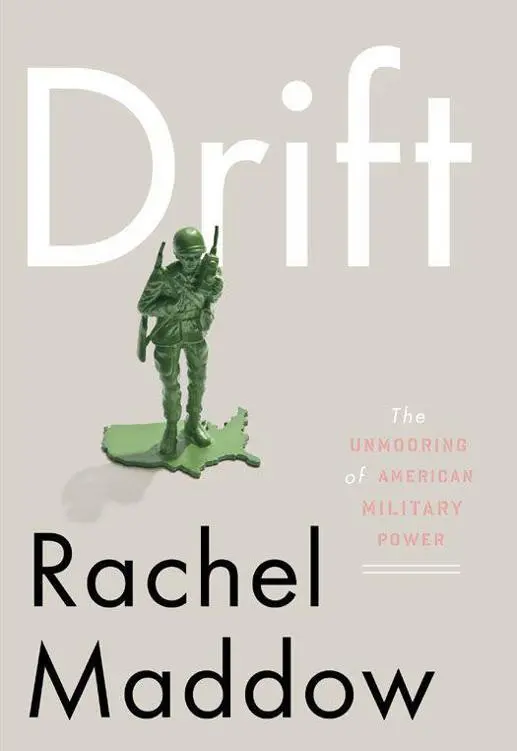
- Название:Drift
- Автор:
- Издательство:Crown Publishers
- Жанр:
- Год:2012
- Город:New York
- ISBN:978-0-307-46100-1
- Рейтинг книги:4 / 5. Голосов: 1
-
Избранное:Добавить в избранное
- Отзывы:
-
Ваша оценка:
Drift: краткое содержание, описание и аннотация
Предлагаем к чтению аннотацию, описание, краткое содержание или предисловие (зависит от того, что написал сам автор книги «Drift»). Если вы не нашли необходимую информацию о книге — напишите в комментариях, мы постараемся отыскать её.
Written with bracing wit and intelligence, Rachel Maddow’s
argues that we’ve drifted away from America’s original ideals and become a nation weirdly at peace with perpetual war, with all the financial and human costs that entails. To understand how we’ve arrived at such a dangerous place, Maddow takes us from the Vietnam War to today’s war in Afghanistan, along the way exploring the disturbing rise of executive authority, the gradual outsourcing of our war-making capabilities to private companies, the plummeting percentage of American families whose children fight our constant wars for us, and even the changing fortunes of G.I. Joe. She offers up a fresh, unsparing appraisal of Reagan’s radical presidency. Ultimately, she shows us just how much we stand to lose by allowing the priorities of the national security state to overpower our political discourse.
Sensible yet provocative, dead serious yet seriously funny,
will reinvigorate a “loud and jangly” political debate about how, when, and where to apply America’s strength and power—and who gets to make those decisions.
http://www.youtube.com/watch?v=Y9xoM7TMiTA
Drift — читать онлайн бесплатно полную книгу (весь текст) целиком
Ниже представлен текст книги, разбитый по страницам. Система сохранения места последней прочитанной страницы, позволяет с удобством читать онлайн бесплатно книгу «Drift», без необходимости каждый раз заново искать на чём Вы остановились. Поставьте закладку, и сможете в любой момент перейти на страницу, на которой закончили чтение.
Интервал:
Закладка:
So there was the whole new world order thing. The otherwise grounded and pragmatic George Herbert Walker Bush was nominating himself for a place among the pantheon of politicians and kings who claimed that one, just one more war would bring world peace. There was also the matter of standing up to a bully, a matter of honor in Bush’s personal code of ethics. Human Rights Watch had reported that Saddam’s soldiers were murdering, raping, and generally brutalizing Kuwaiti citizens. “I mean, people on a dialysis machine cut off, the machine sent to Baghdad,” Bush had exclaimed. “Babies in incubators heaved out of the incubators and the incubators themselves sent to Baghdad.” He was even hearing stories about Kuwaiti children being mowed down and killed on their way to hospitals, or Iraqi soldiers releasing the animals from the Kuwait zoo for target practice. “Their efforts, however, were not completely successful,” a Bush administration official told reporters. “A lion escaped and mauled a young Kuwaiti girl.”
It wasn’t long before Bush, the old World War II fighter pilot, started turning his description of Saddam up to eleven. “Worse than Hitler!” he said. “I began to move from viewing Saddam’s aggression exclusively as a dangerous strategic threat and an injustice to its reversal as a moral crusade,” Bush later wrote. “I became very emotional about the atrocities. They really gave urgency to my desire to do something active in response. At some point it came through to me that this was not a matter of shades of gray, or of trying to see the other side’s point of view. It was good versus evil, right versus wrong. I am sure the change strengthened my determination not to let the invasion stand and encouraged me to contemplate the use of force to reverse it.”
Saddam had rolled into Kuwait on August 2, 1990. Bush had sent troops to wait in Saudi Arabia on August 6. By October 30, 1990, the day he summoned what was effectively his war council to the Situation Room, the president was worried that the air was leaking out of his new world order moral crusade. He was getting edgy; he wasn’t sure how long the international coalition he had personally gathered would hold together. And he wasn’t sure how long the American people would support him in the crisis. He’d had huge backing for his response to Saddam up till then, something near 70 percent of Americans. But he could feel it slipping away.
He’d had a tough month—he’d taken “the damndest pounding I’ve ever seen” from the Democratic-controlled Congress in the budget battle occasioned by the prodigious deficits Reagan had left in his wake, and then another one from his own party when he’d had to back down from his Eastwoodesque “Read My Lips—No New Taxes” pledge. The tax hike was the right thing to do, Bush knew, but that didn’t make it popular with the hard-liners in his party. He was starting to fear the return of that ugly (and he thought unfair) Newsweek headline he’d endured during his presidential campaign, “Fighting the Wimp Factor.” His recent twenty-one-point drop in the polls was “one of the worst slides in public approval of any modern President,” the New York Times noted. “That fall is at least as great, although perhaps not quite as sudden, as the decline in President Gerald R. Ford’s approval rating after he pardoned former President Richard Nixon for his conduct in the Watergate scandal and the tumble that President Ronald Reagan took after disclosure of the Iran-contra affair.”
And now, after pummeling Bush into submission over the budget, Congress was starting to “get in his knickers,” as he sometimes said, about his handling of the Iraqi invasion of Kuwait. Just a few hours before the big October 30 war council meeting, he’d had to endure an hour-and-a-half-long sit-down with congressional leaders—they’d demanded it—so they could lecture him about war powers and public sentiment. The Democratic Speaker of the House had opened the proceedings by formally presenting Bush with a letter signed by eighty-one of his colleagues:
Recent reports and briefings indicate that the United States has shifted from a defensive to an offensive posture and that war may be imminent. We believe that the consequences would be catastrophic—resulting in the massive loss of lives, including 10,000 to 50,000 Americans. This could only be described as war. Under the US Constitution, only the Congress can declare war.
We are emphatically opposed to any offensive military action. We believe that the UN-sponsored embargo must be given every opportunity to work and that all multinational, non-military means of resolving the situation must be pursued. If, after all peaceful means of resolving the conflict are exhausted, and the President believes that military action is warranted, then… he must seek a declaration of war from the Congress…. We firmly believe that consulting with this group in no way replaces the President’s constitutional obligation to seek a declaration of war before undertaking any offensive military action. We demand that the Administration not undertake any offensive military action without the full deliberation and declaration required by the Constitution.
Bush sat and listened. Senate majority leader George Mitchell insisted that the case had not been made that the sanctions had failed. “I want to plead with you personally before you take the country into war,” Speaker Tom Foley implored. “Unless there is gross provocation, you won’t have public support.” Bush listened some more, and then showed them the door. Oh, he’d “consult.” He’d tell them what he was doing— what he’d already done , was more like it. He wouldn’t trust Congress with a decision about China patterns at a state dinner, let alone war and peace. “As long as the people are with us, I’ve got a good chance,” he’d written in his diary. “But once there starts to be erosion, [Congress] is going to do what Lyndon Johnson said: they painted their asses white and ran with the antelopes.”
Bush never bothered to answer that congressional letter. As far as he was concerned, he required no authorization from Congress to make war. In fairness to the president, one has to remember that he had been swimming for eight years in that muddled soup of reasoning that was the Reagan White House, and particularly in Ed Meese’s gooey construct called the “inherent powers of the president.” About his unilateral decision to deploy those troops to Saudi Arabia for more than sixty days, well, he said, they were in “no imminent danger of hostilities,” so the War Powers Act didn’t apply even if he did recognize its reach, which he did not, because it was an unconstitutional check on presidential power. Meese’s lawyers had said so. This was a matter of national security, Bush believed. He was commander in chief. He had all the authority he needed.
And as commander in chief the president made it plain in the Situation Room, a few hours after that congressional invasion of the White House, that he wanted his military—if not the nation—prepared to launch an air-and-ground attack to remove Saddam from Kuwait, and he meant to provide his generals with whatever they needed to do the job.
But what the generals said they needed to do the job functioned as a bit of a check on the move toward war. The chairman of the Joint Chiefs of Staff, Colin Powell, had not been shy in the ask that afternoon. Powell wanted an overwhelming, decisive use of force to meet American military objectives clearly and quickly. The whole Powell Doctrine of disproportionate force, clear goals, a clear exit strategy, and public support was designed to create a kind of quagmire-free war zone. He was unequivocal—he and his commander on the ground, Norman Schwarzkopf, had agreed: two hundred thousand more troops was what it would take. And they’d already made sure the president understood the numbers would go up if he decided he wanted not only to eject Saddam from Kuwait but to destroy his army, or to depose him. The mission objectives would have to be clearly defined before H-Hour. In any case, Powell and Schwarzkopf wanted five, maybe six, aircraft carrier task forces deployed to the Persian Gulf, which would leave naval power dangerously thin in the rest of the world. By the time the offensive capability was in place, about two months down the road, there would be something in the neighborhood of 500,000 American troops in the Middle East—nearly as many as at the high-water mark in Vietnam. Two-thirds of the combat units in the Marine Corps would be deployed in the Gulf. There would be no more talk of rotating troops home after six months. Soldiers had to understand they were in the Gulf until the job was done, however long that took.
Читать дальшеИнтервал:
Закладка:
Похожие книги на «Drift»
Представляем Вашему вниманию похожие книги на «Drift» списком для выбора. Мы отобрали схожую по названию и смыслу литературу в надежде предоставить читателям больше вариантов отыскать новые, интересные, ещё непрочитанные произведения.










Обсуждение, отзывы о книге «Drift» и просто собственные мнения читателей. Оставьте ваши комментарии, напишите, что Вы думаете о произведении, его смысле или главных героях. Укажите что конкретно понравилось, а что нет, и почему Вы так считаете.