Rachel Maddow - Drift
Здесь есть возможность читать онлайн «Rachel Maddow - Drift» весь текст электронной книги совершенно бесплатно (целиком полную версию без сокращений). В некоторых случаях можно слушать аудио, скачать через торрент в формате fb2 и присутствует краткое содержание. Город: New York, Год выпуска: 2012, ISBN: 2012, Издательство: Crown Publishers, Жанр: Публицистика, на английском языке. Описание произведения, (предисловие) а так же отзывы посетителей доступны на портале библиотеки ЛибКат.
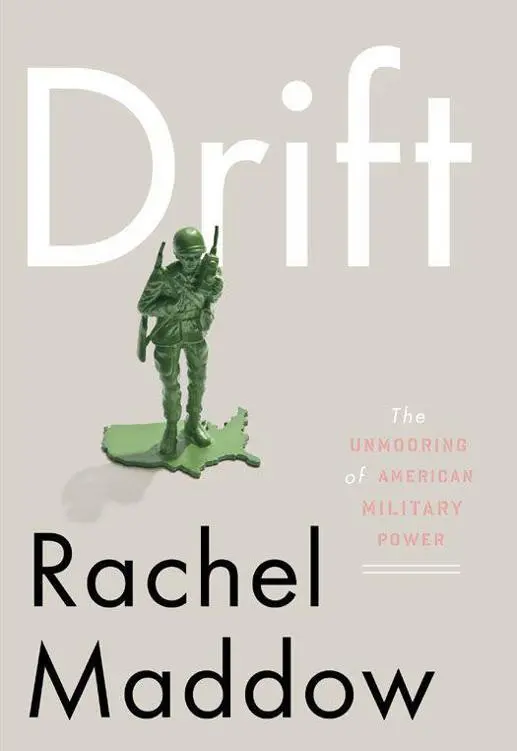
- Название:Drift
- Автор:
- Издательство:Crown Publishers
- Жанр:
- Год:2012
- Город:New York
- ISBN:978-0-307-46100-1
- Рейтинг книги:4 / 5. Голосов: 1
-
Избранное:Добавить в избранное
- Отзывы:
-
Ваша оценка:
Drift: краткое содержание, описание и аннотация
Предлагаем к чтению аннотацию, описание, краткое содержание или предисловие (зависит от того, что написал сам автор книги «Drift»). Если вы не нашли необходимую информацию о книге — напишите в комментариях, мы постараемся отыскать её.
Written with bracing wit and intelligence, Rachel Maddow’s
argues that we’ve drifted away from America’s original ideals and become a nation weirdly at peace with perpetual war, with all the financial and human costs that entails. To understand how we’ve arrived at such a dangerous place, Maddow takes us from the Vietnam War to today’s war in Afghanistan, along the way exploring the disturbing rise of executive authority, the gradual outsourcing of our war-making capabilities to private companies, the plummeting percentage of American families whose children fight our constant wars for us, and even the changing fortunes of G.I. Joe. She offers up a fresh, unsparing appraisal of Reagan’s radical presidency. Ultimately, she shows us just how much we stand to lose by allowing the priorities of the national security state to overpower our political discourse.
Sensible yet provocative, dead serious yet seriously funny,
will reinvigorate a “loud and jangly” political debate about how, when, and where to apply America’s strength and power—and who gets to make those decisions.
http://www.youtube.com/watch?v=Y9xoM7TMiTA
Drift — читать онлайн бесплатно полную книгу (весь текст) целиком
Ниже представлен текст книги, разбитый по страницам. Система сохранения места последней прочитанной страницы, позволяет с удобством читать онлайн бесплатно книгу «Drift», без необходимости каждый раз заново искать на чём Вы остановились. Поставьте закладку, и сможете в любой момент перейти на страницу, на которой закончили чтение.
Интервал:
Закладка:
“Cheney and I dealt with this congressional backlash in the Ford White House,” Cheney’s mentor, Donald Rumsfeld, wrote in his autobiography. “In the early days of the Ford Administration, Bryce Harlow, the savvy White House Liaison to Congress, former Eisenhower aide, and friend, told me—and I am paraphrasing from memory: ‘The steady pressure by Congress and the courts is to reduce executive authority. It is inexorable, inevitable, and historical. Resolve that when you leave the White House, leave it with the same authorities it had when you came. Do not contribute to the erosion of presidential power on your watch.’ Harlow’s words left an impression on me, and, I suspect, on Cheney.”
Even before the congressional hearings on Saddam and Kuwait had commenced in November 1990, Secretary of Defense Cheney had shipped out to the Sunday talk-show circuit to sound the old Reagan line about the “risky proposition” of leaving national security decisions in the shaky hands of 535 members of Congress. “I take you back to September 1941, when World War II had been under way for two years,” Cheney said on Meet the Press . “Hitler had taken Austria, Czechoslovakia, Poland, Norway, Denmark, the Netherlands, Belgium, France, and was halfway to Moscow. And the Congress, in that setting, two months before Pearl Harbor, agreed to extend the draft for twelve more months… by just one vote.” That Saddam Hussein’s misbegotten—and already-stopped-dead-in-its-tracks—adventure in the Middle East was in no way comparable to Hitler’s blitzkrieg through Europe was beside Cheney’s point. Cheney’s point was that Congress was sure to get out that white paint… and run with the antelopes. Wimps.
Secretary Cheney was no more conciliatory when he went to Capitol Hill to testify at Nunn’s hearings; this was not a man coming hat in hand to ask his former colleagues for permission for anything. In an exchange with Sen. Edward Kennedy, Cheney laid down a stunning new marker for executive power.
KENNEDY: Barring an act of provocation, do you agree that the president must obtain the approval of Congress in advance before the United States attacks Iraq?
CHENEY: Senator, I do not believe the president requires any additional authorization from the Congress before committing US forces to achieve our objectives in the Gulf…. There have been some two hundred times, more than two hundred times, in our history, when presidents have committed US forces, and on only five of those occasions was there a prior declaration of war. And so I am not one who would argue, in this instance, that the president’s hands are tied or that he is unable, given his constitutional responsibilities as commander in chief, to carry out his responsibilities.
KENNEDY: Well, Mr. Secretary, we’re not talking about Libya [where Reagan had run a one-shot bombing raid on its leader, Muammar Qaddafi]. We’re not talking about Grenada…. We’re talking about 440,000 American troops who are over there. We’re talking about a major kind of American military involvement if it becomes necessary to do so. And do I understand from your response that you are prepared to tell the American people now that barring provocation by Saddam Hussein, that you believe [the president], and [the president] alone, can bring this country to war?
CHENEY: Senator, I would argue, as has every president to my knowledge, certainly in modern times, that the president, as commander in chief, under Title II [ sic ], Section 2 of the US Constitution, has the authority to commit US forces.
Despite Kennedy’s disbelieving challenge to Cheney in that hearing room, despite Dellums’s lawsuit, Congress as an institution—and congressional leadership in particular—didn’t exactly get up on their hind legs and make a full-on fight with the president. The truth was, it looked like the leaders stepped back and prayed the crisis would resolve itself before they had to show up again for work in January 1991. By then, they hoped, Saddam would have summoned the sense to get out of Kuwait before the shooting started, relieving them of the need to be counted for war or against it.
With Congress in a state of strategic deferral, the White House’s real political energy was spent convincing the rest of the world. The Bush administration was busy shepherding a new UN resolution giving Saddam a drop-dead date for leaving Kuwait: January 15, 1991. If he was still in Kuwait on that day, according to UN resolution 678, the US-led military coalition was free to use “all necessary means” to remove him.
It was only once that resolution was passed—once that international path to war had been cleared—that the president decided he ought to at least make some gesture in the direction of caring about Congress. They’d be back in session—a new Congress convened—before the January 15 deadline, after all. He couldn’t tell the people that the United Nations had more sway over our military than did the elected representatives of the American people. “The Security Council,” Bush wrote, “had voted to go to war… but the carefully negotiated UN vote also called attention to whether, having asked the United Nations, we were obliged to seek similar authority from Congress. Once again we were faced with weighing the president’s inherent power to use force against the political benefits of explicit support from Congress.”
The political benefits! Had President Ronald Reagan believed that the decision to wage war (or not to) resided solely in the executive branch, and not in Congress—that the legislature’s role was just to cheer a president on and give a little political cover—he would never have waged his Contra adventure in secret. He did do it in secret—in violation of federal statute—and he got caught for it. To defend Reagan once he got caught, his administration cooked up the ad hoc, backfilling defense that no crime had been committed, that the legal constraint the president had taken such great secretive pains to elude didn’t really exist. Congress, their argument went, actually had no power over war making—pro or con; the president could wage any war he wanted, on his own terms. It was an absurd argument. But it spewed enough of a smokescreen to save Reagan from impeachment, and after he was gone, it was convenient enough to successor presidents that it survived. It didn’t have to—but it did.
And by 1990, it was this bizarre political inheritance that allowed old small -c conservative patrician George H. W. Bush—a man with no Fum-Poo flair at all, a man who grew up in a town where the country-club locker room was filled with men railing against the unconstitutional presidential overreach of Franklin Delano Roosevelt—to claim for himself and all presidents “inherent powers to use force” for which Congress’s explicit support was useful only as a “political benefit.” We had come a long way in a short time, and the strain showed on George H. W. Bush.
Ignoring the founders’ loud and explicit warning that we should not allow one person to unilaterally take us to war has been demonstrably bad for this country. Turns out it’s not so great for that one person, either. For all his hard-line “I’m the commander in chief” talk, Bush was tied in knots about the whole war powers business. A bracing little tour of President George H. W. Bush’s private diaries and letters from his months of captivity in the Should-I-Make-War-on-Saddam hall of mirrors is instructive:
I feel tension in the stomach and in the neck. I feel great pressure…. I worry, worry, worry about eroded support…. Some wanted me to deliver fireside chats to explain things, as Franklin Roosevelt had done. I am not good at that…. I think this week has been the most unpleasant, or tension filled of the Presidency…. If you want a friend in Washington, get a dog…. Nobody is particularly happy with me…. But some way I have got to convey to the American people that I will try my hardest, and [am] doing my best.
Читать дальшеИнтервал:
Закладка:
Похожие книги на «Drift»
Представляем Вашему вниманию похожие книги на «Drift» списком для выбора. Мы отобрали схожую по названию и смыслу литературу в надежде предоставить читателям больше вариантов отыскать новые, интересные, ещё непрочитанные произведения.








Обсуждение, отзывы о книге «Drift» и просто собственные мнения читателей. Оставьте ваши комментарии, напишите, что Вы думаете о произведении, его смысле или главных героях. Укажите что конкретно понравилось, а что нет, и почему Вы так считаете.