Rachel Maddow - Drift
Здесь есть возможность читать онлайн «Rachel Maddow - Drift» весь текст электронной книги совершенно бесплатно (целиком полную версию без сокращений). В некоторых случаях можно слушать аудио, скачать через торрент в формате fb2 и присутствует краткое содержание. Город: New York, Год выпуска: 2012, ISBN: 2012, Издательство: Crown Publishers, Жанр: Публицистика, на английском языке. Описание произведения, (предисловие) а так же отзывы посетителей доступны на портале библиотеки ЛибКат.
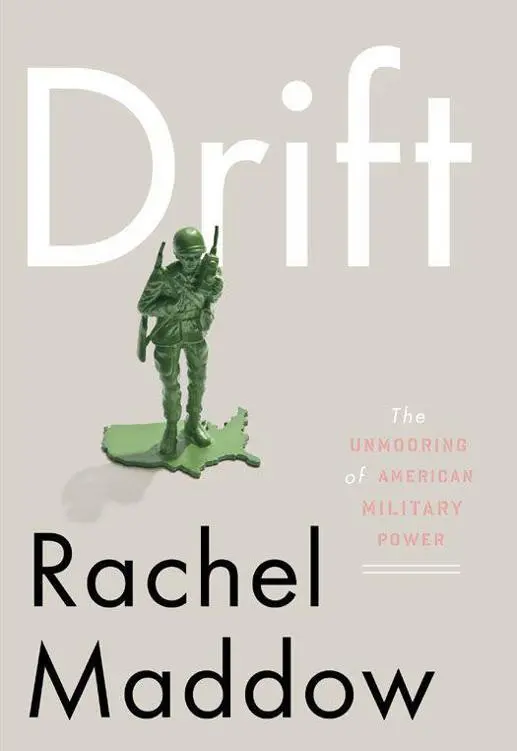
- Название:Drift
- Автор:
- Издательство:Crown Publishers
- Жанр:
- Год:2012
- Город:New York
- ISBN:978-0-307-46100-1
- Рейтинг книги:4 / 5. Голосов: 1
-
Избранное:Добавить в избранное
- Отзывы:
-
Ваша оценка:
Drift: краткое содержание, описание и аннотация
Предлагаем к чтению аннотацию, описание, краткое содержание или предисловие (зависит от того, что написал сам автор книги «Drift»). Если вы не нашли необходимую информацию о книге — напишите в комментариях, мы постараемся отыскать её.
Written with bracing wit and intelligence, Rachel Maddow’s
argues that we’ve drifted away from America’s original ideals and become a nation weirdly at peace with perpetual war, with all the financial and human costs that entails. To understand how we’ve arrived at such a dangerous place, Maddow takes us from the Vietnam War to today’s war in Afghanistan, along the way exploring the disturbing rise of executive authority, the gradual outsourcing of our war-making capabilities to private companies, the plummeting percentage of American families whose children fight our constant wars for us, and even the changing fortunes of G.I. Joe. She offers up a fresh, unsparing appraisal of Reagan’s radical presidency. Ultimately, she shows us just how much we stand to lose by allowing the priorities of the national security state to overpower our political discourse.
Sensible yet provocative, dead serious yet seriously funny,
will reinvigorate a “loud and jangly” political debate about how, when, and where to apply America’s strength and power—and who gets to make those decisions.
http://www.youtube.com/watch?v=Y9xoM7TMiTA
Drift — читать онлайн бесплатно полную книгу (весь текст) целиком
Ниже представлен текст книги, разбитый по страницам. Система сохранения места последней прочитанной страницы, позволяет с удобством читать онлайн бесплатно книгу «Drift», без необходимости каждый раз заново искать на чём Вы остановились. Поставьте закладку, и сможете в любой момент перейти на страницу, на которой закончили чтение.
Интервал:
Закладка:
Right!
The debate got tense, and in a hurry. The 101st Congress had come to a close before the elections, and the 102nd wasn’t scheduled to reconvene until the beginning of January, but that just meant there wasn’t much else on the national agenda to crowd out war talk. Big-time Democrats in the Senate ran for the open and available microphones and, as Bush saw it, started playing to the headline writers. Ted Kennedy remonstrated against the president’s reckless “headlong” drive toward war with Saddam. “Silence by Congress,” Massachusetts’s senior senator said, “is an abdication of our constitutional responsibility and an acquiescence in war.” The Senate majority leader George Mitchell was tougher on the president, stating flatly that Bush “has no legal authority, none whatever,” to take the country to war. “The Constitution clearly invests that great responsibility in the Congress and the Congress alone.”
And it wasn’t just Democrats.
Even Dick Lugar, a Republican senator, supposedly a friend to the administration, was promising to stick the congressional nose deep into the White House’s war-making business. He suggested it might be prudent for the president to spend as much energy convincing the American people that a shooting war against the Iraqi Army was the right thing to do as he was spending in convincing the rest of the world. Lugar went so far as to call for a rare special session of a lame-duck Congress to vote on a resolution authorizing a war in the Persian Gulf. Meanwhile, leaders in both the House and the Senate let Bush know they would get going on oversight hearings into the president’s policies in the Gulf tout de suite , before the new Congress convened.
As far as Bush was concerned, this aggression would not stand either.
The president called the congressional leaders into the White House and fired a warning shot. He had bent over backward to “consult” with Congress, he said, but “consultation is a two-way street. I think it is only fair that I get to hear your specific ideas in private about the tough choices we face before people go out and take public stances.” He pulled out press clippings; read them back, verbatim, to his loudest antagonists; and told them that Saddam might just get the message that the United States didn’t have the spine to stay the course. “This is the wrong signal to send at this time.” And about all that talk of Congress having an exclusive power to declare war? Forget it. According to one report out of the meeting, the president had pulled a copy of the Constitution from his suit jacket and waved it in front of the bipartisan congressional delegation. Bush knew what the document said about war powers, he told the group, but “it also says that I’m the commander in chief.”
What’d they think, he was some kind of wimp?
There were some members of Congress on both sides of the aisle who were squarely with Bush. They were with him on the old Reagan line that open public debate was a dangerous thing. Republican Senate leader Bob Dole asked, “How do we have open debate without sending the wrong signal to Saddam?” Republican congressman Henry Hyde went so far as to say that “Congress are supposed to be leaders. We should be carrying the [president’s] message to the people.”
But the point was, the debate in Congress had already begun. The call-up of the Reserves had assured it. There was going to be a public airing of the merits of this war, no matter what the president said.
On November 20, a few days after Bush’s “I’m the commander in chief” performance, a group of forty-five House members led by Rep. Ron Dellums gathered the Capitol Hill press corps to announce that they had filed a lawsuit asking the federal district court in Washington, DC, to demand that the president send to Congress a formal declaration of war to be debated and voted on before American troops were sent into battle. “There is no necessity for quick action here,” said one congressman. “We are not being invaded. There is no reason at all why the Constitution in this case should not be honored. And that’s what this lawsuit is all about.”
This was a more aggressive challenge to the president than that initial warning letter from the Speaker of the House three weeks earlier, before 200,000 more Americans had been pointed east and told to pack. Dellums and company were essentially asking a judge to tie the president’s hands unless and until he got Congress on board. “Some people have said, ‘Well, don’t you believe that this would inconvenience the president?’ ” Dellums said. “The Constitution is designed to inconvenience one person from taking us to war. War is a very solemn and sobering and extraordinary act and it should not be granted to one person.”
“Some people are saying you’re not inconveniencing [the president],” one reporter observed. “You’re undermining his ability to conduct an effective policy in the Persian Gulf.”
“To do anything other than what we’re suggesting here is to undermine the Constitution of the United States,” Dellums countered. “This is not the president’s sole prerogative.”
In the Senate, the Armed Services Committee, chaired by Georgia Democrat Sam Nunn, convened hearings on military readiness and capability in the Gulf, but the hearings quickly turned to questions about the advisability of and the need for a shooting war in Kuwait. And not just whether we ought to fight a war like that, but who would get to say so. Nunn even called as a witness the sharp-eyed Vietnam vet and author James Webb, not long removed from a tour as Reagan’s secretary of the Navy, who argued that Bush needed to get a declaration of war from Congress. Further, if Bush really meant to start a war of this size, his actions ought to live up to the magnitude of that decision. Stop-lossing active-duty troops was one thing, calling up the Guard and Reserves was all well and good, but to knit this into American life even further, the president needed to reinstitute the draft. The entire country needed to feel it, not just the military.
Up till that point, all the president’s steps toward war had been taken unilaterally. But the sheer magnitude of his actions, the number of military personnel he’d had to involve, demanded attention and challenge. The Bush White House seemed to understand that, but to resent and resist it too. “We were confident that the Constitution was on our side when it came to the president’s discretion to use force if necessary,” wrote Brent Scowcroft. “If we sought congressional involvement, it would not be authority we were after, but support.”
Actually, again, not to insist, but the Constitution “with studied care vested the question of war in the Legislature.” But by 1990 the executive branch wasn’t operating as if this was true anymore. Sure, a president going to war would be wise to engage with Congress on the issue. But that engagement was not determinative of whether we would in fact have that war—it was akin to lining up support from some foreign, sometimes-friendly ally: friends with political benefits. Better to have them on board than not, but if they didn’t come along, no biggie.
Not only didn’t the “question of war” vest in the Legislature anymore—it shouldn’t , either. The loudest voice in the Bush White House in favor of steamrolling the national legislature was the secretary of defense, Dick Cheney. Cheney had cut his bureaucratic teeth (and exceedingly sharp they were) as White House chief of staff during the Gerald Ford presidency, back when Congress was first wielding its War Powers Resolution (stupid regulations!) and making unprecedented and unwelcome trips to the White House to stop Ford from taking the country into another war in Vietnam.
Читать дальшеИнтервал:
Закладка:
Похожие книги на «Drift»
Представляем Вашему вниманию похожие книги на «Drift» списком для выбора. Мы отобрали схожую по названию и смыслу литературу в надежде предоставить читателям больше вариантов отыскать новые, интересные, ещё непрочитанные произведения.






Обсуждение, отзывы о книге «Drift» и просто собственные мнения читателей. Оставьте ваши комментарии, напишите, что Вы думаете о произведении, его смысле или главных героях. Укажите что конкретно понравилось, а что нет, и почему Вы так считаете.