Mark Steyn - America Alone
Здесь есть возможность читать онлайн «Mark Steyn - America Alone» весь текст электронной книги совершенно бесплатно (целиком полную версию без сокращений). В некоторых случаях можно слушать аудио, скачать через торрент в формате fb2 и присутствует краткое содержание. Город: Washington, D.C., Год выпуска: 2006, ISBN: 2006, Издательство: Regnery Publishing, Жанр: Публицистика, Политика, на английском языке. Описание произведения, (предисловие) а так же отзывы посетителей доступны на портале библиотеки ЛибКат.
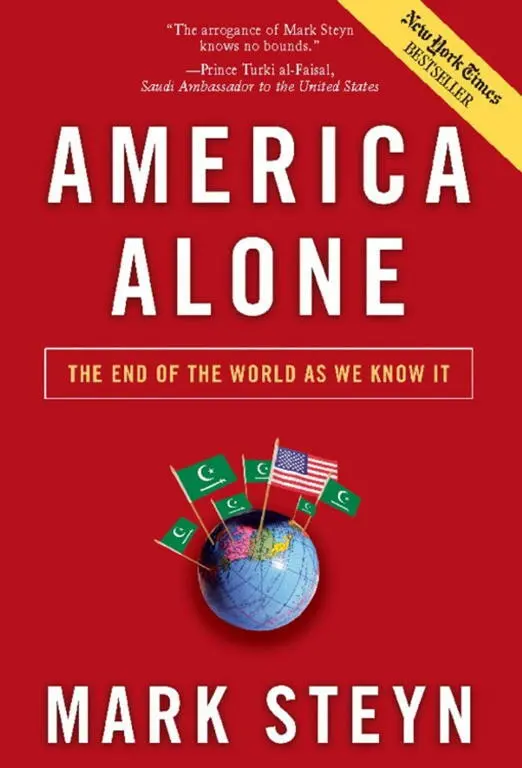
- Название:America Alone
- Автор:
- Издательство:Regnery Publishing
- Жанр:
- Год:2006
- Город:Washington, D.C.
- ISBN:978-0895260789
- Рейтинг книги:5 / 5. Голосов: 1
-
Избранное:Добавить в избранное
- Отзывы:
-
Ваша оценка:
America Alone: краткое содержание, описание и аннотация
Предлагаем к чтению аннотацию, описание, краткое содержание или предисловие (зависит от того, что написал сам автор книги «America Alone»). Если вы не нашли необходимую информацию о книге — напишите в комментариях, мы постараемся отыскать её.
It’s the end of the world as we know it…
Someday soon, you might wake up to the call to prayer from a muezzin. Europeans already are. And liberals will still tell you that “diversity is our strength” — while Talibanic enforcers cruise Greenwich Village burning books and barber shops, the Supreme Court decides sharia law doesn’t violate the “separation of church and state,” and the Hollywood Left decides to give up on gay rights in favor of the much safer charms of polygamy. If you think this can’t happen, you haven’t been paying attention, as the hilarious, provocative, and brilliant Mark Steyn — the most popular conservative columnist in the English-speaking world — shows to devastating effect. The future, as Steyn shows, belongs to the fecund and the confident. And the Islamists are both, while the West is looking ever more like the ruins of a civilization. But America can survive, prosper, and defend its freedom only if it continues to believe in itself, in the sturdier virtues of self-reliance (not government), in the centrality of family, and in the conviction that our country really is the world’s last best hope. Mark Steyn’s
is laugh-out-loud funny — but it will also change the way you look at the world.
[May contain tables.]
From the inside flap
America Alone — читать онлайн бесплатно полную книгу (весь текст) целиком
Ниже представлен текст книги, разбитый по страницам. Система сохранения места последней прочитанной страницы, позволяет с удобством читать онлайн бесплатно книгу «America Alone», без необходимости каждый раз заново искать на чём Вы остановились. Поставьте закладку, и сможете в любой момент перейти на страницу, на которой закончили чтение.
Интервал:
Закладка:
Yet, five years on from September 11 and after a torrent of information on Saudi funding of the jihad, America had changed its policy to Riyadh only to this degree: we’re lavishing even more dough on them than we did before.
The oil revenue collected by the House of Saud not only buys off their subjects but buys up other countries’ subjects around the world. Americans are paying for the rope that will hang them.
The fifth element of national power — “information” — speaks for itself, incessantly: the New York Times, CNN, Hollywood, the universities, Michael Moore… –i.e., quagmire, Islamophobia, BUSH LIED!!!!!, “exit strategy.”
In World War Two, the sands of Iwo Jima were the main event, and rounding up enemy sympathizers in Michigan was the sideshow. One can argue that this time around the priorities are reversed — that bombing Baby Assad out of the presidential palace in Damascus is a more marginal battlefield than turning back the tide of Islamist support in Europe and elsewhere. America and a select few other countries have demonstrated they can just about summon the “war will” on the battlefield. On the cultural front, where this war in the end will be won, there’s little evidence of any kind of will. If you look at the United Kingdom and the impunity with which imams like Abu Hamza incite treason, it requires a perverse genius on the part of Tony Blair to have found the political courage to fight an unpopular war on a distant shore but not the political courage to wage it closer to home, where it would have commanded far more support. That’s the sad lesson of July 7: Her Majesty’s forces can police southern Iraq more effectively than southern England.
If this were World War One, with their fellows in one trench and us in ours facing them over some boggy piece of terrain, it would be over very quickly. Which the smarter Islamists have figured out. They know they can never win on the battlefield, but they figure there’s an excellent chance they can drag things out until Western Civilization collapses in on itself and Islam inherits by default. An army is only one weapon a civilization wields, and the weapon of last resort, too. But when you add up those elements of national power — military, judicial, diplomatic, economic, informational — it’s hard not to conclude that (as was said of the British after the fall of Singapore) at least four of those five guns are pointing in the wrong direction. The point of the media is to speak truth to (domestic) power, the point of transnationalism is to constrain American power, the point of law is to upgrade the defendant — and the upshot of economic power in a time of plenty is that every time you gas up you’re funding an enemy who’s flusher than he’s been since the fall of Constantinople. Meanwhile, we fight the symptoms — the terror plots — but not the cause: the ideology. The self-imposed constraints of this war — legalistic, multilateral, politically correct — are clearer every day.
“Know your enemy,” they say. They know us very well. Do we know them at all?
THE FAINTHEARTED HYPERPOWER
In 2003, Tony Blair spoke to the United States Congress. “As Britain knows,” he said, “all predominant power seems for a time invincible but, in fact, it is transient. The question is: what do you leave behind?”
An excellent question. Today, three-sevenths of the G-7 major economies are nations of British descent. Of the twenty economies with the highest GDP per capita, no fewer than eleven are current or former realms of Her Britannic Majesty. And if you protest that most of those are pinprick colonial tax havens — Bermuda, the Caymans — okay, eliminate all territories with populations lower than twenty million and the top four is an Anglosphere sweep: the United States, United Kingdom, Canada, and Australia. The key regional players in almost every corner of the globe are British-derived — South Africa, India — and, even among the lesser players, as a general rule you’re better off for having been exposed to British rule than not: try doing business in Indonesia rather than Malaysia, or Haiti rather than St. Lucia.
And of course the pre-eminent power of the age derives its political character from eighteenth-century British subjects, who took English ideas a little further than the mother country was willing to go. As for the allegedly inevitable superpower of the coming century, if China ever does achieve that status, it will be because the People’s Republic learned more from British Hong Kong than Hong Kong ever did from the Little Red Book. Sir John Cowperthwaite, the colony’s transformative financial secretary in the sixties, can stake a better claim as the father of modern China than Chairman Mao, and, if Beijing weren’t so twitchy about these things, his would be the face they’d plaster over all the banners in Tiananmen Square.
I point out the obvious because an Englishman never would. “While some nations suffer from folie de grandeur,” wrote President Bush’s former speechwriter David Frum a year or two back, “the British seem uniquely disposed to bad-mouth themselves.” In the late sixties, Sir Richard Turnbull, high commissioner of Aden, remarked bleakly to Defense Secretary Denis Healey that the British Empire would be remembered for only two things — “the popularization of Association Football [soccer] and the term ‘fuck off.’” Instead of their bizarre cultural self-flagellation, the British might usefully deploy the latter formulation toward those kinky Eurofetishists who think the future lies in liquidating English law, custom, and parliamentary democracy within the conglomeration of failed nation states that make up the European Union.
Britain was never an unrivaled colossus, even at its zenith. Yet today, in language, law, politics, business, and the wider culture, there is simply nothing comparable in scale or endurance to the Britannic inheritance.
We now live in the American moment. And, even if nobody’s planning on leaving, the “what do you leave behind?” question is worth asking. How does America want to use its moment? What does it wish to bequeath the world?
Even to present the question in those terms feels vaguely un-American. The United States has an unmatched dominance that the British never enjoyed and that is historically unprecedented. Yet it remains a paradox: the non-imperial superpower. For good or ill, the American people don’t have an imperialist bone in their body — as we saw, in fact, in post-liberation Iraq.
A week before the president’s inaugural address in January 2005, I picked up the Village Voice for the first time in years. Couldn’t resist the cover story: “The Eve of Destruction: George W. Bush’s Four-Year Plan to Wreck the World.”
If only. It’s so easy to raise expectations at the beginning of a new presidential term. In the wake of September 11, the administration pledged itself to a long-overdue reversal of decades of misguided foreign policy that the Second Inaugural made explicit: Bush committed America to spreading freedom through the Muslim world — or, as a skeptical friend of mine phrased it, we’re going to shove liberty down their throats whether they want it or not. It was presented as a kind of lo-carb, organic, environmentally friendly version of “the white man’s burden.”
But no country has ever seemed more burdened by it. It’s America’s world; she just doesn’t want to live in it.
Almost as soon as American troops entered Iraq, Senate Democrats demanded to know what the “exit strategy” was. “Exit strategy” is a phrase that might have been designed as a textbook definition of lack of will. In war, there are usually only two exit strategies: victory or defeat. The latter’s easier. Just say, whoa, we’re the world’s dominant power but we can’t handle an unprecedently low level of casualties, so if you don’t mind we’d just as soon get off at the next stop. Taking your ball and going home is a seductive argument in a paradoxical superpower whose inclinations on the Right have a strong isolationist streak and on the Left a strong transnational streak — which is isolationism with a sappy face and biennial black-tie banquets in EU capitals. Transnationalism means poseur solutions — the Kyotification of foreign policy.
Читать дальшеИнтервал:
Закладка:
Похожие книги на «America Alone»
Представляем Вашему вниманию похожие книги на «America Alone» списком для выбора. Мы отобрали схожую по названию и смыслу литературу в надежде предоставить читателям больше вариантов отыскать новые, интересные, ещё непрочитанные произведения.







Обсуждение, отзывы о книге «America Alone» и просто собственные мнения читателей. Оставьте ваши комментарии, напишите, что Вы думаете о произведении, его смысле или главных героях. Укажите что конкретно понравилось, а что нет, и почему Вы так считаете.