Mark Steyn - America Alone
Здесь есть возможность читать онлайн «Mark Steyn - America Alone» весь текст электронной книги совершенно бесплатно (целиком полную версию без сокращений). В некоторых случаях можно слушать аудио, скачать через торрент в формате fb2 и присутствует краткое содержание. Город: Washington, D.C., Год выпуска: 2006, ISBN: 2006, Издательство: Regnery Publishing, Жанр: Публицистика, Политика, на английском языке. Описание произведения, (предисловие) а так же отзывы посетителей доступны на портале библиотеки ЛибКат.
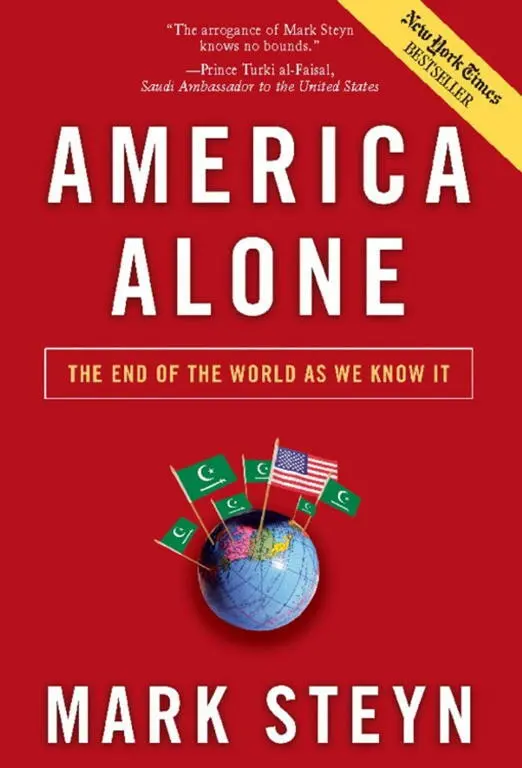
- Название:America Alone
- Автор:
- Издательство:Regnery Publishing
- Жанр:
- Год:2006
- Город:Washington, D.C.
- ISBN:978-0895260789
- Рейтинг книги:5 / 5. Голосов: 1
-
Избранное:Добавить в избранное
- Отзывы:
-
Ваша оценка:
America Alone: краткое содержание, описание и аннотация
Предлагаем к чтению аннотацию, описание, краткое содержание или предисловие (зависит от того, что написал сам автор книги «America Alone»). Если вы не нашли необходимую информацию о книге — напишите в комментариях, мы постараемся отыскать её.
It’s the end of the world as we know it…
Someday soon, you might wake up to the call to prayer from a muezzin. Europeans already are. And liberals will still tell you that “diversity is our strength” — while Talibanic enforcers cruise Greenwich Village burning books and barber shops, the Supreme Court decides sharia law doesn’t violate the “separation of church and state,” and the Hollywood Left decides to give up on gay rights in favor of the much safer charms of polygamy. If you think this can’t happen, you haven’t been paying attention, as the hilarious, provocative, and brilliant Mark Steyn — the most popular conservative columnist in the English-speaking world — shows to devastating effect. The future, as Steyn shows, belongs to the fecund and the confident. And the Islamists are both, while the West is looking ever more like the ruins of a civilization. But America can survive, prosper, and defend its freedom only if it continues to believe in itself, in the sturdier virtues of self-reliance (not government), in the centrality of family, and in the conviction that our country really is the world’s last best hope. Mark Steyn’s
is laugh-out-loud funny — but it will also change the way you look at the world.
[May contain tables.]
From the inside flap
America Alone — читать онлайн бесплатно полную книгу (весь текст) целиком
Ниже представлен текст книги, разбитый по страницам. Система сохранения места последней прочитанной страницы, позволяет с удобством читать онлайн бесплатно книгу «America Alone», без необходимости каждый раз заново искать на чём Вы остановились. Поставьте закладку, и сможете в любой момент перейти на страницу, на которой закончили чтение.
Интервал:
Закладка:
Agreeing to fight the jihad with subpoenas is a declaration that you’re willing to plea bargain. Instead of a Churchillian “We will never surrender!” it’s more of a “Well, the judge has thrown out the mass murder charges, but the D.A. says we can still nail him on mail fraud.” And even that may prove increasingly difficult. In 2005, the British authorities finally moved against the most famous of the country’s many incendiary imams. Abu Hamza is a household name in the United Kingdom thanks to the tabloids anointing him as “Hooky” — he lost his hands in an, er, “accident” in Afghanistan in 1991. On trial in London for nine counts of soliciting to murder plus various other charges, he retained the services of a prestigious Queen’s Counsel, who certainly came up with an ingenious legal strategy:
“Edward Fitzgerald, QC, for the defence, said that Abu Hamza’s interpretation of the Koran was that it imposed an obligation on Muslims to do jihad and fight in the defence of their religion. He said that the Crown case against the former imam of Finsbury Park Mosque was ‘simplistic in the extreme.’ He added: ‘It is said he was preaching murder, but he was actually preaching from the Koran itself.’”
If the Koran permit, you must acquit? Brilliant. To convict would be multiculturally disrespectful: if the holy book of the religion of peace recommends killing infidels, who are we to judge? SIAC, the United Kingdom’s anti-terrorist court, found in 2003 that a thirty-five-year-old Algerian male had “actively assisted terrorists who have links to al Qaeda.” But he was released from Belmarsh Prison the following year because jail causes him to suffer a “depressive illness.”
By Western standards, every Islamic terrorist is “depressive” — for a start, as suicide bombers, they’re suicidal. What’s impressive about these “unassimilated” Islamists is the way they pick up on our weaknesses so quickly — the legalisms, the ethnic squeamishness, the bureaucratic inertia. The courtroom evens the playing field to the enemy’s advantage.
What of U.S. diplomacy as an element of national power? At the dawn of the American era, after the Second World War, Washington chose not to be an active promoter of America’s values, America’s ideas, America’s voice, but instead opted to be what Michael Mandelbaum called an ordnungsmacht — an “order maker.” In the interests of economic order, the United States set up a network of international bodies — the World Bank, the International Monetary Fund, the General Agreement on Tariffs and Trade. In the interests of geopolitical order, it created transnational institutions in which the non-imperial hegemon was so self-deprecating it artificially inflated everybody else’s ideas and values and voices. In recent years, for example, I can find only one example of a senior UN figure having the guts to call a member state a “totalitarian regime.” It was the former secretary-general Boutros Boutros-Ghali in 2004, and he was talking about America.
The organization’s more artful critics agree that yes, the UN’s in a terrible state, what with the Oil-for-Fraud and the Congolese child-sex racket and the flop response to genocide in Darfur and the tsunami, but that’s all the more reason why America needs to be able to build consensus for much-needed reforms. The problem with that seductive line is that most of the proposed reforms are likely to make things worse. For most of its leading members, the organization is not a reflection of geopolitical reality but a substitute for it. The UN is no longer a latter-day Congress of Vienna, a permanent talking-shop for the world’s powers, but instead an alternative power in and of itself — a sort of ersatz superpower intended to counter the real one. Look at the eighty-five yes-or-no votes America made in the General Assembly in 2003:
• The Arab League members voted against the U.S. position 88.7 percent of the time.
• The ASEAN members voted against the U.S. position 84.5 percent of the time.
• The Islamic Conference members voted against the U.S. position 84.1 percent of the time.
• The African members voted against the U.S. position 83.8 percent of the time.
• The Non-Aligned Movement members voted against the U.S. position 82.7 percent of the time.
• And European Union members voted against the U.S. position 54.5 percent of the time.
Yay! Go, Europe, America’s steadfast 45 percent friends! You can take the view of the European elites that this is proof of America’s isolation and that the United States now needs to issue a “Declaration of Interdependence” with the world. Or you can be like the proud mom in Irving Berlin’s Great War marching song: “They Were All Out of Step but Jim.” But what the figures really demonstrate is that the logic of the post-Cold War UN is to be institutionally anti-American.
Washington could seize on the embarrassments of the Kofi Annan regime and lean hard on Turtle Bay to reform this and reorganize that and reinvent the other and, if they threw their full diplomatic muscle behind it, they might get those anti-U.S. votes down to-what, a tad over 80 percent? And along the way they’d find that they’d “reformed” a corrupt dysfunctional sclerotic anti-American club into a lean mean effectively functioning antiAmerican club. Which is, if they’re honest, what most reformers mean by “reform.”
The Sufi theologian and jurist al-Ghazali, regarded by many as the greatest Muslim after Mohammed, died a millennium ago but his words on the conduct of dhimmis — non-Muslims in Muslim society — seem pertinent today: “The dhimmi is obliged not to mention Allah or His Apostle…. Jews, Christians, and Majians must pay the jizya.” The jizya is the poll tax paid by non-Muslims to their Muslim betters. One cause of the lack of economic innovation in the Islamic world is that they’ve always placed the main funding burden of society on infidels. This goes back to Mohammed’s day. If you take a bunch of warring Arab tribes and unite them as one umma under Allah, one drawback is that you close off a prime source of revenue — fighting each other and then stealing each other’s stuff. That’s why the Prophet, while hardly in a position to deny Islam to those who wished to sign up, was relatively relaxed about the presence of non-Muslim peoples within Muslim lands: they were a revenue stream. If one looks at their comparative dissemination patterns, Christianity spread by acquiring believers and then land; Islam spread by acquiring land and then believers. When Islam conquered infidel territory, it set in motion a massive transfer of wealth, enacting punitive taxation to transfer money from non-believers to Muslims — or from the productive part of the economy to the non-productive. It was, in its way, a prototype welfare society. When admirers talk up Islam and the great innovations and rich culture of its heyday, they forget that even at its height Muslims were never more than a minority in the Muslim world, and they were in large part living off the energy of others. That’s still a useful rule of thumb: if you take the least worst Muslim societies, the reason for their dynamism often lies with whichever group they share the turf with — the Chinese in Malaysia, for example.
But eventually almost all Muslim societies tend toward the economically moribund, if only because an ever-shrinking infidel base eventually wises up. You can see it literally in the landscape in rural parts of the Balkans: Christian tradesmen got fed up paying the jizya and moved out of the towns up into remote hills. In other parts of the world, non-Muslims found it easier to convert. That’s in part what drove Islamic expansion. Once Araby was allMuslim, it was necessary to move on to the Levant, and to Persia, and to Central Asia and North Africa and India and Europe — in search of new infidels from which to extract the jizya. As engines of growth, the Muslim world and the European Union suffer a similar flaw: both encourage defections to the non-productive segment of the economy. But the Muslim world has effortlessly extended the concept of jizya worldwide. If you’re on the receiving end, it’s possible to see the American, European, and Israeli subsidies of the Palestinian Authority as a form of jizya. Or even the billions of dollars Washington has lavished on Egypt, to such little effect (other than Mohammed Atta coming through the window). Not to mention every twenty bucks you put in the gas tank. The telegram has been replaced by the e-mail and the victrola has yielded to the CD player, but, aside from losing the rumble seat and adding a few cupholders, the automobile is essentially unchanged from a century ago. If you can’t sell the country on the need for new energy sources when your present ones are funding your enemies, when can you?
Читать дальшеИнтервал:
Закладка:
Похожие книги на «America Alone»
Представляем Вашему вниманию похожие книги на «America Alone» списком для выбора. Мы отобрали схожую по названию и смыслу литературу в надежде предоставить читателям больше вариантов отыскать новые, интересные, ещё непрочитанные произведения.









Обсуждение, отзывы о книге «America Alone» и просто собственные мнения читателей. Оставьте ваши комментарии, напишите, что Вы думаете о произведении, его смысле или главных героях. Укажите что конкретно понравилось, а что нет, и почему Вы так считаете.