Mark Steyn - America Alone
Здесь есть возможность читать онлайн «Mark Steyn - America Alone» весь текст электронной книги совершенно бесплатно (целиком полную версию без сокращений). В некоторых случаях можно слушать аудио, скачать через торрент в формате fb2 и присутствует краткое содержание. Город: Washington, D.C., Год выпуска: 2006, ISBN: 2006, Издательство: Regnery Publishing, Жанр: Публицистика, Политика, на английском языке. Описание произведения, (предисловие) а так же отзывы посетителей доступны на портале библиотеки ЛибКат.
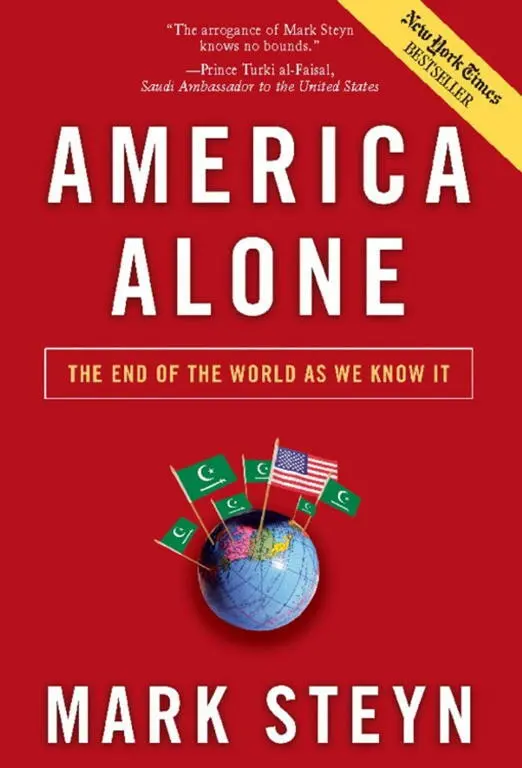
- Название:America Alone
- Автор:
- Издательство:Regnery Publishing
- Жанр:
- Год:2006
- Город:Washington, D.C.
- ISBN:978-0895260789
- Рейтинг книги:5 / 5. Голосов: 1
-
Избранное:Добавить в избранное
- Отзывы:
-
Ваша оценка:
America Alone: краткое содержание, описание и аннотация
Предлагаем к чтению аннотацию, описание, краткое содержание или предисловие (зависит от того, что написал сам автор книги «America Alone»). Если вы не нашли необходимую информацию о книге — напишите в комментариях, мы постараемся отыскать её.
It’s the end of the world as we know it…
Someday soon, you might wake up to the call to prayer from a muezzin. Europeans already are. And liberals will still tell you that “diversity is our strength” — while Talibanic enforcers cruise Greenwich Village burning books and barber shops, the Supreme Court decides sharia law doesn’t violate the “separation of church and state,” and the Hollywood Left decides to give up on gay rights in favor of the much safer charms of polygamy. If you think this can’t happen, you haven’t been paying attention, as the hilarious, provocative, and brilliant Mark Steyn — the most popular conservative columnist in the English-speaking world — shows to devastating effect. The future, as Steyn shows, belongs to the fecund and the confident. And the Islamists are both, while the West is looking ever more like the ruins of a civilization. But America can survive, prosper, and defend its freedom only if it continues to believe in itself, in the sturdier virtues of self-reliance (not government), in the centrality of family, and in the conviction that our country really is the world’s last best hope. Mark Steyn’s
is laugh-out-loud funny — but it will also change the way you look at the world.
[May contain tables.]
From the inside flap
America Alone — читать онлайн бесплатно полную книгу (весь текст) целиком
Ниже представлен текст книги, разбитый по страницам. Система сохранения места последней прочитанной страницы, позволяет с удобством читать онлайн бесплатно книгу «America Alone», без необходимости каждый раз заново искать на чём Вы остановились. Поставьте закладку, и сможете в любой момент перейти на страницу, на которой закончили чтение.
Интервал:
Закладка:
The United States has zero interest in empire, for obvious reasons. For one thing, it’s already as big as an empire, and most countries that controlled that big a land mass would probably run it in imperial fashion. Instead, America took a federation designed for a baker’s dozen of ethnically homogeneous East Coast colonies and successively applied it across the continent and halfway over the Pacific. It’s not strictly true that the sun never sets on the American Republic, but it’s up an awful lot of the time. Beyond that, Americans are deeply suspicious of the notion that you can swan around the world “giving” freedom to people. They have to want it, like the first Americans did — as we say in New Hampshire, live free or die. If the Iraqis want a free society badly enough, they’ll stick with it; if they don’t and they take the easy option of falling for some puffed-up strongman, that’s their problem, not America’s.
While this might be philosophically admirable, the practical drawback is that power abhors a vacuum. If America won’t export its values — self-reliance, decentralization — others will export theirs. In the eighties, Paul Kennedy warned the United States of “imperial overstretch.” But the danger right now is of imperial understretch — of a hyperpower reluctant to sell its indisputably successful inheritance to the rest of the world. After Mao’s victory, America’s anti-Communists famously demanded to know, “Who lost China?”
Answer: Nobody. China wasn’t lost. Chiang Kai-shek had never won it in the first place. He was merely an early beneficiary of American foreign policy’s faith in unreal realpolitik-the system embodied in the cynicalline that so-and-so may be a sonofabitch but he’s our sonofabitch. In the case of Mubarak, the House of Saud, and many others, the obverse is more to the point: he may be our sonofabitch but in the end he’s a sonofabitch. Even if it wasn’t licensing anti-Americanism as a safety valve for what might otherwise be more locally directed grievances, the Cairo government would not be a meaningful friend. There’s a huge difference between having a regime as an ally and having a nation as one, the difference being Egypt’s Mohammed Atta and fifteen Saudi citizens flying through the windows of the World Trade Center and the Pentagon — which suggests considerable limitations to the theory that, as long as America gets along fine with President Mubarak and key Saudi princes, it doesn’t matter if everyone else in Egypt and Saudi Arabia is shouting “Death to the Great Satan!” That, too, is a lesson in demography.
So instead of waiting ten years and demanding to know “Who lost Japan? Who lost Russia? And Europe? Oh, and who lost Britain?” analysts might be better advised to ponder why a supposed moment of unprecedented unipolar dominance doesn’t feel like it. Most Americans are familiar with their stereotype abroad: the ugly American, loud, brash, ignorant, arrogant. It is, in most respects, the inversion of reality: America may be the most modest and retiring hegemon in history. “You’re either with us or you’re with the terrorists”? Most of America’s European “allies” checked the Neither of the Above box and most Middle Eastern “allies” checked the Both of the Above box. Belgium isn’t exactly with the terrorists but it isn’t with us in any meaningful sense. Saudi Arabia is with us but also funding the terrorists in every corner of the world. And both countries get away with it. America has huge advantages. On the Continent, the Euroconsensus is shrinking both its economy and its population; America is managing to grow both. Why then project American power through transnational institutions disproportionately in thrall to European ideas? Especially when the one consistent feature of twenty-first century politics is the comprehensive failure of the over-Europeanized international order: UN staff facilitates Saddam’s subversion of the Oil-for-Food program; the EU subsidizes the Palestinian intifada; the International Atomic Energy Agency provides cover for Iran’s nuclear ambitions; the UN summit on racism is a grotesque orgy of racism. As we’ve learned since September 11, if there is a “white man’s burden” in the early twenty-first century, it’s not the burden of doing one’s bit for the natives, but doing so under a hail of continual sniping from Chirac, Schröder, the Belgian guy, Kofi, Oxfam, the BBC, and a gazillion others: There’s something a little bizarre about a so-called unipolar world, in which it’s the unipole that gets shafted every time.
And, as the various local demographic adjustments start to take effect, America is in danger of finding itself in the same lonely camp as Israel. Nudge things half a decade down the road. There’ll be an informal Islamo-veto over many areas of French and European policy. Russia and China have already determined that, whatever their own little local difficulties with Muslims, their long-term strategic interest lies in keeping the jihad as an American problem. The internal logic of the demographic shifts will be to make much of the world figure it makes sense to be on the side America’s not.
Al Qaeda thinks it’s got America pegged — an effete, fleshy sultan sprawled languorously on overstuffed cushions, lost in sensual distractions. The choice for the United States is between those who believe America can take the lead in shaping the times and those who think the most powerful nation in human history can simply climb in the Suburban and go to the mall for its entire period of dominance. That’s what the great Democratic Party allpurpose “multilateral” cure-all for United States foreign policy boils down to: “We need to hand power back to the UN. Or the EU. Or the Arab League. Or the Deputy Fisheries Minister of the Turks and Caicos Islands.” Or as Thomas Friedman, the hilariously tortured foreign-policy grandee of the New York Times, agonized: “Mr. Bush needs to invite to Camp David the five permanent members of the UN Security Council, the heads of both NATO and the UN, and the leaders of Egypt, Jordan, Saudi Arabia, and Syria. There, he needs to eat crow, apologize for his mistakes,” etc, etc. Why would it be in America’s interest to inflate the prestige of Boy Assad and Mubarak?
This lame-o multilateral outsourcing is the geopolitical equivalent of subcontracting your lawn care to “undocumented” immigrants: here you are, we don’t mind giving you the money, just take care of it, we don’t want to know the details, we want to go back to watching American Idol. Is foreign policy just another one of those “jobs Americans won’t do”?
“Common values” and “universal values” are not all that common and universal, and the willingness to defend those values is even rarer. They’ve been sustained over the long haul by a very small group of countries. In the years ahead, America has to take the American moment seriously — in part, to ensure that the allies of tomorrow don’t make the mistakes Western Europe did. That means at the very minimum something beyond cheeseburger imperialism. In the end, the world can do without American rap and American cheeseburgers. American ideas on individual liberty, federalism, capitalism, and freedom of speech would be far more helpful.
In 2004, Goh Chok Tong, the prime minister of Singapore and a man who talks a lot more sense than most Continental prime ministers, visited Washington at the height of the Democrats’ headless-chicken quagmire frenzy. He put it in a nutshell: “The key issue is no longer WMD or even the role of the UN. The central issue is America’s credibility and will to prevail.”
The prime minister of Singapore apparently understands that more clearly than many Americans.
Chapter Nine
The Importance of Being Exceptional
Интервал:
Закладка:
Похожие книги на «America Alone»
Представляем Вашему вниманию похожие книги на «America Alone» списком для выбора. Мы отобрали схожую по названию и смыслу литературу в надежде предоставить читателям больше вариантов отыскать новые, интересные, ещё непрочитанные произведения.









Обсуждение, отзывы о книге «America Alone» и просто собственные мнения читателей. Оставьте ваши комментарии, напишите, что Вы думаете о произведении, его смысле или главных героях. Укажите что конкретно понравилось, а что нет, и почему Вы так считаете.