Mark Steyn - America Alone
Здесь есть возможность читать онлайн «Mark Steyn - America Alone» весь текст электронной книги совершенно бесплатно (целиком полную версию без сокращений). В некоторых случаях можно слушать аудио, скачать через торрент в формате fb2 и присутствует краткое содержание. Город: Washington, D.C., Год выпуска: 2006, ISBN: 2006, Издательство: Regnery Publishing, Жанр: Публицистика, Политика, на английском языке. Описание произведения, (предисловие) а так же отзывы посетителей доступны на портале библиотеки ЛибКат.
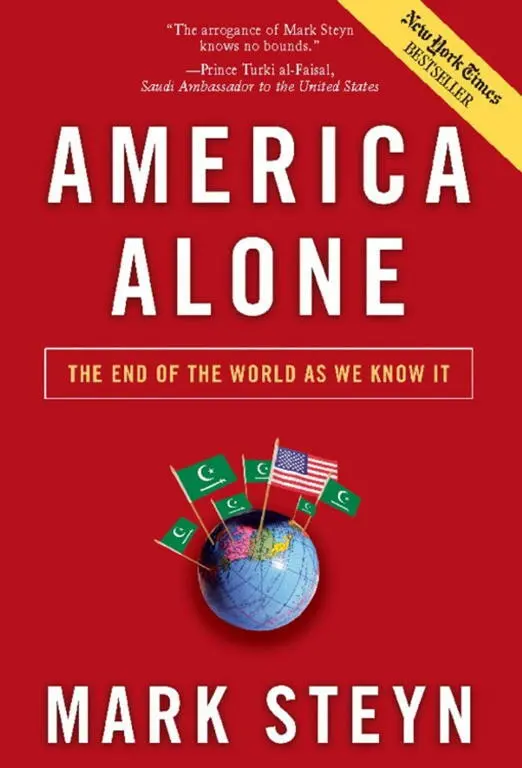
- Название:America Alone
- Автор:
- Издательство:Regnery Publishing
- Жанр:
- Год:2006
- Город:Washington, D.C.
- ISBN:978-0895260789
- Рейтинг книги:5 / 5. Голосов: 1
-
Избранное:Добавить в избранное
- Отзывы:
-
Ваша оценка:
America Alone: краткое содержание, описание и аннотация
Предлагаем к чтению аннотацию, описание, краткое содержание или предисловие (зависит от того, что написал сам автор книги «America Alone»). Если вы не нашли необходимую информацию о книге — напишите в комментариях, мы постараемся отыскать её.
It’s the end of the world as we know it…
Someday soon, you might wake up to the call to prayer from a muezzin. Europeans already are. And liberals will still tell you that “diversity is our strength” — while Talibanic enforcers cruise Greenwich Village burning books and barber shops, the Supreme Court decides sharia law doesn’t violate the “separation of church and state,” and the Hollywood Left decides to give up on gay rights in favor of the much safer charms of polygamy. If you think this can’t happen, you haven’t been paying attention, as the hilarious, provocative, and brilliant Mark Steyn — the most popular conservative columnist in the English-speaking world — shows to devastating effect. The future, as Steyn shows, belongs to the fecund and the confident. And the Islamists are both, while the West is looking ever more like the ruins of a civilization. But America can survive, prosper, and defend its freedom only if it continues to believe in itself, in the sturdier virtues of self-reliance (not government), in the centrality of family, and in the conviction that our country really is the world’s last best hope. Mark Steyn’s
is laugh-out-loud funny — but it will also change the way you look at the world.
[May contain tables.]
From the inside flap
America Alone — читать онлайн бесплатно полную книгу (весь текст) целиком
Ниже представлен текст книги, разбитый по страницам. Система сохранения места последней прочитанной страницы, позволяет с удобством читать онлайн бесплатно книгу «America Alone», без необходимости каждый раз заново искать на чём Вы остановились. Поставьте закладку, и сможете в любой момент перейти на страницу, на которой закончили чтение.
Интервал:
Закладка:
For a serious power, the correct answer to “What’s the exit strategy?” is: there isn’t one, and there shouldn’t be one, and it’s a dumb expression. The more polite response came in the president’s second inaugural speech: “The survival of liberty in our land increasingly depends on the success of liberty in other lands.”
If you want an example of “exit strategy” thinking, look no further than the southern “border.” A century ago, American policy in Mexico was all exit and no strategy. That week’s president-for-life gets out of hand? Go in, whack him, exit, and let the locals figure out who gets to be the new bad guy. If the new guy gets out of hand, go back, whack him, and exit again. The result of that stunted policy is that three-quarters of Mexico’s population is now living in California and Arizona — and, as fine upstanding members of the Undocumented American community, they’ve got no exit strategy at all. Judging from the placards brandished at the Million Mexican Marches held across the United States in 2006 (“Honkies, Why Don’t You Take Your Asses Back to Europe?”) many of them feel it’s the Documented Americans who ought to be planning on an exit.
By contrast, the British went in to India without an exit strategy, stayed for generations, and midwifed the world’s most populous democracy and a key U.S. ally in the years ahead. Which looks like the smarter approach now? Those American conservatives — the realpolitik crowd — who scorn “nation-building” ought to reflect on what the Indian subcontinent would look like if the British had been similarly skeptical: today, it might well be another Araby — a crazy quilt of authoritarian sultanates, Hindu and Muslim, punctuated by thug dictatorships following Baath-type local variations on Fascism and Marxism. It would be a profoundly unstable region with a swollen uneducated citizenry of little use for call centers or tech support. Any American who’s found himself at three in the morning talking to Suresh or Rajiv in customer service will appreciate the benefits of an Indian education. He can thank Lord Macaulay and his famous 1835 government memo on the subject for that: London dispatched generations of English, Scots, and Irish schoolma’ams and masters to obscure outposts of empire because they thought that by introducing them to Shakespeare and the Magna Carta and Sir Isaac Newton they were effectively giving their colonial subjects a passport to the modern world.
Failed states destabilize their neighbors, and Americans don’t have to pore over maps of West Africa to figure that out. Insofar as four of the September 11 killers obtained the picture ID with which they boarded their flights that morning through the support network for “undocumented” workers, it’s not unreasonable to argue that, if you’re looking for really deep “root causes” for what happened that day, you could easily start with America’s failure to nation-build in Mexico. And the problem with “exit strategy” fetishization is that these days, everywhere’s Mexico — literally, in the sense that the September 11 killers were part of the Undocumented American community, and more figuratively in the sense that if you’ve got a few hundred bucks and an ATM card you can come to America and blow it up. Everyone lives next door now.
The United States, almost in inverse proportion to its economic and military might, is culturally isolated. I know, I know — you’ve read a thousand articles about America’s “cultural imperialism.” And that’s fine if you mean you can fly around the world and eat at McDonald’s, dress at the Gap, listen to Hilary Duff, and go see Charlie’s Angels 3 or Dude, Where’s My Car? 7 pretty much anywhere on the planet. But so what? The Merry Widow was both a blockbuster sensation on Broadway and Hitler’s favorite operetta. If I sent my profile in to the average computer dating agency, they’d fix me up with Saddam Hussein: he and I have the same favorite singer (Frank Sinatra) and favorite candy (Britain’s Quality Street toffees). It’s not enough. You can easily like American pop culture without liking America: in London, the broadsheet newspapers that devote most space to U.S. cultural trends — the Guardian, the Independent — are the most vehemently anti-American. Then again, if you despise America’s trash pop culture, it’ll make you despise America even more. Thus Jean-Pierre Chevenement, former French foreign minister, and his celebrated assertion that the United States is dedicated to “the organized cretinization of our people” — a claim that’s a lot more persuasive if you’ve never had the misfortune to sit through a weekend of French TV. In 2002, there was a shoot-out in a French town hall by some left-wing eco-loon, and one of the country’s presidential candidates, Alain Madelin, deplored it as an “American-style by-product.” One Frenchman kills eight other Frenchman and somehow it’s proof of America’s malign cultural influence.
You can sort of see what he’s getting at. With very few exceptions, wherever you live in the world the landscape of the imagination is America: in the movie in your mind, the car chase takes place on the Los Angeles freeway, the love scene in Central Park, the massive explosion at the World Trade Center. The world watches Hollywood’s America in a kind of post-neutron-bombed way: you get the sex and drugs and rock n’ roll, the shoot-outs and fireballs, but the spirit of the country remains as foreign as ever. This is not a healthy phenomenon. On the things that matter — which, no disrespect, Hilary Duff doesn’t — the gap between America and the rest of the world is wider than ever. If you define “cultural dominance” as cheeseburgers, America rules. But in the bigger cultural sense, it’s a taste most of the world declines to pick up.
“Europe and America,” said George W. Bush in Ireland in 2004, “are linked by the ties of family, friendship, and common struggle and common values.” If so, the president and many other Americans have an all too common struggle articulating what those common values are. In Prague in 2002, Mr. Bush told fellow NATO members, “We share common values — the common values of freedom, human rights, and democracy.” Big deal. In a post-Communist world, these are vague, unobjectionable generalities to everyone except the head hackers in the Sunni Triangle. The “common values” stuff is the transnational equivalent of “Have a nice day.” It’s when you try to flesh it out that it all gets more complicated. The United States spends 3.4 percent of GDP on defense, the other NATO members spend on average 1.9 percent. So, if they do share “common values,” Europe’s prepared to spend a lot less defending them. On a raft of other issues, from guns to religion, America is also the exception. In North American terms, it’s Canadian ideas, from socialized health care to confiscatory taxation, that are now the norm in the other Western democracies and, alas, in many of the emerging democracies. The raucousness of American pop culture — jazz, showgirls, hard-boiled cops — belies the hyperpower’s geopolitical circumspection. And, on the receiving end, the Americanization of global pop culture puts a greater premium on being un-American in every other respect. Almost all the supranational bodies — from the EU to the International Criminal Court — are, if not explicitly hostile to American values, at the very least antipathetic to them. In the face of this rejection of the broader American culture, the popularity of Brad Pitt and Angelina Jolie isn’t much consolation. Britain exported its language, law, and institutions around the world to the point where today there are dozens of countries whose political and legal cultures derive principally from London. On islands from the Caribbean to the South Pacific, you can find miniature Westminsters proudly displaying their maces and Hansards. But if England is the mother of parliaments, America’s a wealthy spinster with no urge to start dating. Of all the new nations that have come to independence since 1945 not one has adopted the American system of republican decentralized federalism — even though it’s arguably the most successful ever invented.
Читать дальшеИнтервал:
Закладка:
Похожие книги на «America Alone»
Представляем Вашему вниманию похожие книги на «America Alone» списком для выбора. Мы отобрали схожую по названию и смыслу литературу в надежде предоставить читателям больше вариантов отыскать новые, интересные, ещё непрочитанные произведения.












Обсуждение, отзывы о книге «America Alone» и просто собственные мнения читателей. Оставьте ваши комментарии, напишите, что Вы думаете о произведении, его смысле или главных героях. Укажите что конкретно понравилось, а что нет, и почему Вы так считаете.