Mark Steyn - America Alone
Здесь есть возможность читать онлайн «Mark Steyn - America Alone» весь текст электронной книги совершенно бесплатно (целиком полную версию без сокращений). В некоторых случаях можно слушать аудио, скачать через торрент в формате fb2 и присутствует краткое содержание. Город: Washington, D.C., Год выпуска: 2006, ISBN: 2006, Издательство: Regnery Publishing, Жанр: Публицистика, Политика, на английском языке. Описание произведения, (предисловие) а так же отзывы посетителей доступны на портале библиотеки ЛибКат.
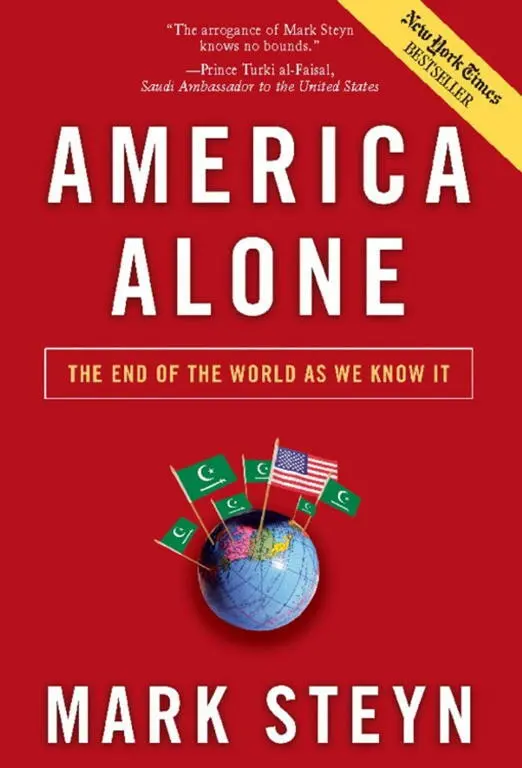
- Название:America Alone
- Автор:
- Издательство:Regnery Publishing
- Жанр:
- Год:2006
- Город:Washington, D.C.
- ISBN:978-0895260789
- Рейтинг книги:5 / 5. Голосов: 1
-
Избранное:Добавить в избранное
- Отзывы:
-
Ваша оценка:
America Alone: краткое содержание, описание и аннотация
Предлагаем к чтению аннотацию, описание, краткое содержание или предисловие (зависит от того, что написал сам автор книги «America Alone»). Если вы не нашли необходимую информацию о книге — напишите в комментариях, мы постараемся отыскать её.
It’s the end of the world as we know it…
Someday soon, you might wake up to the call to prayer from a muezzin. Europeans already are. And liberals will still tell you that “diversity is our strength” — while Talibanic enforcers cruise Greenwich Village burning books and barber shops, the Supreme Court decides sharia law doesn’t violate the “separation of church and state,” and the Hollywood Left decides to give up on gay rights in favor of the much safer charms of polygamy. If you think this can’t happen, you haven’t been paying attention, as the hilarious, provocative, and brilliant Mark Steyn — the most popular conservative columnist in the English-speaking world — shows to devastating effect. The future, as Steyn shows, belongs to the fecund and the confident. And the Islamists are both, while the West is looking ever more like the ruins of a civilization. But America can survive, prosper, and defend its freedom only if it continues to believe in itself, in the sturdier virtues of self-reliance (not government), in the centrality of family, and in the conviction that our country really is the world’s last best hope. Mark Steyn’s
is laugh-out-loud funny — but it will also change the way you look at the world.
[May contain tables.]
From the inside flap
America Alone — читать онлайн бесплатно полную книгу (весь текст) целиком
Ниже представлен текст книги, разбитый по страницам. Система сохранения места последней прочитанной страницы, позволяет с удобством читать онлайн бесплатно книгу «America Alone», без необходимости каждый раз заново искать на чём Вы остановились. Поставьте закладку, и сможете в любой момент перейти на страницу, на которой закончили чтение.
Интервал:
Закладка:
Do you remember when that statue of Saddam came down? It proved to be hollow. The Islamists think Western Civilization’s like that: tough exterior, but empty inside; protected by a layer of hard steel — the U.S. military — there’s nothing underneath. Why would they get that idea? Well, from a million and one little things — itsy-bitsy footof-page-thirty-seven news items, none too important in itself but cumulatively an avalanche. Take one trivial example: just before Christmas 2003, Muslim community leaders in California applauded the decision of the Catholic high school in San Juan Capistrano to change the name of its football team from the Crusaders to the less culturally insensitive Lions.
Meanwhile, twenty miles up the road in Irvine, the schedule for the Muslim Football League’s New Year tournament promised to bring together some of the most exciting Muslim football teams in Orange County: the Intifada, the Mujahideen, the Saracens, and the Sword of Allah.
That’s the spirit. I can’t wait for the California sporting calendar circa 2015: the San Diego Jihadi vs. the Oakland Culturally Sensitives, the Malibu Hezbollah vs. the Santa Monica Inoffensives, the Pasadena Sword of the Infidel Slayer vs. the Bakersfield SelfDeprecators, the San Jose Decapitators vs. the Berkeley Mutually Respectfuls. I suppose the rationale, conscious or not, behind such trivial concessions as school sports team names is that a big powerful wealthy culture can afford to be generous to a weaker culture. Unfortunately, magnanimity is often seen as weakness by those on the receiving end. It’s easy to be sensitive, tolerant, and multicultural — it’s the default mode of the age — yet, when you persist in being sensitive to the insensitive, tolerant of the intolerant, and impeccably multicultural about the avowedly unicultural, don’t be surprised if they take it for weakness.
If this is a “long war,” then in the long run, which is the real battlefield? The sands of Araby? Or the football fields of Orange County and a thousand others? When it chose to expose the U.S. Treasury program for tracking terrorist finances, the New York Times was heavily criticized for damaging national security and responded that, au contraire, it took its responsibilities very seriously and would never reveal “troop movements.” But this isn’t a “troop movement” war: in asymmetrical warfare, the troop movements are the wire transfers — getting the money from Saudi Arabia to America not just to pull off September 11 but to advance its cause in all manner of slyer ways. We know the jihad hasn’t got anything to match the Third Infantry Division. But what about the other fronts?
If you go to war colleges or strategic studies institutes in almost any country, they teach the importance of looking at all elements of national power. For example, from the 2004
U.S. Department of Defense Strategic Deterrence Joint Operating Concept: “Strategic deterrence requires a national deterrence strategy that integrates and brings to bear all elements of national power: diplomatic, informational, military, and economic.” Nothing unusual about that. I’d add a fifth element: judicial power, law enforcement. The difference between military power and the others is obvious: with military power, you give the orders and somewhere at the other end someone carries them out. With the other elements of national power, the chain of command isn’t that direct. So let’s consider how they’re going:
The United States has the most powerful armed forces on the planet. The fact that Washington’s responsible for 40 percent of the planet’s military spending pales in comparison to the really critical statistic: it’s responsible for almost 80 percent of military research-and-development spending, which means the capability gap between it and everyone else widens every day. In Afghanistan, a handful of prototype robots assisted in the cave-by-cave search for al Qaeda nutters. If these innovations have certain snot-nosed Brit toffs pining for the dash and élan of old-school imperialism, America’s enemies project their own prejudices onto them, too: the Great Satan prefers antiseptic technological warfare because he can’t stomach a three-figure death toll. Therefore, the trick is not to provoke him into walloping you with daisy cutters and bunker busters but to gnaw away at him incrementally, with one or two casualties per evening news bulletin. As for America’s “friends,” there’s another paradox of the non-imperial hyperpower: the United State garrisons not remote ramshackle colonies but its wealthiest allies, thereby freeing them to spend their tax revenues on luxuriant welfare programs rather than on tanks and aircraft carriers and thus further exacerbating the differences between America and the rest of the free world. Like any other form of welfare, defense welfare is a hard habit to break and damaging to the recipient. The peculiarly obnoxious character of modern Europe is a logical consequence of America’s willingness to absolve it of responsibility for its own security. In 1796 George Washington wrote to Alexander Hamilton:
“The nation which indulges towards another an habitual hatred, or an habitual fondness, is in some degree a slave. It is a slave to its animosity or to its affection, either of which is sufficient to lead it astray from its duty and its interest.” That neatly sums up the Euro-American relationship: the United States has become a slave to its habitual if largely misplaced fondness for Europe, while Europe has become a slave to its habitual if entirely irrational hatred for America. There’s a line conservatives are fond of when they’re discussing welfare: what’s better for a man — to give him a fish or to teach him to fish for himself? That goes double for defense welfare. So, just as the only guy in town with a tennis racket isn’t going to be playing a lot of matches, the logic of America’s military dominance is that both its allies and enemies have every interest to find some other form of battlefield, whether (for France) the international talking shops or (for Islamist clerics) the suburban mosques of North America, just to name two venues where the hyperpower is far less confident.
What about law enforcement as an element of national power? Well, in the words of the so-called “twentieth hijacker” Zacarias Moussaoui, upon being sentenced to life imprisonment: “America, you lose.”
Hard to disagree. On the day Mr. Moussaoui was led out of court to begin his sentence, some pompous member of the ghastly 9-11 Commission turned up on one of the cable shows to declare proudly that jihadists around the world were marveling at the fairness of the U.S. justice system. The leisurely legal process Mr. Moussaoui enjoyed had lasted longer than America’s participation in World War Two. Around the world, everybody was having a grand old laugh at the U.S. justice system.
Except for Saddam Hussein, who must be regretting he had the misfortune to fall into the hands of the Iraqi justice system. Nine out of twelve U.S. jurors agreed that the “emotional abuse” Mr. Moussaoui suffered as a child should be a mitigating factor. Saddam could claim the same but his jury wasn’t operating on the legal principles of the Oprahfonic Code. Criminal prosecution gives terrorists all the rights of criminals, including the “Gee, Officer Krupke” defense: I’m depraved on account of I’m deprived. It’s a very worn cliche to say America is over-lawyered but the extent of that truism only becomes clear when you realize how overwhelming is our culture’s reflex to cover war as just another potential miscarriage-of-justice story. In the Moussaoui case, the first instinct of the news shows to the verdict was to book some relative of the September 11 families and ask whether they were satisfied with the result, as if the prosecution of the war on terror is some kind of national-security Megan’s Law on which they have inviolable proprietary rights. Sorry, but that’s not what happened that Tuesday morning. The thousands who died were not targeted as individuals: they were killed because they were American, not because somebody in a cave far away decided to murder Mrs. Smith. Their families have a unique claim to our sympathy and a grief we can never truly share, but they’re not plaintiffs and war isn’t a suit. It’s not about “closure” for the victims; it’s about victory for the nation.
Читать дальшеИнтервал:
Закладка:
Похожие книги на «America Alone»
Представляем Вашему вниманию похожие книги на «America Alone» списком для выбора. Мы отобрали схожую по названию и смыслу литературу в надежде предоставить читателям больше вариантов отыскать новые, интересные, ещё непрочитанные произведения.










Обсуждение, отзывы о книге «America Alone» и просто собственные мнения читателей. Оставьте ваши комментарии, напишите, что Вы думаете о произведении, его смысле или главных героях. Укажите что конкретно понравилось, а что нет, и почему Вы так считаете.