Mark Steyn - America Alone
Здесь есть возможность читать онлайн «Mark Steyn - America Alone» весь текст электронной книги совершенно бесплатно (целиком полную версию без сокращений). В некоторых случаях можно слушать аудио, скачать через торрент в формате fb2 и присутствует краткое содержание. Город: Washington, D.C., Год выпуска: 2006, ISBN: 2006, Издательство: Regnery Publishing, Жанр: Публицистика, Политика, на английском языке. Описание произведения, (предисловие) а так же отзывы посетителей доступны на портале библиотеки ЛибКат.
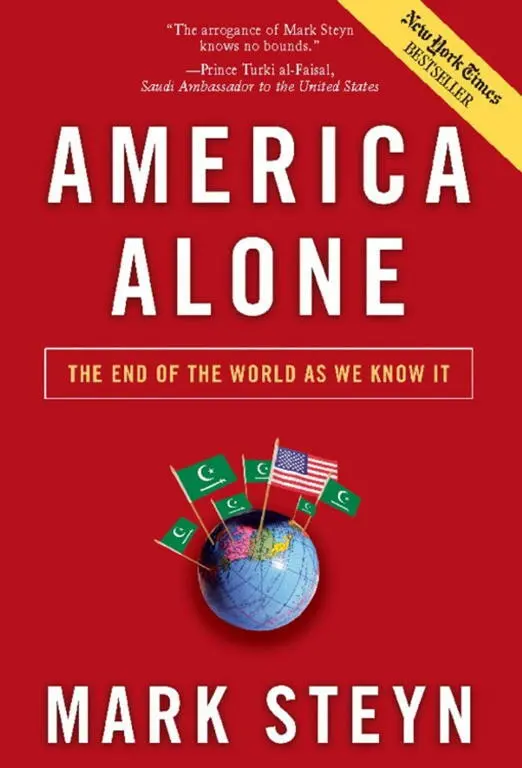
- Название:America Alone
- Автор:
- Издательство:Regnery Publishing
- Жанр:
- Год:2006
- Город:Washington, D.C.
- ISBN:978-0895260789
- Рейтинг книги:5 / 5. Голосов: 1
-
Избранное:Добавить в избранное
- Отзывы:
-
Ваша оценка:
America Alone: краткое содержание, описание и аннотация
Предлагаем к чтению аннотацию, описание, краткое содержание или предисловие (зависит от того, что написал сам автор книги «America Alone»). Если вы не нашли необходимую информацию о книге — напишите в комментариях, мы постараемся отыскать её.
It’s the end of the world as we know it…
Someday soon, you might wake up to the call to prayer from a muezzin. Europeans already are. And liberals will still tell you that “diversity is our strength” — while Talibanic enforcers cruise Greenwich Village burning books and barber shops, the Supreme Court decides sharia law doesn’t violate the “separation of church and state,” and the Hollywood Left decides to give up on gay rights in favor of the much safer charms of polygamy. If you think this can’t happen, you haven’t been paying attention, as the hilarious, provocative, and brilliant Mark Steyn — the most popular conservative columnist in the English-speaking world — shows to devastating effect. The future, as Steyn shows, belongs to the fecund and the confident. And the Islamists are both, while the West is looking ever more like the ruins of a civilization. But America can survive, prosper, and defend its freedom only if it continues to believe in itself, in the sturdier virtues of self-reliance (not government), in the centrality of family, and in the conviction that our country really is the world’s last best hope. Mark Steyn’s
is laugh-out-loud funny — but it will also change the way you look at the world.
[May contain tables.]
From the inside flap
America Alone — читать онлайн бесплатно полную книгу (весь текст) целиком
Ниже представлен текст книги, разбитый по страницам. Система сохранения места последней прочитанной страницы, позволяет с удобством читать онлайн бесплатно книгу «America Alone», без необходимости каждый раз заново искать на чём Вы остановились. Поставьте закладку, и сможете в любой момент перейти на страницу, на которой закончили чтение.
Интервал:
Закладка:
“My heart has turned into a sad block of pain. One day I will buy a weapon and I will blow away the fetters. I will propel my living-dead body into your arms…. ” The famously “moderate” mullah Yusuf al-Qaradawi, the favorite imam of London mayor Ken Livingstone, was invited to speak at the 2004 “Our Children Our Future” conference sponsored and funded by the Metropolitan Police and Britain’s Department for Work and Pensions. When it comes to children and their future, Imam al-Qaradawi certainly has it all mapped out: “Israelis might have nuclear bombs but we have the children bomb and these human bombs must continue until liberation. ”
Thank heaven for little girls; they blow up in the most delightful way. We are not dealing with “enemies” like the Soviets, or “terrorists” like the IRA. We are a long way from the common humanity that bound those German and British soldiers at Christmas Eve 1914. Try to imagine what a jihadist feels when he looks at a Russian schoolchild or an Israeli diner or a British contractor or an American pacifist. Now try to imagine how he’d feel if asked to participate in a nuclear plot, and to kill vastly greater numbers of Russians and Israelis and Britons and Americans. That moment is now upon us. Or as the Daily Telegraph in London reported in 2006:
“Iran’s hard-line spiritual leaders have issued an unprecedented new fatwa, or holy order, sanctioning the use of atomic weapons against its enemies.”
Well, there’s a surprise.
WHAT PART OF “KNOW” DON’T WE UNDERSTAND?
In 2003, Donald Rumsfeld made a much quoted rumination. “Reports that say that something hasn’t happened are always interesting to me,” the defense secretary began,
“because, as we know, there are known knowns; there are things we know we know. We also know there are known unknowns; that is to say we know there are some things we do not know. But there are also unknown unknowns — the ones we don’t know we don’t know.” A lot of people jeered at Rummy. The witless twits at Britain’s Plain English Campaign gave him that year’s award for the worst use of English. But Rumsfeld is perhaps the best speaker of Plain English in English-speaking politics, and it would be a less despised profession if there were more like him. His little riff about known knowns, known unknowns, and unknown unknowns is in fact a brilliant distillation of the dangers we face. Let’s take an example close to the heart of arrogant Texas cowboys: John Wayne is holed up in an old prospector’s shack. He peeks over the sill and drawls, “It’s quiet out there. Too quiet.”
What he means is that he knows the things he doesn’t know. He doesn’t know the precise location of the bad guys, but he knows they’re out there somewhere, inching through the dust, perhaps trying to get to the large cactus from behind which they can get a clean shot at him. Thus he knows what to be on the lookout for: he is living in a world of known unknowns. But suppose, while he was scanning the horizon for a black hat or the glint of a revolver, a passenger jet suddenly ploughed into the shack. That would be one of Rumsfeld’s unknown unknowns: something poor John Wayne didn’t know he didn’t know — until it hit him.
That’s how most of the world reacted to September 11: we didn’t know this was one of the things we didn’t know. For most people in the developed world, terrorism meant detonating bombs in shopping streets, railway stations, and park bandstands — killing a couple dozen, maiming another thirty, tops. As Thomas Friedman wrote in the New York Times:
“The failure to prevent September 11 was not a failure of intelligence or co-ordination. It was a failure of imagination.”
In other words, it was an unknown unknown: we didn’t know enough to be alert for the things we didn’t know.
There’s a legitimate disagreement about that. Given al Qaeda’s stated ambitions, given its previous targeting of the World Trade Center, given the number of young Arab men taking flight lessons in America, one can make the case that September 11 should have been a known unknown — one of those things we ought to have been scanning the horizon for. Friedman insists that “even if all the raw intelligence signals had been shared among the FBI, the CIA, and the White House, I’m convinced that there was no one there who would have put them all together, who, would have imagined evil on the scale Osama bin Laden did.” For the sake of argument, concede that. After all, the Cold War was a half century of very well-known unknowns. We didn’t know the precise timing or specifics of what would happen, but we knew the rough shape — a mushroom cloud — so well that, from Dr. Strangelove on, the known unknowns generated the most numbingly homogeneous body of predictive fiction ever seen.
It’s trickier now. This is an age of unknown unknowns. If you’ve ever been at an airport counter buying a ticket when the computer goes down and the clerk explains that he can’t do anything until the system’s back up, you’ll know that blank look on his face as he sits and waits and sits and waits, an able-bodied man effectively disabled. It wasn’t like that if you were at the desk buying your ticket in 1937. He tore the stub off the book in his cash drawer and that was that. Today our system has a million points of vulnerability. Some of those are known unknowns — some type of terrorist-sparked electromagnetic pulse that wipes out every bank account in the United States and Canada and crashes the financial markets. We know some of the other things we don’t know — who North Korea’s been pitching its wares to, where the missing Soviet nuke materials have gone walkabout, who else has the kind of “explosive socks” found by Scotland Yard in 2003 — but we have no real idea in what combination these states and groups and technology and footwear might impress themselves on us, or what other links in the chain there might be. And we might not know until we switch on the TV and the screen’s full of smoke again, but this time it’s May 7 in Frankfurt, or February 3 in Vancouver, or October 22 in Dallas. Or we might not be able to switch on the TV at all, because the unknown unknown is a variation of technological catastrophe we haven’t imagined.
Yet what we’re confronted with in Iran are known knowns: a state that’s developing nuclear weapons, a state that’s made repeated threats to use such weapons against a neighboring state, a state with a long track record of terrorist sponsorship, a state whose actions align with its rhetoric very precisely. What’s not to know?
So the question is: will they do it?
And the minute you have to ask the question you know the answer.
It’s the same answer to the same question: Will they go ahead and slaughter the Beslan schoolchildren? Will they decapitate the bumbling Englishman? Will they kill the Iraqi aid worker and the American “Christian peacemaker” In 1993 a Hezbollah suicide bomber killed twenty-nine people and injured hundreds more in an attack on the Israeli embassy in Argentina. The following year, the Argentine Israel Mutual Association was bombed in Buenos Aires. Nearly a hundred people died and 250 were injured — the worst massacre of Jewish civilians since the Holocaust. An Argentine court eventually issued warrants for two Iranian diplomats and two former cabinet ministers. The chief perpetrator had flown from Lebanon a few days earlier and entered Latin America through the porous “tri-border” region of Argentina, Brazil, and Paraguay. Suppose Iran had had a “dirty nuke” shipped to Hezbollah, or even the full-blown thing: Would it have been any less easy to get it into the country? And if a significant chunk of downtown Buenos Aires were rendered uninhabitable, what would the Argentine government do? Iran can project itself to South America effortlessly, but Argentina can’t project itself to the Middle East at all. It can’t nuke Tehran, and it can’t attack Iran in conventional ways.
Читать дальшеИнтервал:
Закладка:
Похожие книги на «America Alone»
Представляем Вашему вниманию похожие книги на «America Alone» списком для выбора. Мы отобрали схожую по названию и смыслу литературу в надежде предоставить читателям больше вариантов отыскать новые, интересные, ещё непрочитанные произведения.







Обсуждение, отзывы о книге «America Alone» и просто собственные мнения читателей. Оставьте ваши комментарии, напишите, что Вы думаете о произведении, его смысле или главных героях. Укажите что конкретно понравилось, а что нет, и почему Вы так считаете.