Mark Steyn - America Alone
Здесь есть возможность читать онлайн «Mark Steyn - America Alone» весь текст электронной книги совершенно бесплатно (целиком полную версию без сокращений). В некоторых случаях можно слушать аудио, скачать через торрент в формате fb2 и присутствует краткое содержание. Город: Washington, D.C., Год выпуска: 2006, ISBN: 2006, Издательство: Regnery Publishing, Жанр: Публицистика, Политика, на английском языке. Описание произведения, (предисловие) а так же отзывы посетителей доступны на портале библиотеки ЛибКат.
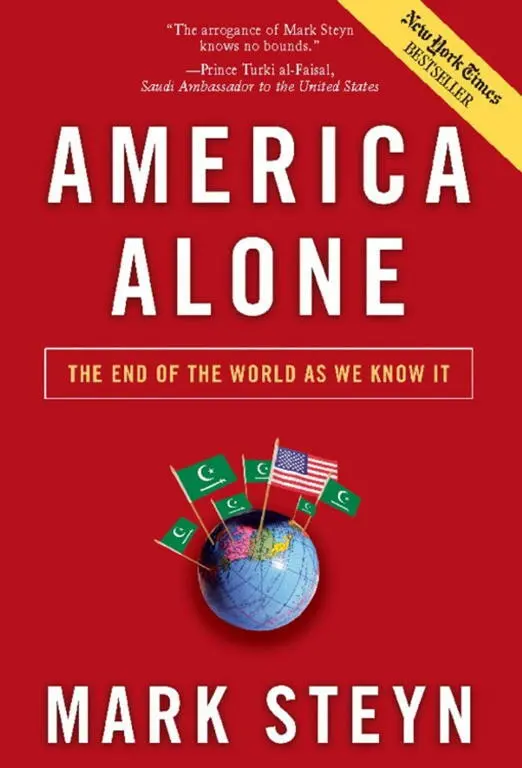
- Название:America Alone
- Автор:
- Издательство:Regnery Publishing
- Жанр:
- Год:2006
- Город:Washington, D.C.
- ISBN:978-0895260789
- Рейтинг книги:5 / 5. Голосов: 1
-
Избранное:Добавить в избранное
- Отзывы:
-
Ваша оценка:
America Alone: краткое содержание, описание и аннотация
Предлагаем к чтению аннотацию, описание, краткое содержание или предисловие (зависит от того, что написал сам автор книги «America Alone»). Если вы не нашли необходимую информацию о книге — напишите в комментариях, мы постараемся отыскать её.
It’s the end of the world as we know it…
Someday soon, you might wake up to the call to prayer from a muezzin. Europeans already are. And liberals will still tell you that “diversity is our strength” — while Talibanic enforcers cruise Greenwich Village burning books and barber shops, the Supreme Court decides sharia law doesn’t violate the “separation of church and state,” and the Hollywood Left decides to give up on gay rights in favor of the much safer charms of polygamy. If you think this can’t happen, you haven’t been paying attention, as the hilarious, provocative, and brilliant Mark Steyn — the most popular conservative columnist in the English-speaking world — shows to devastating effect. The future, as Steyn shows, belongs to the fecund and the confident. And the Islamists are both, while the West is looking ever more like the ruins of a civilization. But America can survive, prosper, and defend its freedom only if it continues to believe in itself, in the sturdier virtues of self-reliance (not government), in the centrality of family, and in the conviction that our country really is the world’s last best hope. Mark Steyn’s
is laugh-out-loud funny — but it will also change the way you look at the world.
[May contain tables.]
From the inside flap
America Alone — читать онлайн бесплатно полную книгу (весь текст) целиком
Ниже представлен текст книги, разбитый по страницам. Система сохранения места последней прочитанной страницы, позволяет с удобством читать онлайн бесплатно книгу «America Alone», без необходимости каждый раз заново искать на чём Вы остановились. Поставьте закладку, и сможете в любой момент перейти на страницу, на которой закончили чтение.
Интервал:
Закладка:
Rich Lowry, the editor of National Review, wasn’t impressed by this notion. “The line seems pretty clear,” he said. “Developing mass commercial aviation and soaring skyscrapers was the West’s idea; slashing the throats of stewardesses and flying the planes into the skyscrapers was radical Islam’s idea.”
True. But, as a form of cross-civilization intertwining, that’s not to be disdained, at least from one party’s point of view. Indeed, Mr. Lowry has identified the only “interconnectedness” a significant chunk of Islam is interested in. Islamism is a twenty-firstcentury political project driven by seventh-century ideology. That’s a potent combination of ancient and modern. In Europe and North America, incendiary imams — uneducated and knowing barely a word of the language spoken by the society in which they live — have nevertheless done a grand job at re-primitivizing second-and third-generation Western Muslims. Not all of them, of course, but how many does it have to be to become a problem?
There are three strategies Islam deploys against a dying West: first, demography; second, conversion; and third, the murky “intertwining” of modern technology and ancient hatreds. For example, I hadn’t really followed Sudanese current events closely since, oh, General Kitchener’s victory at the Battle of Omdurman in 1898, but in 2003 a story from that benighted land happened to catch my eye. In the fall of that year mass hysteria apparently swept the capital city, Khartoum, after reports that foreigners were shaking hands with Sudanese men and causing their penises to disappear. One victim, a fabric merchant, told his story to the London Arabic newspaper Al-Quds Al-Arabi: a man from West Africa came into the shop and “shook the store owner’s hand powerfully until the owner felt his penis melt into his body.”
I know the feeling. The same thing happened to me after shaking hands with Senator Clinton. Anyway, as Al-Quds reported, “The store owner became hysterical, and was taken to the hospital.” The country’s chief criminal attorney general, Yasser Ahmad Muhammad, told the Sudanese daily Al-Rai Al-A’am that “the rumor broke out when one merchant went to another merchant to buy some Karkady [a Sudanese beverage]. Suddenly, the seller felt his penis shriveling.” The invaluable Middle East Media Research Institute, in its exhaustive coverage, noted that the penises of Khartoum were vulnerable not merely to handshaking:
“Another victim, who refused to give his name, said that while he was at the market, a man approached him, gave him a comb, and asked him to comb his hair. When he did so, within seconds, he said, he felt a strange sensation and discovered that he had lost his penis.” Tales of the vanishing penises ran rampant through the city. Sudan’s attorney general, Salah Abu Zayed, declared that all complaints about missing dangly bits would be brought before a special investigative committee, though doctors had determined that the first plaintiff was “perfectly healthy.” The health minister, Ahmad Bilal Othman, said that the epidemic was “scientifically groundless,” and that it was “sorcery, magic, or an emotional problem.”
Whatever it is, it’s the perfect tale of Islamic victimhood: the foreigners have made us impotent! It doesn’t matter that the foreigners didn’t do anything except shake hands. It doesn’t matter whether you are, in fact, impotent. You feel impotent, just as (so we’re told constantly) millions of Muslims from Algerian Islamists to the Bali bombers on the other side of the world feel “humiliated” by the Palestinian situation. Whether there is a rational basis for their sense of humiliation or impotence is irrelevant.
But here’s the telling detail: the vanishing-penis hysteria was spread by cell phones and text messaging.
Think about that: you can own a cell phone, yet still believe that shaking hands with an infidel will cause you to lose your penis. That’s a state-of-the-art primitive. Aside from its doubts in its collective manhood, Sudan is no laughing matter. Two million people were slaughtered there in the nineties. That’s one-third of the victims of the Holocaust — and the world barely noticed. So much for “never again.” The Christian minority is vanishing a lot faster than that fabric merchant’s privates. Among the, er, nonChristian majority, Osama certainly found the country fertile ground for his ideology: Sudanese mujahideen have been captured as far afield as Algeria, Bosnia, Chechnya, and Afghanistan. Sudan is an economic basket case with a 27 percent literacy rate that nevertheless has managed to find enough spare cash to export revolutionary Islam to many other countries. And they’ve got half a billion dollars’ worth of top Chinese weaponry imported via Iran. What else might Sudan get from Tehran in the years ahead? In April 2006, Iran’s Supreme Leader, Ayatollah Khamenei, announced that his government was ready to share its nuclear technology with other interested parties. “Iran’s nuclear capability is one example of various scientific capabilities in the country,” said the ayatollah. “The Islamic Republic of Iran is prepared to transfer the experience, knowledge, and technology of its scientists.” He made this offer at a meeting with the president of Sudan, Omar al-Bashir. A handshake-fearing guy with a cell phone is one thing; what happens when the handshake-fearers have cell phones and a suitcase nuke? It’s at the meeting of apparently indestructible ancient ignorance and cheap, widely available modern technology that the dark imponderables of the future lie.
How far does that techno-primitive hybrid reach? In 2004, there was another story about cell phones in the paper. Not Khartoum this time. The Times of London reported that “mobile phones are being used by young Muslims living in Britain to watch videos of hostages being beheaded by militants in Iraq.” “This is the best use of this phone,” the paper was told by “an Algerian in his thirties who has lived in London for almost ten years” and has collected the entire set of snuff videos on his cell. “Most of the people in this country are using it to download pictures of naked women. For us the jihad is alive in our hands as we watch American infidels get their heads chopped off…. Within a few minutes of the Americans dying last week I was watching them on my phone. The Englishman should not have been there,” he added, referring to then hostage Ken Bigley. “He will be beheaded and I can tell you I will see it here on my phone.”
He was and that Muslim Londoner undoubtedly did.
In 1898, after Kitchener slaughtered the dervishes at Omdurman, Hilaire Belloc wrote a characteristically pithy summation of the British technological advantage:
Whatever happens
We have got
The Maxim gun
And they have not.
But the dervishes have cell phones now, and there are plenty of people out there willing to help them get cheap knock-offs of the twenty-first century’s Maxim gun. And, Maxim guns aside, we’re bound by “maxims of prudence” (in Kant’s phrase), and they’re not. As Lee Harris wrote, “The liberal world system has collapsed internally.” We no longer know the limits of behavior. When the president of Iran threatens to wipe Israel off the face of the map, we cannot reliably assure ourselves that this is just a bit of rhetorical red meat, a little playing to the gallery for the Saturday-night jihad crowd.
Nonetheless, many foolish experts do. We persist in seeing Iran’s President Ahmadinejad as the equivalent of the Sudanese crazy raving about his vanished manhood, except that in this case he’s raving about having No Dong, which, like a nuclear K-Mart, Kim Jong-il is happily dispersing around the planet. (One could foresee certain problems if the president of Sudan goes on TV and announces, “I am proud to tell the people I have No Dong.” Oh no-the epidemic’s spread to the palace! Mass panic, etc.) Confronted by the minimal degrees of separation between the loonies and many of their leaders, we look away and pretend that President Ahmadinejad is no different from the Politburo of yore. The Reds could have nuked us but they had compelling reasons not to. They had the capability but we were able to make a rational assessment of their intent by considering what we would do in their situation. It’s the other way around with Iran. They have the intent and the only question mark is over their capability.
Читать дальшеИнтервал:
Закладка:
Похожие книги на «America Alone»
Представляем Вашему вниманию похожие книги на «America Alone» списком для выбора. Мы отобрали схожую по названию и смыслу литературу в надежде предоставить читателям больше вариантов отыскать новые, интересные, ещё непрочитанные произведения.









Обсуждение, отзывы о книге «America Alone» и просто собственные мнения читателей. Оставьте ваши комментарии, напишите, что Вы думаете о произведении, его смысле или главных героях. Укажите что конкретно понравилось, а что нет, и почему Вы так считаете.