Mark Steyn - America Alone
Здесь есть возможность читать онлайн «Mark Steyn - America Alone» весь текст электронной книги совершенно бесплатно (целиком полную версию без сокращений). В некоторых случаях можно слушать аудио, скачать через торрент в формате fb2 и присутствует краткое содержание. Город: Washington, D.C., Год выпуска: 2006, ISBN: 2006, Издательство: Regnery Publishing, Жанр: Публицистика, Политика, на английском языке. Описание произведения, (предисловие) а так же отзывы посетителей доступны на портале библиотеки ЛибКат.
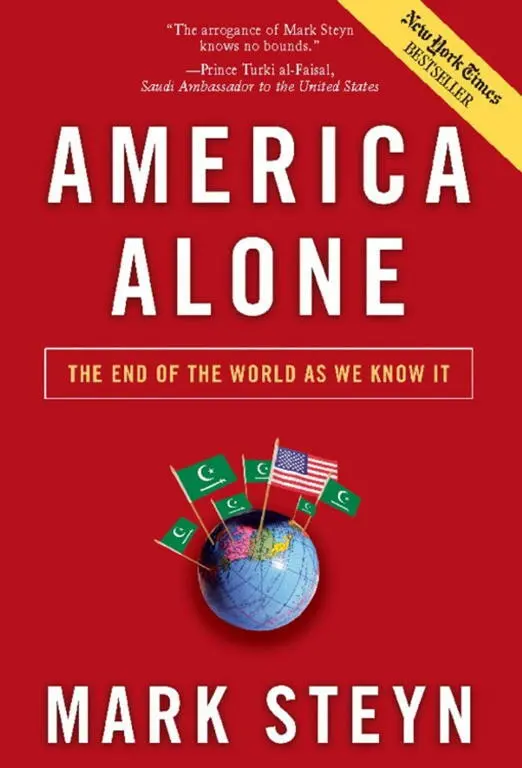
- Название:America Alone
- Автор:
- Издательство:Regnery Publishing
- Жанр:
- Год:2006
- Город:Washington, D.C.
- ISBN:978-0895260789
- Рейтинг книги:5 / 5. Голосов: 1
-
Избранное:Добавить в избранное
- Отзывы:
-
Ваша оценка:
America Alone: краткое содержание, описание и аннотация
Предлагаем к чтению аннотацию, описание, краткое содержание или предисловие (зависит от того, что написал сам автор книги «America Alone»). Если вы не нашли необходимую информацию о книге — напишите в комментариях, мы постараемся отыскать её.
It’s the end of the world as we know it…
Someday soon, you might wake up to the call to prayer from a muezzin. Europeans already are. And liberals will still tell you that “diversity is our strength” — while Talibanic enforcers cruise Greenwich Village burning books and barber shops, the Supreme Court decides sharia law doesn’t violate the “separation of church and state,” and the Hollywood Left decides to give up on gay rights in favor of the much safer charms of polygamy. If you think this can’t happen, you haven’t been paying attention, as the hilarious, provocative, and brilliant Mark Steyn — the most popular conservative columnist in the English-speaking world — shows to devastating effect. The future, as Steyn shows, belongs to the fecund and the confident. And the Islamists are both, while the West is looking ever more like the ruins of a civilization. But America can survive, prosper, and defend its freedom only if it continues to believe in itself, in the sturdier virtues of self-reliance (not government), in the centrality of family, and in the conviction that our country really is the world’s last best hope. Mark Steyn’s
is laugh-out-loud funny — but it will also change the way you look at the world.
[May contain tables.]
From the inside flap
America Alone — читать онлайн бесплатно полную книгу (весь текст) целиком
Ниже представлен текст книги, разбитый по страницам. Система сохранения места последней прочитанной страницы, позволяет с удобством читать онлайн бесплатно книгу «America Alone», без необходимости каждый раз заново искать на чём Вы остановились. Поставьте закладку, и сможете в любой момент перейти на страницу, на которой закончили чтение.
Интервал:
Закладка:
Poitiers was the high-water point of the Muslim tide in Western Europe. It was an opportunistic raid by the Moors, but if they’d won, they’d have found it hard to resist pushing on to Paris, to the Rhine and beyond. “Perhaps,” wrote Edward Gibbon in The Decline and Fall of the Roman Empire, “the interpretation of the Koran would now be taught in the schools of Oxford, and her pulpits might demonstrate to a circumcised people the sanctity and truth of the revelation of Mahomet.” There would be no Christian Europe. The Anglo-Celts who settled North America would have been Muslim. Poitiers, said Gibbon, was “an encounter which would change the history of the whole world.” Battles are very straightforward: Side A wins, Side B loses. But Europe is way beyond anything so clarifying. Today, a fearless Muslim advance has penetrated far deeper into Europe than Abd al-Rahman. They’re in Brussels, where Belgian police officers are advised not to be seen drinking coffee in public during Ramadan, and in Malmo, where Swedish ambulance drivers will not go without police escort. It’s way too late to re-run the Battle of Poitiers. When Martine Aubry, the mayor of Lille, daughter of former prime minister and EU bigwig Jacques Delors and likely presidential candidate in the post-Chirac era, held a meeting with an imam in Roubaix, the gentleman demanded that it take place on the edge of the neighborhood — in recognition that his turf was Muslim territory which she was bound not to enter. Mme. Aubry conceded the point, as more and more politicians will in the years ahead.
The peoples of Europe may not be willing to go as far down the appeasement path as their rulers, but Europe is a top-down construct, so the rulers will get quite a long way down before the masses start to drag them back. One observes, for example, that brave figures who draw attention to these trends — men and women such as Theo van Gogh, Bat Ye’or, and Oriana Fallaci — are either murdered, forced to live under armed guard, driven into exile overseas, or sued under specious hate-crimes laws. Dismissed by the European establishment, they’re banished to the fringe. Ayaan Hirsi Ali, the Somali-born Dutch parliamentarian, spoke out against the ill-treatment of Muslim women, a subject she knows about firsthand, and found herself under threat of death. Her neighbors, the justice system, and the Dutch government reacted to this by taking her to court, getting her evicted from her home, and announcing plans to revoke her citizenship. Boundlessly tolerant Europe, which finds it so hard to expel openly treasonous jihad-inciting imams, finally found one Muslim it’s willing to kick out.
Meanwhile, the complaceniks hold down prestigious chairs at European universities and think tanks and assure us there’s no problem. Timothy Garton Ash is an Oxford professor who directs its European Studies Center, the sort of chap National Public Radio calls in when they need an “expert” on the EU. Very reasonable fellow, so reasonable that in 2003
he was attacking yours truly in every leading European newspaper for promoting “anti-Europeanism in the United States.” Yet after scoffing at my Euro-predictions for many years, he seems to have accepted them. The only difference between us is that he thinks it’s a good thing:
The populations of Europe are aging fast, so more immigrants will be needed to support the pensioners, and these will largely be Muslim immigrants. For this increasingly Muslim Europe to define itself against Islam would be ridiculous and suicidal…. Let’s imagine, for a moment, Europe in 2025 at its possible best. A political, economic, and security community of some forty free countries and 650 million people, embracing all the lands in which the two world wars began, and producing, still, a large part of the wealth of the world. A further 650 million people, born in the most explosive parts of the early twenty-first-century globe, but now living in a great arc of partnership with this European Union, from Marrakesh, via Cairo, Jerusalem, Baghdad, and Tbilisi, all the way to Vladivostok. That would not be nothing.
No, indeed. It would certainly be something, but quite what he declines to say. And that’s what Garton Ash sees as the Continent’s “possible best” — a giant Euro-Muslim “arc of partnership.” Faced with a choice between correcting course or drifting irrevocably into Eurabia, Garton Ash has chosen consciously to embrace the latter. He will not be the last. And so those Continental demographic trends will accelerate, as they did during the decline of the Roman Empire, when the imperial capital’s population fell at one point as low as five hundred. Some French natives will figure they don’t have the stomach for the fight and opt for retirement elsewhere. The ones who don’t will increasingly be drawn down the old road to the neo-nationalist strongmen promising to solve the problem. That’s why I call it the Eurabian civil war. The de Villepin-Chiraquiste tendency will be to accommodate and capitulate, but an unreconstructed minority will not be so obliging and will eventually act. Meanwhile, it will be the Muslims who develop a pan-European identity, if only because many have no particular attachment to France or Belgium or Denmark, and they’ll quickly grasp that cross-border parties and lobby groups will further enhance their status. The European Union’s already the walking dead, but the Eurabian Union might well be a runner. If Chirac, de Villepin, and Co. aren’t exactly Charles Martel, the rioters aren’t doing a bad impression of the Muslim armies of thirteen centuries ago. They’re seizing their opportunities, testing their foe, probing his weak spots. If burning the ’burbs gets you more “respect,” they’ll burn ’em again and again. In defiance of traditional immigration patterns, these young men are less assimilated than their grandparents. And why should they be? On present demographic trends, it will be for ethnic Europeans to assimilate with them. In City Journal, Theodore Dalrymple concluded a piece on British suicide bombers with this grim summation of the new Europe: “The sweet dream of universal cultural compatibility has been replaced by the nightmare of permanent conflict.”
Which sounds an awful lot like a new Dark Ages — or the future implicit in Cardinal Ratzinger’s choice of name for his papacy: Benedict XVI. Born in Umbria in 480, St. Benedict was the man who ensured during the Dark Ages that the critical elements of Roman and Greek civilization were preserved and that, by infusing them with Christianity, they would emerge in a new and stronger form: the basis for Europe and Western Civilization. Referring to his namesake, Pope Benedict XVI once quoted a Benedictine motto: “Succisa virescit.” Pruned, it grows again.
That may prove true for Christianity: it’s a growing faith in Africa and China, and could yet be so again in Europe. Whether there will be any Spaniards or Italians left to re-enlist is more questionable. In the course of the twenty-first century, Germany’s population will fall by over 50 percent to some thirty-eight million or lower — killed not by disease or war but by the Eutopia to which the German people are wedded. And every time they’re asked to vote on the issue they decide that, like that Frenchman, they can live with the stench of death as long as the state benefits keep coming. The trouble with the social-democratic state is that, when government does too much, nobody else does much of anything.
After September 11, I wondered rhetorically midway through a column what we in the West are prepared to die for, and got a convoluted e-mail back from a French professor explaining that the fact that Europeans weren’t prepared to die for anything was the best evidence of their superiority: they were building a post-historical utopia — a Europe it would not be necessary to die for.
Читать дальшеИнтервал:
Закладка:
Похожие книги на «America Alone»
Представляем Вашему вниманию похожие книги на «America Alone» списком для выбора. Мы отобрали схожую по названию и смыслу литературу в надежде предоставить читателям больше вариантов отыскать новые, интересные, ещё непрочитанные произведения.










Обсуждение, отзывы о книге «America Alone» и просто собственные мнения читателей. Оставьте ваши комментарии, напишите, что Вы думаете о произведении, его смысле или главных героях. Укажите что конкретно понравилось, а что нет, и почему Вы так считаете.