Mark Steyn - America Alone
Здесь есть возможность читать онлайн «Mark Steyn - America Alone» весь текст электронной книги совершенно бесплатно (целиком полную версию без сокращений). В некоторых случаях можно слушать аудио, скачать через торрент в формате fb2 и присутствует краткое содержание. Город: Washington, D.C., Год выпуска: 2006, ISBN: 2006, Издательство: Regnery Publishing, Жанр: Публицистика, Политика, на английском языке. Описание произведения, (предисловие) а так же отзывы посетителей доступны на портале библиотеки ЛибКат.
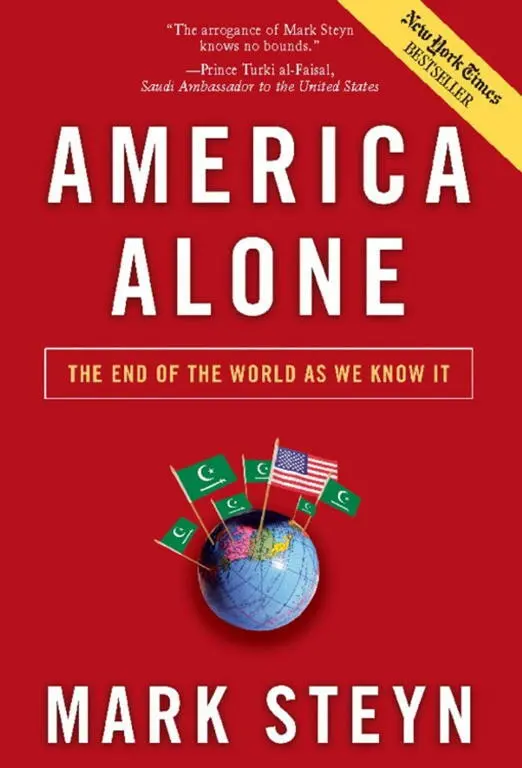
- Название:America Alone
- Автор:
- Издательство:Regnery Publishing
- Жанр:
- Год:2006
- Город:Washington, D.C.
- ISBN:978-0895260789
- Рейтинг книги:5 / 5. Голосов: 1
-
Избранное:Добавить в избранное
- Отзывы:
-
Ваша оценка:
America Alone: краткое содержание, описание и аннотация
Предлагаем к чтению аннотацию, описание, краткое содержание или предисловие (зависит от того, что написал сам автор книги «America Alone»). Если вы не нашли необходимую информацию о книге — напишите в комментариях, мы постараемся отыскать её.
It’s the end of the world as we know it…
Someday soon, you might wake up to the call to prayer from a muezzin. Europeans already are. And liberals will still tell you that “diversity is our strength” — while Talibanic enforcers cruise Greenwich Village burning books and barber shops, the Supreme Court decides sharia law doesn’t violate the “separation of church and state,” and the Hollywood Left decides to give up on gay rights in favor of the much safer charms of polygamy. If you think this can’t happen, you haven’t been paying attention, as the hilarious, provocative, and brilliant Mark Steyn — the most popular conservative columnist in the English-speaking world — shows to devastating effect. The future, as Steyn shows, belongs to the fecund and the confident. And the Islamists are both, while the West is looking ever more like the ruins of a civilization. But America can survive, prosper, and defend its freedom only if it continues to believe in itself, in the sturdier virtues of self-reliance (not government), in the centrality of family, and in the conviction that our country really is the world’s last best hope. Mark Steyn’s
is laugh-out-loud funny — but it will also change the way you look at the world.
[May contain tables.]
From the inside flap
America Alone — читать онлайн бесплатно полную книгу (весь текст) целиком
Ниже представлен текст книги, разбитый по страницам. Система сохранения места последней прочитанной страницы, позволяет с удобством читать онлайн бесплатно книгу «America Alone», без необходимости каждый раз заново искать на чём Вы остановились. Поставьте закладку, и сможете в любой момент перейти на страницу, на которой закончили чтение.
Интервал:
Закладка:
But the central fact of a new Dark Ages is this: it would be not a world in which the American superpower is succeeded by other powers but a world with no dominant powers at all. Today, lots of experts crank out analyses positing China as the unstoppable hegemon of the twenty-first century. Yet the real threat is not the strengths of your enemies but their weaknesses. China is a weak power: its demographic and other structural defects are already hobbling its long-term ambitions. Russia is a weak power, a kind of greatest-hits medley of all the planet’s worst pathologies — disease-wise, nuke-wise, Islamist-wise. Europe is a weak power, a supposed Greater France remorselessly evolving month by month into Greater Bosnia.
Islam is a weak power: in the words of Dr. Mahathir bin Mohammed, the former prime minister of Malaysia, one of the least worst Muslim nations in the world, “We produce practically nothing on our own, we can do almost nothing for ourselves, we cannot even manage our wealth.” Yet in Iran they’re working full-speed on nukes that will be able to hit every European city.
North Korea is the weakest power of all. But on the Fourth of July 2006 its dictator gamely got in the spirit and held a fireworks display. Impressive stuff: the rockets’ red glare, the bombs bursting in air — though, as sometimes happens with your highest-price firecracker, it was over sooner than expected. Kim Jong-il has No Dong. Please, no giggling. It’s not a side effect of that counterfeit Viagra that North Korea manufactures (seriously). No Dong is the name of his missile system. “Dong” is Korean for “dong,” and “no” is Korean for “big swinging,” and that’s how Kim Jong-il sees himself on the freelance nuke scene. Anyway, on the Glorious Fourth, he decided to test the latest version of his No Dong. That’s a “test” in the sense that I test my new shotgun by firing it through your kitchen window and seeing if it penetrates to the living room. Kim’s Dong went up and came straight down again forty seconds later. From the trajectory, experts calculated that it was headed to Hawaii. Instead, it fell in the Sea of Japan.
And everyone had a big laugh. What a loser, what a bozo. Mister Nukes R Us talks the talk but he can’t nuke the nuke. Ha ha, what a joke.
But no, that’s the point. That’s why he’s dangerous. He’s not the United States, not the Soviet Union, not India, he’s not even France. He’s an incompetent but he’s got nuclear weapons. In 2006, he aimed for Hawaii and just about cleared his perimeter fence. Next time, he might aim for Hawaii and hit San Diego. Or Oakland. Or Calgary, or Presque Isle, Maine. Or Beijing, Addis Ababa, Salzburg, or Dublin. He’s a self-taught nuclear madman and he hasn’t quite gotten the hang of it. If you’re on the New Jersey Turnpike and there’s a confused ninety-three-year-old granny behind the wheel of a Toyota Corolla, that’s mostly a problem for her. If she’s in an eighteen-wheeler and coming across the median, that’s a problem for you. North Korea has millions of starving people; it has one of the lowest GDPs per capita on the planet, lower than Ghana, lower than Zimbabwe, lower than Mongolia.
But it’s a nuclear power.
The danger we face is not a Chinese superpower or an Islamist superpower: if there’s a new boss, you learn the new rules and adjust as best you can. But the greater likelihood is of a world with no superpower at all, in which unipolar geopolitics gives way to non-polar geopolitics, a world without order in which pipsqueak thug states who can’t feed their own people globalize their psychoses.
Take the subject of, say, decapitation — not something most of us had given a thought to since, oh, the French Revolution. But there’s a lot of it about. In 2006, a Taliban-like Islamist regime took control of Somalia, and, in the course of their seizure of Mogadishu, captured troops from the warlords’ side and beheaded them. The so-called emir of al Qaeda in Iraq, Abu Musab al-Zarqawi, made beheading his signature act, cutting the throats of American hostage Nick Berg and British hostage Ken Bigley and then releasing the footage as boffo snuff videos over the Internet.
And it’s not just guerrillas and insurgents who are hot for decapitation. The Saudis, who are famously “our friends,” behead folks on a daily basis. In 2005, the kingdom beheaded six Somalis. What for? Murder? Rape? Homosexuality? No, it was worse than that: auto theft. They’d been convicted and served five-year sentences but at the end thereof the Saudi courts decided to upgrade their crime to a capital offense. Some two-thirds of those beheaded in Saudi Arabia are foreign nationals, which would be an unlikely criminal profile in any civilized state and suggests that the justice “system” is driven by the Saudis’ contempt for non-Saudis as much as anything else.
The decapitators are getting closer. In an Ontario courtroom in 2006, it was alleged that a terrorist cell planned to storm the Canadian parliament and behead the prime minister. On the face of it, that sounds ridiculous. As ridiculous as it must have seemed to Ken Bigley, a British contractor in Iraq with no illusions about the world. He’d spent most of his adult life grubbing around the seedier outposts of empire and thought he knew the way the native chappies did things. He never imagined the last sounds he’d ever hear were delirious cries of “Allahu Akhbar” and the man behind him reaching for the blade to saw his head off. And why would an act of such awesome symbolic power remain confined to Islamists?
A week or two after the revelation of that Toronto plot, there was a flurry of beheadings on America’s southern border: the heads of three decapitated policemen were found in the Tijuana River; a fourth turned up in Acapulco a week later. It’s wishful thinking to assume hip depravity won’t migrate beyond the Islamist world. But no doubt Al Gore will carry on talking about global warming and Nancy Pelosi about college tuition costs and Hillary Clinton about prescription drug plans as the world sinks into economic decline, arbitrary bombings and kidnappings, the occasional nuking — and a million small concessions to Muslim sensitivities that will nudge Western society ever further down a bleaker path. Writing about the collapse of nations such as Somalia, the Atlantic Monthly’s Robert D. Kaplan referred to the “citizens” of such “states” as “re-primitivized man.” When lifelong Torontonians are hot for decapitation, when Yorkshiremen born and bred into fish n’ chips and cricket and lousy English pop music self-detonate on the London Tube, it would seem that the phenomenon of “re-primitivized man” is being successfully exported around the planet.
In 1998, Thomas Friedman of the New York Times unveiled his Golden Arches theory-that no two countries with a McDonald’s franchise ever went to war. The ink was barely dry when America and NATO began bombing Serbia. So much for the civilizing effects of Big Macs in Belgrade. The Yugoslav meltdown of the nineties suggests the opposite of Friedman’s thesis. In the eighties, the federation was on its way to a comfortable, prosperous, post-Communist future: Croatia was a popular holiday destination with Britons, Germans, and other wealthy Westerners. But, invited to choose between a booming economy and ancient hatreds, the people of Yugoslavia preferred to reduce their country to rubble. How many other bits of the map, under pressure from predatory forces and with a leading power unable to lead, might opt for “re-primitivization”?
A couple of weeks after September 11, Edward Said, the New York based America disparager and author of the bestselling Orientalism, made some remarks about the “interconnectedness” of the West and Islam. The professor deplored the tendency of commentators to separate cultures into what he called “sealed-off entities,” when in reality Western Civilization and the Muslim world are so “intertwined” that it was impossible to “draw the line” between them.
Читать дальшеИнтервал:
Закладка:
Похожие книги на «America Alone»
Представляем Вашему вниманию похожие книги на «America Alone» списком для выбора. Мы отобрали схожую по названию и смыслу литературу в надежде предоставить читателям больше вариантов отыскать новые, интересные, ещё непрочитанные произведения.








Обсуждение, отзывы о книге «America Alone» и просто собственные мнения читателей. Оставьте ваши комментарии, напишите, что Вы думаете о произведении, его смысле или главных героях. Укажите что конкретно понравилось, а что нет, и почему Вы так считаете.