Mark Steyn - America Alone
Здесь есть возможность читать онлайн «Mark Steyn - America Alone» весь текст электронной книги совершенно бесплатно (целиком полную версию без сокращений). В некоторых случаях можно слушать аудио, скачать через торрент в формате fb2 и присутствует краткое содержание. Город: Washington, D.C., Год выпуска: 2006, ISBN: 2006, Издательство: Regnery Publishing, Жанр: Публицистика, Политика, на английском языке. Описание произведения, (предисловие) а так же отзывы посетителей доступны на портале библиотеки ЛибКат.
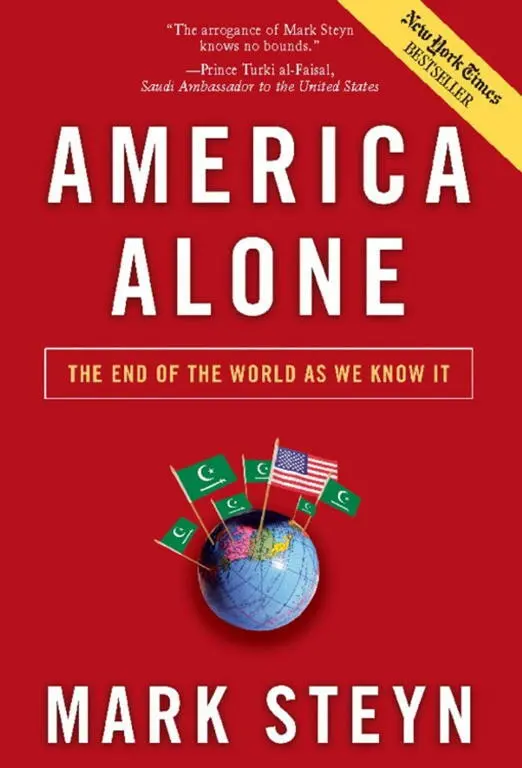
- Название:America Alone
- Автор:
- Издательство:Regnery Publishing
- Жанр:
- Год:2006
- Город:Washington, D.C.
- ISBN:978-0895260789
- Рейтинг книги:5 / 5. Голосов: 1
-
Избранное:Добавить в избранное
- Отзывы:
-
Ваша оценка:
America Alone: краткое содержание, описание и аннотация
Предлагаем к чтению аннотацию, описание, краткое содержание или предисловие (зависит от того, что написал сам автор книги «America Alone»). Если вы не нашли необходимую информацию о книге — напишите в комментариях, мы постараемся отыскать её.
It’s the end of the world as we know it…
Someday soon, you might wake up to the call to prayer from a muezzin. Europeans already are. And liberals will still tell you that “diversity is our strength” — while Talibanic enforcers cruise Greenwich Village burning books and barber shops, the Supreme Court decides sharia law doesn’t violate the “separation of church and state,” and the Hollywood Left decides to give up on gay rights in favor of the much safer charms of polygamy. If you think this can’t happen, you haven’t been paying attention, as the hilarious, provocative, and brilliant Mark Steyn — the most popular conservative columnist in the English-speaking world — shows to devastating effect. The future, as Steyn shows, belongs to the fecund and the confident. And the Islamists are both, while the West is looking ever more like the ruins of a civilization. But America can survive, prosper, and defend its freedom only if it continues to believe in itself, in the sturdier virtues of self-reliance (not government), in the centrality of family, and in the conviction that our country really is the world’s last best hope. Mark Steyn’s
is laugh-out-loud funny — but it will also change the way you look at the world.
[May contain tables.]
From the inside flap
America Alone — читать онлайн бесплатно полную книгу (весь текст) целиком
Ниже представлен текст книги, разбитый по страницам. Система сохранения места последней прочитанной страницы, позволяет с удобством читать онлайн бесплатно книгу «America Alone», без необходимости каждый раз заново искать на чём Вы остановились. Поставьте закладку, и сможете в любой момент перейти на страницу, на которой закончили чтение.
Интервал:
Закладка:
I strongly dislike that veteran-foreign-correspondent look, where you wander around like you’ve been sleeping in the back of the souk for a week. So I was wearing the same suit I’d wear in Washington or New York, from the Western Imperialist Aggressor line at Brooks Brothers. I had a sharp necktie I’d bought in London the week before. My cuff links were the most stylish in the room, and also the only ones in the room. I’m not a Sunni Triangulator, so there’s no point pretending to be one. If you’re an infidel and agent of colonialist decadence, you might as well dress the part.
So I ordered the mixed grill, which turned out to be not that mixed. Just a tough old stringy chicken. My tie would have been easier to chew. The locals watched me — a few obviously surly and resentful, the rest somewhere between wary and amused. Or so it appeared. But in cultures that are as foreign to one as a just-liberated Arab dictatorship it’s hard to say for sure. Even facial expressions don’t always mean what they seem: at times my fellow diners appeared to be grinning in another language. Still, I’ve had worse welcomes in Berkeley, so I chewed on, and, washed down with a pitcher of coliform bacteria, the unmixed grill wasn’t bad. As a parodic courtesy, me in host switched the flickering black-and-white TV from an Arabic station to the BBC, which as usual was full of doom and gloom about the quagmire.
And I gave no further thought to Fallujah until a year later, when four American contractors working in Iraq — Scott Helvenston, Wesley Batalona, Jerry Zovko, and Michael Teague — were ambushed while driving through town. They were dragged from their vehicles, shot, burned, mutilated, and what was left was dangled from a bridge over the Euphrates while the natives danced in the streets. The “insurgents” were pleased as punch, made a video of the attack, and distributed it around the world.
There’s not a lot to be said for the oh-my-God-that-could-have-been me routine. But, watching the scenes on TV, I did think back to my lunch eleven months earlier, and wondered about some of those inscrutable toothy grins at the adjoining tables. Would those fellows have liked to kill me? Well, I’ll bet one or two would have enjoyed giving it a go. And if they had, I’ll bet three or four more would have enthusiastically beaten my corpse with their shoes. And five or six would have had no particular feelings about me one way or the other but would have been generally supportive of the decision to kill me after the fact. And the rest might have had a few qualms but they would have kept quiet. So why didn’t they kill me? I’m not brave, and certainly not suicidally brave. And, if I’d known the Sunni Triangle was the most dangerous place on Earth, I wouldn’t have been there driving around on my own in some beat-up rented Nissan.
But, of course, Fallujah wasn’t dangerous in those days. Why?
Because, as Osama gloated after September 11, when people see a strong horse and a weak horse, they go with the strong horse. And in May 2003, four weeks after the fall of Baghdad, the coalition forces were indisputably the strong horse. They’d removed Saddam Hussein — the self-declared new Saladin — in nothing flat. And so, even when a dainty little trotting gelding of a touring writer comes through the door, they figure he’s with the stronghorse crowd and act accordingly. What happened within the next year was that America ceased to be perceived as a strong horse. It was a range of factors, from the West’s defeatist media to the Bush administration’s wish to be seen as, so to speak, a compassionate crusader. Nice idea. But to the Arab mindset there’s no such thing. So the compassion got read by the locals not as cultural respect but as weakness. And the quagmiritis diagnosed by the media from Day One suggested that a hyperpower of historically unprecedented dominance didn’t have the stomach for a body count that in the course of a year added up to little more than a quiet week’s internal policing for Saddam. By comparison, some four million people died in the Congo in the couple of years either side of the turn of the century — and how many books or TV investigations have you seen on that subject?
Before I got to Fallujah, on the deserted highway between the Jordanian border and the town of Rutba, I came across my first burnt-out tank. You’d see them periodically-a charred wreck blocking the lane or shoved over to the shoulder. With that first one I stopped, walked around it, and pondered the fate of the men inside. Sobering. Yet as the great strategist of armored warfare Basil Liddell Hart wrote: “The destruction of the enemy’s armed forces is but a means — and not necessarily an inevitable or infallible one — to the attainment of the real objective.”
The object of war is not to destroy the enemy’s tanks but to destroy his will. As Liddell Hart put it: “Our goal in war can only be attained by the subjugation of the opposing will…. All such acts as defeat in the field, propaganda, blockade, diplomacy, or attack on the centers of government and population are seen to be but means to that end.” America is extremely good at destroying tanks. If you make the mistake of luring the United States into a hot war — i.e., tanks, bombers, ships, etc. — you’ll lose very quickly. The Taliban did, and so did Saddam Hussein. That’s why my lunch in Fallujah required no personal courage on my part: just about the safest time to visit anywhere in the Muslim world is in the month after the United States has toppled its dictator. But an enemy folds when he knows he’s finished. In Iraq, despite the swift fall of the Saddamites, it’s not clear the enemy did know. Even during the combat phase we were playing the compassionate crusader. The Western peaceniks’ prewar “human shields” operation proved to be completely superfluous, mainly because the Anglo-American forces decided to treat not just Iraqi civilians and not just Iraqi conscripts but virtually everyone other than Saddam, Uday, and Qusay as a de facto human shield. Washington made a conscious choice to give every Iraqi the benefit of the doubt, including the fake surrenderers who ambushed the U.S. Marines at Nasiriyah. The main victims of Western squeamishness in those few weeks in the spring of 2003 turned out to be not American or coalition troops but the Iraqi civilians who two years later were providing the principal target for “insurgents.” It would have been better for them had more Baathists been killed in the initial invasion. It would have been preferable, too, if the swarm of foreign jihadi from neighboring countries had occasionally been met with the “accidental” bombing of certain targets on the Syrian side of the border. Wars fought under absurd degrees of self-imposed etiquette are the most difficult to win — see Korea and Vietnam — and one lesson of Germany and Japan is that it’s easier to rebuild totalitarian states if they’ve first been completely smashed. Colin Powell famously framed Iraq in Pottery Barn terms: you break it, you own it. But Saddam’s Baathist apparatus and other parties concluded the opposite: we didn’t have the guts to break it; therefore, we didn’t own it.
I’m not worried about Iraq. Its political class has behaved with both amazing restraint and impressive resolve: the country won’t be New Hampshire or Singapore, but it will be good enough and (even if it dissolves into three separate states) better governed than any of its neighbors. That’s fine if you live in Mosul or Basra, where the Iraq question is a question about Iraq. But, for the rest of the world, what’s at issue in the Iraq war is not the future of Iraq but the future of America. Can the world’s leading nation still lead, or is John Kerry’s Vietnam Syndrome “seared” (as he’d say) into its bones? If so, how likely is it that America can stick out the “long war”? Especially if it’s fought not in sudden swift total devastating military campaigns but in arenas where our military and technological advantage is peripheral and other factors come into play. Facing a foe who has nothing but will and manpower, do we have the strength to (in Liddell Hart’s phrase) subjugate that will? The enemy was certainly impressed by the speed with which U.S. forces raced to Baghdad. But the invasion becomes a liberation and the liberation becomes a policing operation and the further you get from that first month of hard power the more constrained the hyperpower becomes, the less willing to use any but a tiny proportion of his awesome might until in the end he’s Gulliver ensnared by more motivated Lilliputians.
Читать дальшеИнтервал:
Закладка:
Похожие книги на «America Alone»
Представляем Вашему вниманию похожие книги на «America Alone» списком для выбора. Мы отобрали схожую по названию и смыслу литературу в надежде предоставить читателям больше вариантов отыскать новые, интересные, ещё непрочитанные произведения.







Обсуждение, отзывы о книге «America Alone» и просто собственные мнения читателей. Оставьте ваши комментарии, напишите, что Вы думаете о произведении, его смысле или главных героях. Укажите что конкретно понравилось, а что нет, и почему Вы так считаете.