Mary Roach - Grunt
Здесь есть возможность читать онлайн «Mary Roach - Grunt» весь текст электронной книги совершенно бесплатно (целиком полную версию без сокращений). В некоторых случаях можно слушать аудио, скачать через торрент в формате fb2 и присутствует краткое содержание. Город: New York, Год выпуска: 2016, ISBN: 2016, Издательство: W. W. Norton, Жанр: nonf_military, sci_popular, на английском языке. Описание произведения, (предисловие) а так же отзывы посетителей доступны на портале библиотеки ЛибКат.
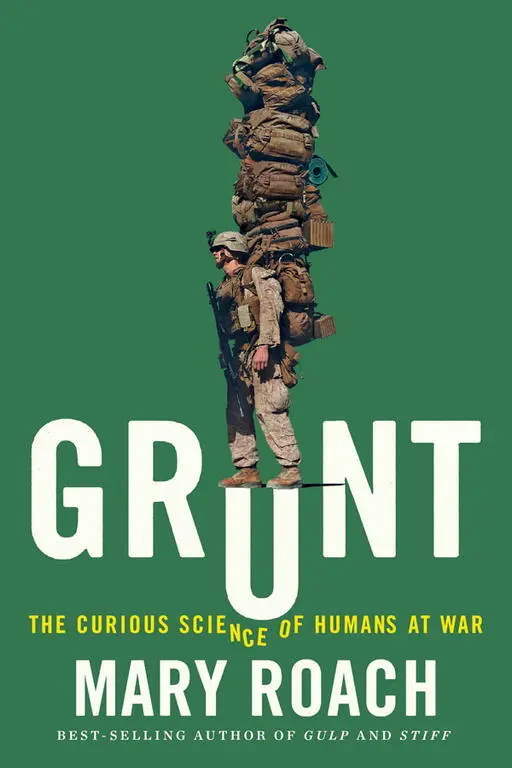
- Название:Grunt
- Автор:
- Издательство:W. W. Norton
- Жанр:
- Год:2016
- Город:New York
- ISBN:978-0-393-24544-8
- Рейтинг книги:3 / 5. Голосов: 1
-
Избранное:Добавить в избранное
- Отзывы:
-
Ваша оценка:
Grunt: краткое содержание, описание и аннотация
Предлагаем к чтению аннотацию, описание, краткое содержание или предисловие (зависит от того, что написал сам автор книги «Grunt»). Если вы не нашли необходимую информацию о книге — напишите в комментариях, мы постараемся отыскать её.
Grunt
Tennessee
An Amazon Best Book of June 2016:
Amazon.com Review It takes a special kind of writer to make topics ranging from death to our gastrointestinal tract interesting (sometimes hilariously so), and pop science writer Mary Roach is always up to the task. In her latest book,
, she explores how our soldiers combat their non-gun-wielding opponents—panic, heat exhaustion, the runs, and more. It will give you a new appreciation not only for our men and women in uniform (and by the way, one of the innumerable things you’ll learn is how and why they choose the fabric for those uniforms), but for the unsung scientist-soldiers tasked with coming up with ways to keep the “grunts” alive and well. If you are at all familiar with Roach’s oeuvre, you know her enthusiasm for her subjects is palpable and infectious. This latest offering is no exception.
—Erin Kodicek,
“A mirthful, informative peek behind the curtain of military science.” (Washington Post)
“From the ever-illuminating author of
and
comes an examination of the science behind war. Even the tiniest minutiae count on the battlefield, and Roach leads us through her discoveries in her inimitable style.” (Elle)
“Mary Roach is one of the best in the business of science writing… She takes readers on a tour of the scientists who attempt to conquer the panic, exhaustion, heat, and noise that plague modern soldiers.” (Brooklyn Magazine)
“Extremely likable … and quick with a quip…. [Roach’s] skill is to draw out the good humor and honesty of both the subjects and practitioners of these white arts among the dark arts of war.” (San Francisco Chronicle)
“Nobody does weird science quite like [Roach], and this time, she takes on war. Though all her books look at the human body in extreme situations (sex! space! death!), this isn’t simply a blood-drenched affair. Instead, Roach looks at the unexpected things that take place behind the scenes.” (Wired)
“Brilliant.” (Science)
“Roach … applies her tenacious reporting and quirky point of view to efforts by scientists to conquer some of the soldier’s worst enemies.” (Seattle Times)
“Covering these topics and more, Roach has done a fascinating job of portraying unexpected, creative sides of military science.” (New York Post)
“Having investigated sex, death, and preparing for space travel,
best-selling Roach applies her thorough—and thoroughly entertaining—techniques to the sobering subject of keeping soldiers not just alive but alert and healthy of mind and body during warfare.” (Library Journal)
“A rare literary bird, a best selling science writer … Roach avidly and impishly infiltrates the world of military science…. Roach is exuberantly and imaginatively informative and irreverently funny, but she is also in awe of the accomplished and committed military people she meets.” (Booklist (starred review))
Grunt — читать онлайн бесплатно полную книгу (весь текст) целиком
Ниже представлен текст книги, разбитый по страницам. Система сохранения места последней прочитанной страницы, позволяет с удобством читать онлайн бесплатно книгу «Grunt», без необходимости каждый раз заново искать на чём Вы остановились. Поставьте закладку, и сможете в любой момент перейти на страницу, на которой закончили чтение.
Интервал:
Закладка:
The word alone makes people want to laugh: diarrhea. Riddle doesn’t fight this. On the contrary. He recruits study subjects through GOT DIARRHEA? signs on the backs of restroom stall doors. One of the photographs on the Stool Grading Visual Aid he created for participants in the current study comes from a Campbell’s Chunky soup ad. (“Look closely,” he’ll confide, “there’s a spoon sticking out.”) Nevertheless, for reasons you will come to understand, Riddle takes diarrhea very seriously. As he has put it, intending nothing funny, “I live and breathe this stuff.” I have heard him use the word sacred to describe a collection of frozen stool samples. Riddle would like military brass to take it seriously, too.
In past centuries, this took no convincing. Dysentery “has been more fatal to soldiers than powder and shot,” wrote William “Father of Modern Medicine” Osler in 1892. (“Dysentery” is an umbrella term for infections in which the pathogens invade the lining of the intestine, causing cells and capillaries to ooze their contents and creating dysentery’s hallmark symptom, the one that sounds like British profanity: bloody diarrhea.) For every American killed by battle injuries during the Mexican War of 1848, seven died of disease, mostly diarrheal. During the American Civil War, 95,000 soldiers died from diarrhea or dysentery. During the Vietnam War, hospital admissions for diarrheal diseases outnumbered those for malaria by nearly four to one.
Once germ theory gained acceptance and the mechanics of infection became known, microorganisms—and the filth they breed in, and the insects that deliver them—became targets of military campaigns. Suddenly there were Fly Control Units, sanitation officers, military entomologists. The US military has been involved in most of the major advances in preventing, treating, and understanding diarrheal disease. Cairo’s NAMRU-3, the parent unit of Mark Riddle’s humble container lab in Djibouti, has a four-star antidiarrheal pedigree. Its first director, Navy Captain Robert A. Phillips, figured out that adding glucose to rehydration fluids enhances intestinal absorption of salts and water. This meant rehydration could be achieved by drinking the fluids rather than making one’s way to a clinic to have them administered intravenously. This has been a lifesaver not only for people who fight in remote, medically underserved areas but for people who live there. A 1978 Lancet editorial called Phillips’s discovery “potentially the most important medical advance this century.”
The full name of Riddle’s study is Trial Evaluating Ambulatory Treatment of Travelers’ Diarrhea (TrEAT TD). [29] By the fair play rules of acronyms, this should be TEAT TD. Never mind, though. It’s hard enough for diarrhea researchers to get the respect they deserve without bringing teats on board.
“Travelers’ diarrhea” is another catch-all term. Most of it—at least 80 percent—is bacterial, with 5 to 10 percent viral (vomit typically joining the waterworks here) and a miscellaneous percentage from protozoa like amoeba or giardia. All of it is caused by contaminated food or water. There used to be a separate category called “military diarrhea” ( military referring to the patients, not the explosive nature of their evacuations), but if you look at the responsible pathogens, the breakdown is almost the same. Military diarrhea is travelers’ diarrhea, because service members are travelers—in places where you don’t want to be drinking the water. A survey conducted by Riddle, David Tribble, [30] Here is my diarrhea research statistic: When you are communicating with a pair of diarrhea researchers named Riddle and Tribble, there is a 94 percent chance you are going to slip up and refer to one or both of them as Dribble.
and others with the US Naval Medical Research Center revealed that from 2003 to 2004, 30 to 35 percent of military personnel in combat in Iraq experienced situations where they lacked access to safe food and water. In the early days of a conflict especially, combatants are like backwater backpackers, crapping in the dirt and waving the flies off whatever food the locals are peddling. In that same survey, 77 percent of combatants in Iraq and 54 percent in Afghanistan came down with diarrhea. Forty percent of the cases were serious enough that the person sought medical help.
For every person who shows up at morning sick call, four tough it out. Riddle would like to know why. The average bout of travelers’ diarrhea lasts three to five days. Why endure this, when some of the new antibiotics, Riddle’s data show, can have you back to normal in four to twelve hours? He’s been asking around, mostly at mealtimes. The tables in the hangar-size Dorie [31] Full name: the Dorie Miller Galley. It is unusual for the military to use a nickname when naming a facility after one of its own. When the man’s full name is Doris, an exception is eagerly made. Doris “Dorie” Miller was a cook who showed commendable bravery during the Japanese attack on Pearl Harbor, so commendable that his name appears on twenty-three government and civic facilities, eight opting for “Dorie” and fifteen—including the US Postal Service—embracing the full Doris. The US Navy named a frigate after Doris Miller. Since most frigates omit first names, the Doris issue was easily skirted, or pantsed.
are arranged church basement–style, in long rows, so there’s always a friendly stranger across from you or at your elbow, someone new with whom to chat about loose bowel movements while you eat.
Riddle gets right into it this morning with the man to his left. The uniform identifies the man as a Marine sergeant, last name Robinson. “I’m in the Navy,” Riddle is saying, “and we’re looking at simplified treatment regimens for travelers’ diarrhea. We’re finding that a single dose of antibiotic and an anti-motility…”
Robinson looks up from his eggs. “Anti—?”
“Like Imodium,” I offer. “Stops you up.”
“Oh, absolutely not. You do not want to mess with Nature like that.” Robinson has the booming vocals and commanding bullnecked air of the actor Ving Rhames. One imagines Riddle going straight over to the lab after breakfast and tossing his data in the trash— What was I thinking?
“You have something bad in you, bad water or what have you? You got to pass it.” It’s like discussing diarrhea with the Giant Voice. “Defeat the purpose if you mess with that.”
We’ve been hearing this a lot. People think diarrhea is the body’s attempt to rid itself of invaders, or to flush out the toxins they produce. They won’t take an antimotility drug like Imodium because they think it interferes with the purge. But diarrhea is not something you are doing to pathogens; it is something they are doing to you. In varied and dastardly ways. Shigella and campylobacter, two common causes of bacterial dysentery, wield a toxin-delivering “secretion apparatus”—a hypodermic-cum-bayonet that injects toxins into cells in the intestinal lining, killing them and causing the fluid inside them to spill out. That spillage is part of the watery-stool scenario, but there’s more! With enough of those cells out of commission, the large bowel can no longer perform its duty as an absorber of water. Instead of food waste getting drier and more solid as it moves along the gastrointestinal tract, it stays liquid all the way along. The bacterium called enteroaggregative E. coli produces the same effect, in a different manner. It becomes a living cling wrap, a bacterial phalanx that coats the intestine and blocks absorption. Vibrio cholera and enterotoxigenic E. coli , or ETEC, inflict chemical weapons: Both produce a toxin that hijacks the pump that maintains cellular homeostasis. The commandeered pump begins pulling water out of cells faster than patients can replace it by drinking. [32] The dose makes the poison. In small amounts, a mimic of the cholera/ETEC toxin is an effective treatment for constipation (in particular, the constipation that afflicts a third of irritable bowel syndrome sufferers). In 2012, Ironwood Pharmaceuticals released a synthetic version that was promptly forecast by one pharmaceutical market researcher to achieve “blockbuster status,” and what could be more fitting for a constipation drug?
Интервал:
Закладка:
Похожие книги на «Grunt»
Представляем Вашему вниманию похожие книги на «Grunt» списком для выбора. Мы отобрали схожую по названию и смыслу литературу в надежде предоставить читателям больше вариантов отыскать новые, интересные, ещё непрочитанные произведения.











Обсуждение, отзывы о книге «Grunt» и просто собственные мнения читателей. Оставьте ваши комментарии, напишите, что Вы думаете о произведении, его смысле или главных героях. Укажите что конкретно понравилось, а что нет, и почему Вы так считаете.