Mary Roach - Grunt
Здесь есть возможность читать онлайн «Mary Roach - Grunt» весь текст электронной книги совершенно бесплатно (целиком полную версию без сокращений). В некоторых случаях можно слушать аудио, скачать через торрент в формате fb2 и присутствует краткое содержание. Город: New York, Год выпуска: 2016, ISBN: 2016, Издательство: W. W. Norton, Жанр: nonf_military, sci_popular, на английском языке. Описание произведения, (предисловие) а так же отзывы посетителей доступны на портале библиотеки ЛибКат.
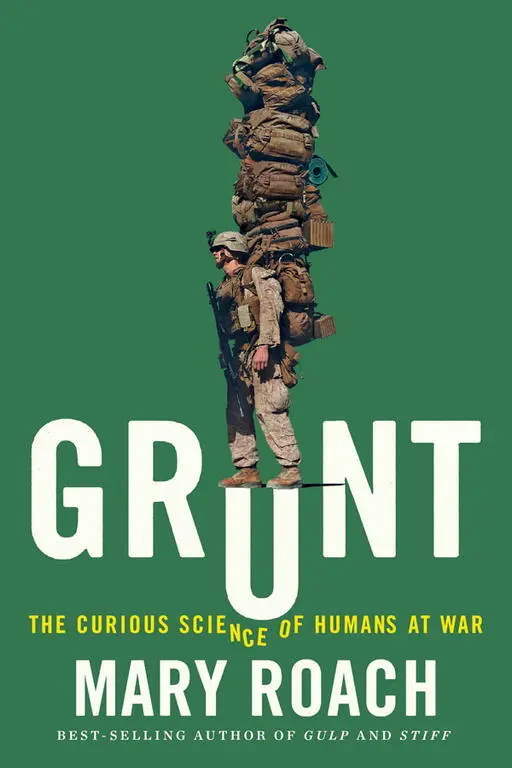
- Название:Grunt
- Автор:
- Издательство:W. W. Norton
- Жанр:
- Год:2016
- Город:New York
- ISBN:978-0-393-24544-8
- Рейтинг книги:3 / 5. Голосов: 1
-
Избранное:Добавить в избранное
- Отзывы:
-
Ваша оценка:
Grunt: краткое содержание, описание и аннотация
Предлагаем к чтению аннотацию, описание, краткое содержание или предисловие (зависит от того, что написал сам автор книги «Grunt»). Если вы не нашли необходимую информацию о книге — напишите в комментариях, мы постараемся отыскать её.
Grunt
Tennessee
An Amazon Best Book of June 2016:
Amazon.com Review It takes a special kind of writer to make topics ranging from death to our gastrointestinal tract interesting (sometimes hilariously so), and pop science writer Mary Roach is always up to the task. In her latest book,
, she explores how our soldiers combat their non-gun-wielding opponents—panic, heat exhaustion, the runs, and more. It will give you a new appreciation not only for our men and women in uniform (and by the way, one of the innumerable things you’ll learn is how and why they choose the fabric for those uniforms), but for the unsung scientist-soldiers tasked with coming up with ways to keep the “grunts” alive and well. If you are at all familiar with Roach’s oeuvre, you know her enthusiasm for her subjects is palpable and infectious. This latest offering is no exception.
—Erin Kodicek,
“A mirthful, informative peek behind the curtain of military science.” (Washington Post)
“From the ever-illuminating author of
and
comes an examination of the science behind war. Even the tiniest minutiae count on the battlefield, and Roach leads us through her discoveries in her inimitable style.” (Elle)
“Mary Roach is one of the best in the business of science writing… She takes readers on a tour of the scientists who attempt to conquer the panic, exhaustion, heat, and noise that plague modern soldiers.” (Brooklyn Magazine)
“Extremely likable … and quick with a quip…. [Roach’s] skill is to draw out the good humor and honesty of both the subjects and practitioners of these white arts among the dark arts of war.” (San Francisco Chronicle)
“Nobody does weird science quite like [Roach], and this time, she takes on war. Though all her books look at the human body in extreme situations (sex! space! death!), this isn’t simply a blood-drenched affair. Instead, Roach looks at the unexpected things that take place behind the scenes.” (Wired)
“Brilliant.” (Science)
“Roach … applies her tenacious reporting and quirky point of view to efforts by scientists to conquer some of the soldier’s worst enemies.” (Seattle Times)
“Covering these topics and more, Roach has done a fascinating job of portraying unexpected, creative sides of military science.” (New York Post)
“Having investigated sex, death, and preparing for space travel,
best-selling Roach applies her thorough—and thoroughly entertaining—techniques to the sobering subject of keeping soldiers not just alive but alert and healthy of mind and body during warfare.” (Library Journal)
“A rare literary bird, a best selling science writer … Roach avidly and impishly infiltrates the world of military science…. Roach is exuberantly and imaginatively informative and irreverently funny, but she is also in awe of the accomplished and committed military people she meets.” (Booklist (starred review))
Grunt — читать онлайн бесплатно полную книгу (весь текст) целиком
Ниже представлен текст книги, разбитый по страницам. Система сохранения места последней прочитанной страницы, позволяет с удобством читать онлайн бесплатно книгу «Grunt», без необходимости каждый раз заново искать на чём Вы остановились. Поставьте закладку, и сможете в любой момент перейти на страницу, на которой закончили чтение.
Интервал:
Закладка:
Besides, I saw him go into the secure zone.
This promises to be awkward. It’s not just the topic. It’s how people like this make you feel: the sudden reveal of your smallness and the inconsequential preoccupations of your existence. What could be smaller than writing about diarrhea? And how to explain why I’ve singled him out?
“Seamus, come with me. Introduce me.”
Seamus peels an orange, one long strip spiraling down to his tray. “I don’t know, Mary. We weren’t trained on this in public affairs school.”
I collect my notepad and tape recorder.
“Hang on.” Seamus, clearly stalling, wipes orange from his fingers, one at a time. “I’m going to be shaking his hand. He’ll kill me.” He lowers his voice: “You got me sticky.”
I stand up. Seamus makes a brief, warbling unhappiness sound and pushes back his chair.
We cross the cafeteria, nervous middle-schoolers at the dance. The man sees us but does not alter his expression. We stop a couple feet back from the table. Some kind of attitudinal concertina wire. Seamus plunges ahead. “Mind if we join you for a second?”
The man takes hold of the sides of his meal tray. “I’m done.”
“We…”
“I’m leaving.”
Seamus keeps paddling. “Do you have time for a quick question, what line of work are you in?” What line of work are you in! I adore Seamus Nelson.
The man glances at Seamus, at me, and back to Seamus. “Who are you.” Said like something thrown.
“I’m in Public Affairs, and this is an author. She’s working on a chapter for a book, and she’s specifically focused on how diarrhea impacts a mission…”
This is my cue. I’m going to assume the man is Special Operations, and that he knows we know. “I was wondering whether you might ever have been in a situation where… in a critical mission that…” I back up. “Well, because diarrhea is looked on as sort of a silly—”
“It’s not.”
He speaks softly, and what he says next I can’t quite make out. Something about being curled up in a hole in the fetal position. He says that where he just got back from, some unnamed “out station” in Somalia, it hits everyone. This is probably not exaggeration. In Riddle’s survey of diarrhea in Iraq and Afghanistan, 32 percent of respondents reported having been in a situation where they couldn’t get to a toilet in time. And Special Operators in the field get sick twice as frequently as everyone else.
His name, he says, is Carey. He invites us to sit down. I place my tape recorder in plain view—that is to say, in plain view of anyone on my side of the table. That is also to say, behind the condiment caddy.
I need Carey to set the scene. “What if you… I mean, what if someone were a sniper, and they’re in a hide for… well, how many hours would it be?”
“Depends on the mission. You’re watching for something to happen that might not happen.”
“Right, and most likely you’re out in some village, and you’ve had to be eating stuff that’s not prepared as hygienically as—”
“Goat,” he says. I had heard a story earlier about a goat meal in rural Afghanistan. It contained the phrases “singed hair” and “otherwise uncooked.” Unsanitary conditions, Carey confirms, are a given. “Unfortunately, we don’t fight in first-world countries.”
Carey says he does not, as Mark Riddle had heard some men did, take antibiotics or Imodium prophylactically before the mission or after the goat. He takes one precaution. It is a strict rule among Special Operators. “You go to the bathroom before going into a danger situation.” There has been no shift from the gravely quiet tone with which Carey has been speaking. Nonetheless, Seamus blurts, “Kind of like a road trip with the family, and Dad’s like, ‘I don’t care that you don’t need to go.’”
On a family road trip, no one has you in the sights of a semiautomatic rifle while you squat in the dirt. Historian of military medicine A. J. Bollet quotes a letter written by a Civil War soldier who explained that an unwritten code of honor forbade the shooting of a man “attending to the imperative calls of nature.” [37] Dale Smith, a historian of military medicine at the Uniformed Services University of the Health Sciences, is dubious. Bollet, he says, drew the conclusion from one man’s story. Certainly no such etiquette prevails among military historians, who take any opportunity to shoot each other down.
In the war on terror, there’s no such etiquette.
I’m still trying to get Carey to tell the story of a specific high-stakes operation. “Have you have been in a situation where you’ve been—”
“Inabilitated?” I like this: a combination of inability and disabled. “Yes. I have been inabilitated because of food sickness.” Carey leans back, one arm along the back of the adjacent chair. “I’m not sure what you guys want from me.”
Seamus tries to help. “Can you walk us through the story. You know, like: There I was …”
Carey isn’t going to supply the There-I-Was. “I have many stories where I’ve soiled my pants on missions. In Iraq, I’ve soiled my pants. In Afghanistan, I’ve soiled my pants.” No one stays back or leaves to find a toilet once an operation is under way. Diarrhea cannot be a “kill stopper.”
“And then what happens?” Seamus leaning forward like a kid at story hour. “You go on to… do the job?”
“There’s no other option. I mean, it’s kind of a life or death thing. So.” He shrugs one shoulder. “You go. Worry about it later. As long as you walk out and the mission is accomplished. And that’s about as specific as I can get.”
I tell him about Mark Riddle’s TrEAT TD study. “You should bring along a single sixteen-hundred-milligram dose of rifaximin and a bottle of Imodium.”
Carey holds my gaze for a moment. “What is the objective here?”
I restate my mission. I show him my notebook, open to the page where Mark Riddle is describing what, for the purposes of his study, constitutes diarrhea (“has to be pourable or take the shape of the container”).
“Well, you’re in the wrong place, Mary.” Carey tells me to go down to Somalia. Yes, let’s picture it—middle-aged American with her cork-bed comfort sandals and wheelie bag, wandering the desert redoubts of the local al-Qaeda affiliate. Yoo-hoo! I’m looking for the Navy SEAL safe house?
“You could get yourself down there if you wanted to. It’s not dangerous.” He pushes two fingertips through the curl of his beard. “Well, it’s a little dangerous.”
Carey apologizes for the frosty reception earlier. “I thought you guys were NCIS.” Naval Criminal Investigative Service. “You scared me.”
CAREY IS right. People don’t get diarrhea by eating at Camp Lemonnier. They get it by “eating on the economy”: the Special Operators get it in remote villages, and everyone else gets it by going in to Djibouti City for a change of pace from spaghetti and Taco Tuesdays. Like you on your Mexican [38] How did Mexico become the poster child for travelers’ diarrhea? One hypothesis, mine, points a finger at the godfather of diarrhea research, Herbert DuPont. For almost thirty years, DuPont ran studies out of Guadalajara, Mexico. If you plug “Guadalajara” and “diarrhea” into the PubMed database, you get forty-five journal articles and a persuasive argument for changing your holiday destination to Switzerland. (“Enteric pathogens in Mexican sauces in popular restaurants in Guadalajara…”; “Coliform contamination of vegetables obtained from popular restaurants in Guadalajara…”; “Coliform and E. coli contamination of desserts served in public restaurants in Guadalajara…”) There has been at least one well-intentioned effort to clear Mexico’s name. The author of a paper in California Medicine had read that Mexicans often get travelers’ diarrhea when they visit California. She wondered if perhaps the stress of travel, rather than poor sanitation, was to blame. She interviewed 215 foreign UCLA freshmen and 238 American freshmen about “changes in frequency and consistency of stools.” None of the foreign students appeared to have had travelers’ diarrhea, though it was difficult to tell because many “did not understand the interviewer’s terms.” You can see where “watery stool” or “explosive diarrhea” might be confusing, frightening even, for the non-native speaker.
holiday, they ingest contaminated tap water or food that’s been sitting out unrefrigerated. Before a downtown suicide bombing caused the base to be put on restricted liberty, a month before I arrived, Riddle was seeing two dozen food poisoning cases a week. During the past month, since everyone’s been confined to base, only one person—the guy who found a restaurant that delivers—has stepped through the door. Riddle catches up on paperwork. The lonely diarrhea researcher.
Интервал:
Закладка:
Похожие книги на «Grunt»
Представляем Вашему вниманию похожие книги на «Grunt» списком для выбора. Мы отобрали схожую по названию и смыслу литературу в надежде предоставить читателям больше вариантов отыскать новые, интересные, ещё непрочитанные произведения.











Обсуждение, отзывы о книге «Grunt» и просто собственные мнения читателей. Оставьте ваши комментарии, напишите, что Вы думаете о произведении, его смысле или главных героях. Укажите что конкретно понравилось, а что нет, и почему Вы так считаете.