Mary Roach - Grunt
Здесь есть возможность читать онлайн «Mary Roach - Grunt» весь текст электронной книги совершенно бесплатно (целиком полную версию без сокращений). В некоторых случаях можно слушать аудио, скачать через торрент в формате fb2 и присутствует краткое содержание. Город: New York, Год выпуска: 2016, ISBN: 2016, Издательство: W. W. Norton, Жанр: nonf_military, sci_popular, на английском языке. Описание произведения, (предисловие) а так же отзывы посетителей доступны на портале библиотеки ЛибКат.

- Название:Grunt
- Автор:
- Издательство:W. W. Norton
- Жанр:
- Год:2016
- Город:New York
- ISBN:978-0-393-24544-8
- Рейтинг книги:3 / 5. Голосов: 1
-
Избранное:Добавить в избранное
- Отзывы:
-
Ваша оценка:
Grunt: краткое содержание, описание и аннотация
Предлагаем к чтению аннотацию, описание, краткое содержание или предисловие (зависит от того, что написал сам автор книги «Grunt»). Если вы не нашли необходимую информацию о книге — напишите в комментариях, мы постараемся отыскать её.
Grunt
Tennessee
An Amazon Best Book of June 2016:
Amazon.com Review It takes a special kind of writer to make topics ranging from death to our gastrointestinal tract interesting (sometimes hilariously so), and pop science writer Mary Roach is always up to the task. In her latest book,
, she explores how our soldiers combat their non-gun-wielding opponents—panic, heat exhaustion, the runs, and more. It will give you a new appreciation not only for our men and women in uniform (and by the way, one of the innumerable things you’ll learn is how and why they choose the fabric for those uniforms), but for the unsung scientist-soldiers tasked with coming up with ways to keep the “grunts” alive and well. If you are at all familiar with Roach’s oeuvre, you know her enthusiasm for her subjects is palpable and infectious. This latest offering is no exception.
—Erin Kodicek,
“A mirthful, informative peek behind the curtain of military science.” (Washington Post)
“From the ever-illuminating author of
and
comes an examination of the science behind war. Even the tiniest minutiae count on the battlefield, and Roach leads us through her discoveries in her inimitable style.” (Elle)
“Mary Roach is one of the best in the business of science writing… She takes readers on a tour of the scientists who attempt to conquer the panic, exhaustion, heat, and noise that plague modern soldiers.” (Brooklyn Magazine)
“Extremely likable … and quick with a quip…. [Roach’s] skill is to draw out the good humor and honesty of both the subjects and practitioners of these white arts among the dark arts of war.” (San Francisco Chronicle)
“Nobody does weird science quite like [Roach], and this time, she takes on war. Though all her books look at the human body in extreme situations (sex! space! death!), this isn’t simply a blood-drenched affair. Instead, Roach looks at the unexpected things that take place behind the scenes.” (Wired)
“Brilliant.” (Science)
“Roach … applies her tenacious reporting and quirky point of view to efforts by scientists to conquer some of the soldier’s worst enemies.” (Seattle Times)
“Covering these topics and more, Roach has done a fascinating job of portraying unexpected, creative sides of military science.” (New York Post)
“Having investigated sex, death, and preparing for space travel,
best-selling Roach applies her thorough—and thoroughly entertaining—techniques to the sobering subject of keeping soldiers not just alive but alert and healthy of mind and body during warfare.” (Library Journal)
“A rare literary bird, a best selling science writer … Roach avidly and impishly infiltrates the world of military science…. Roach is exuberantly and imaginatively informative and irreverently funny, but she is also in awe of the accomplished and committed military people she meets.” (Booklist (starred review))
Grunt — читать онлайн бесплатно полную книгу (весь текст) целиком
Ниже представлен текст книги, разбитый по страницам. Система сохранения места последней прочитанной страницы, позволяет с удобством читать онлайн бесплатно книгу «Grunt», без необходимости каждый раз заново искать на чём Вы остановились. Поставьте закладку, и сможете в любой момент перейти на страницу, на которой закончили чтение.
Интервал:
Закладка:
The Camp Lemonnier galley goes to lengths to keep bacteria away from the food. The entry hall is flanked by rows of knee-operated hand-washing stations, with pole-mounted Purell dispensers at the end of these. All well and good, but here’s what really matters. First, the cooks and prep crew wash their hands after they go number two. So if any of them has diarrhea, that person isn’t spreading the bacteria to food that then sits out at room temperature, allowing said bacteria to multiply to levels at which they cause illness. And second: There are no flies in the Dorie Miller Galley. Since the dawn of air-conditioning, military chow halls have been sealed. No one needs to open a window, and no one can.
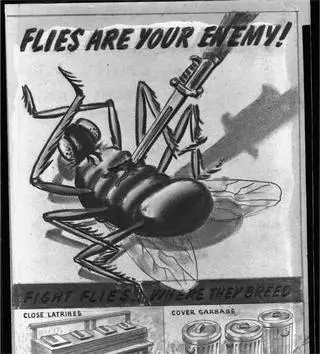
It was as a result of this connection—fewer flies in the mess equals fewer gastrointestinal infections—that the filth fly was originally busted as a vector of disease. In 1898, during the Spanish-American War, a trio of army physicians, including the illustrious and eponymous Walter Reed, were called to Cuba to investigate an outbreak of typhoid fever that was killing one in five US troops. (It was Reed’s medical sleuthing that proved it was mosquitoes, not bad air or unclean bedding, that transmitted yellow fever.) Straightaway, the team noticed that the infection rate was lower among the officers whose mess tents had screens to keep bugs out. It also varied by the different camps’ methods of “disposing of the excretions.” Open pit latrines were associated with higher rates, possibly because, as Reed’s team wrote, “flies swarm over the infected fecal matter.”
Reed had his two suspects—flies and the bacteria-laden feces they feed on—but no smoking gun. Flies don’t bite. How were they transmitting the pathogen? One fine day Reed’s gaze fell upon a fly walking around on the soldiers’ food. Looking more closely, he noticed white powder on its little hairy legs. Where had he just seen a white powder? The pit latrines! Soldiers had been sprinkling lime in an attempt at camp sanitation. The flies’ feet were delivering bacteria from shit to stew. They’re what’s called a mechanical vector. Ten Salmonella enterica serovar Typhimurium isolates multiplying in a pot of beans in the warmth of a Cuban noon will be a million by dinnertime.
Reed’s legacy lives on in the Entomology Branch of the Walter Reed Army Institute of Research, my next destination. Military entomology runs the gamut you’d likely expect: killing disease-carrying insects, keeping them away from soldiers, and creating vaccines and treatments for the times when neither of those can be managed. In the case of filth flies, something less usual has been going on. Unlike in most military entomology war stories, the insect this time is the hero.
9. THE MAGGOT PARADOX
Flies on the Battlefield, for Better and Worse
IN A MEMORABLE CARTOON from my formative years, a well-dressed man with a goatee is seated at a restaurant table across from a fly. It’s a giant fly, a fly large enough to fill a dining room chair much the way a person would. The man addresses a waiter. I’m paraphrasing here. “I’ll have the gazpacho, and some shit for my fly.” It was a commentary on flies, or perhaps an observation on the odd human habit of elevating nutrient intake to social ritual. Or maybe just this: No matter how fond you are of a fly, dining out together is going to be awkward.
And the cartoonist only drew the half of it. Because flies have no teeth, they must first liquefy what they plan to eat. (Or order the gazpacho.) This they do by applying their digestive enzymes outside their body. The process was captured on film and included in the 1940s British Army hygiene filmstrip The Housefly . “Their vomit is puddled about your food to make a kind of porridge,” says an incongruously posh-sounding narrator, “which the fly then sucks up.” Technical Guide No. 30 ( Filth Flies ) of the US Armed Forces Pest Management Board would also have you know that “flies further contaminate food by defecating on it while they feed.”
No flies of any size are eating at Mi Rancho Mexican restaurant in downtown Silver Spring this evening, but some fly biologists are here, and that can be equally disquieting. We’re talking now about those out-of-body digestive enzymes. A researcher I had spoken to the previous week referred to the salivary glands, not the stomach, as the source. For clarification, I have turned to one of my dinner companions, George Peck, resident filth fly expert at the Entomology Branch of the Walter Reed Army Institute of Research (WRAIR), just down the road.
“I think it’s both,” Peck is saying. “They vomit up enzymes from the crop along with the saliva and let it—”
“Are you all done here?”
Peck looks up to acknowledge our waitress. “I am, thanks… and let it fall onto the food.”
With George Peck, the topic of flies and their unusual physiology doesn’t elicit disgust. Awe, mostly. I have heard him marvel at the sensitivity of the fly’s body hairs, how they enable it to detect the bow wave of an approaching hand and lift off in the split second before contact is made. He talks about the halteres, tiny gyroscopes that enable the fly to hover or change direction “faster than the fastest flight computer on any jet.”
Less awesome: Researchers in Japan established that the strain of E. coli known as 0157:H7—deadly outbreaks of which periodically make headlines in the United States—thrives in housefly mouthparts and frass. [39] Insect shit.
Bacteria on or in filth flies have been shown to transmit typhoid fever, cholera, dysentery, and a whole wet bar of lesser diarrheal infections. (Both houseflies and blowflies fall under the grouping “filth flies.”) British researchers documented a close association between filth fly populations and cases of food poisoning from the campylobacter bacterium, both of which peak during the warmest months. (The English used to speak of “summer diarrhea”—loose stools and cramping having joined warm nights and fireflies as hallmarks of the season.) In a 1991 study, an Israeli military field unit that undertook an intensive filth fly control program saw 85 percent fewer cases of food poisoning than a similar one that did not.
The Armed Forces Pest Management Board’s filth fly technical guide includes a figure for the number of times in twenty-four hours that a single fly vomits and defecates on its food after a controlled feeding of milk. The figure, a range from 16 to 31, was arrived at not by staying up all night watching but by counting “fecal spots” and “vomit spots” (the latter distinguishable from the former by their lighter color). The reader is invited to speculate about the number of “spots” on food in a military chow line in the era before sealed dining facilities. Fly infestation in the mess halls of the Vietnam War, the guide relates, was so intense that “it was difficult to eat without ingesting one or two…”
Infestations still happen, mostly in the rough and not entirely ready first few days or weeks of a war. Early on, weapons and ammo take priority over latrines and refrigeration units in terms of what supplies get shipped. During the first Gulf war, Marines arrived in the region via the port of Jubail, where the Saudis housed them in a warehouse. “We had ten thousand Marines and two squat toilets,” recalls Joe Conlon, a retired Navy entomologist. The toilets soon clogged and sewage ran in the streets. Meanwhile, with no refrigerated storage, pallets of produce began piling up on the dock in the 100-degree heat. Thousands of flies converged. Conlon estimates 60 percent of the Marines got sick.
Читать дальшеИнтервал:
Закладка:
Похожие книги на «Grunt»
Представляем Вашему вниманию похожие книги на «Grunt» списком для выбора. Мы отобрали схожую по названию и смыслу литературу в надежде предоставить читателям больше вариантов отыскать новые, интересные, ещё непрочитанные произведения.











Обсуждение, отзывы о книге «Grunt» и просто собственные мнения читателей. Оставьте ваши комментарии, напишите, что Вы думаете о произведении, его смысле или главных героях. Укажите что конкретно понравилось, а что нет, и почему Вы так считаете.