Walker Percy - Lost in the Cosmos
Здесь есть возможность читать онлайн «Walker Percy - Lost in the Cosmos» весь текст электронной книги совершенно бесплатно (целиком полную версию без сокращений). В некоторых случаях можно слушать аудио, скачать через торрент в формате fb2 и присутствует краткое содержание. Год выпуска: 2011, Издательство: Open Road Media, Жанр: Критика, История, Философия, на английском языке. Описание произведения, (предисловие) а так же отзывы посетителей доступны на портале библиотеки ЛибКат.
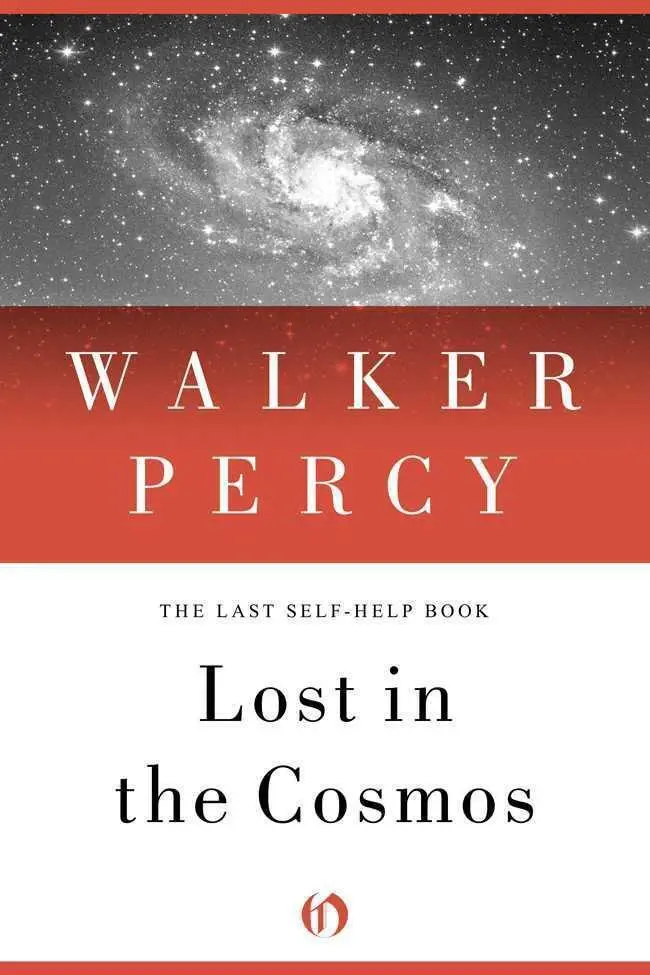
- Название:Lost in the Cosmos
- Автор:
- Издательство:Open Road Media
- Жанр:
- Год:2011
- ISBN:нет данных
- Рейтинг книги:5 / 5. Голосов: 1
-
Избранное:Добавить в избранное
- Отзывы:
-
Ваша оценка:
Lost in the Cosmos: краткое содержание, описание и аннотация
Предлагаем к чтению аннотацию, описание, краткое содержание или предисловие (зависит от того, что написал сам автор книги «Lost in the Cosmos»). Если вы не нашли необходимую информацию о книге — напишите в комментариях, мы постараемся отыскать её.
is Percy’s unforgettable riff on the trend that swept the nation. Filled with quizzes, essays, short stories, and diagrams,
is a laugh-out-loud spin on a familiar genre that also pushes readers to serious contemplation of life’s biggest questions. One part parody and two parts philosophy,
is an enlightening guide to the dilemmas of human existence, and an unrivaled spin on self-help manuals by one of modern America’s greatest literary masters.
Lost in the Cosmos — читать онлайн бесплатно полную книгу (весь текст) целиком
Ниже представлен текст книги, разбитый по страницам. Система сохранения места последней прочитанной страницы, позволяет с удобством читать онлайн бесплатно книгу «Lost in the Cosmos», без необходимости каждый раз заново искать на чём Вы остановились. Поставьте закладку, и сможете в любой момент перейти на страницу, на которой закончили чтение.
Интервал:
Закладка:
(7) Reentry by Eastern window. Angle of reentry too shallow, skip back into space, out of singular self in a singular place back into Cosmic Self, and out of linear time and into the cycles of reincarnation and the Eternal Return. Comet orbit.
The self escapes the burden of itself and achieves satori through the negating of self, the atman, with the Cosmic Self, the Brahman of Hinduism.
Such a disposal of the self was ever an attractive option, what with the perennial inability of the self to perceive itself, but in this age is more attractive than ever as a consequence of the modern historical predicament of the self. The movement of science tends to abstract the self from the world both for the scientist and for the layman, who is willy-nilly abstracted by the triumphant spirit of science without, however, being compensated by the joy of the practice of science. The movement of art is toward the isolation and sequestering of the artist as individual in pursuit of art.
Hence the openness of the Eastern window, particularly in California, where the options of reentry often make their first appearance.
There are characteristic affinities between the mode of reentry by the Eastern window and certain other modes of reentry, e.g., the travel and exile modes, often with a dash of science for seasoning.
Examples: English writers in Hollywood — Huxley, Isherwood, et al. Reentry by travel (geographical) plus travel (homosexual) plus Eastern window, the multiple reentry mode underwritten by science (mind-altering drugs opening the doors of perception and assisting the self in its escape from itself).
It is no accident that the post-Protestant English in the van of the scientific and industrial revolution for two centuries were also the discoverers and masters of characteristic reentry modes, especially travel (geographical and sexual) and disguises. It is no coincidence that the English are not only the best actors in the world but the best spies. The modern Englishman can become anyone else. The prototypical Englishman of the twentieth century is not John Bull or Colonel Blimp but Lawrence in Arabia, Olivier in The Entertainer, Maugham in the Secret Service.
Do you think it is an accident that all the best writers of spy novels are English?
(8) Refusal of reentry and exitus forever into deep space, which is to say, suicide. Suicide, strangely enough, though the direst of options, is often the most honest, in the sense that the suicide may have run out of the other options and found them lacking. Suicide, that is to say, is arguably a more logical option than a constant recycling of past options — from booze to Spain to broads and back, from booze to Spain and so on; from cruising Buena Vista Park for the five hundredth fellatio.
(9) Reentry deferred: Self on indefinite hold in orbit. That is to say, the withdrawal of the artist. E.g., Salinger in the woods, Proust in the cork-lined room. Thus, there is no a priori semiotic reason, after all, why the self must reenter the world. It can simply maintain the artistic posture throughout the day, at four o’clock in the afternoon, and have no more to do with the world than a Carthusian monk who receives his food through a turnstile.
(10) Reentry under the direct sponsorship of God. It is theoretically possible, if practically extremely difficult, to reenter the world and become an intact self through the reentry mode Kierkegaard described when he noted that “the self can only become itself if it does so transparently before God.” This is in fact, according to both Kierkegaard and Pascal, the only viable mode of reentry, the others being snares and delusions.
There are at least two reasons, having to do with the nature of the age, why this option is so difficult.
One is that from the abstracted perspective of the sciences and arts — an attitude of self-effacing objectivity which through the spectacular triumph of science has become the natural stance of the educated man — God, if he is taken to exist at all, is perforce understood as simply another item in the world which one duly observes, takes note of, and stands over against.
The other reason is that the God-party, at least those who say “Lord Lord” most often, are so ignorant and obnoxious that most educated people want no part of them. If they’re for it, then I can’t go far wrong in being against it.
It is true that both St. Paul and God are on record as preferring simple folk to the overeducated, especially philosophers. But media preachers have little reason to take comfort. Being uneducated is no guarantee against being obnoxious.
Question: Who is the most obnoxious, Protestants, Catholics, or Jews?
Answer: It depends on where you are and who you are talking to — though it is hard to conceive any one of the three consistently outdoing the other two in obnoxiousness. Yet, as obnoxious as are all three, none is as murderous as the autonomous self who, believing in nothing, can fall prey to ideology and kill millions of people — unwanted people, old people, sick people, useless people, unborn people, enemies of the state — and do so reasonably, without passion, even decently, certainly without the least obnoxiousness.
Religion, at any rate, has been having a bad time of it lately, perhaps for good and sufficient reason. By and large, scientists and artists and the autonomous self have gotten rid of God, whether or not for good reason, whether or not with catastrophic consequences, remains to be seen.
In any case, reentry into ordinary life, into concrete place and time, from the strange abstractions of the twentieth century, the reentry undertaken under the direct sponsorship of God, is a difficult if not nigh-impossible task. Yet there have existed, so I have heard, a few writers even in this day and age who have become themselves transparently before God and managed to live intact through difficult lives, e.g., Simone Weil, Martin Buber, Dietrich Bonhoeffer. Some have even outdone Kierkegaard and seen both creation and art as the Chartres sculptor did, as both dense and mysterious, gratuitous, anagogic, and sacramental, e.g., Flannery O’Connor.
(11) Reentry by assault. The writer-artist makes sure that he is in the world and that he is real by taking on the world, usually by political action and, more often than not, revolutionary. Even if one is imprisoned by the state — especially if one is imprisoned — one can be certain of being human. Ghosts can’t be imprisoned. This stratagem is more available to European writers, who are taken more seriously than American writers. The secret envy of American writers: Alexander Solzhenitsyn. Despite their most violent attacks on the state and the establishment, nobody pays much attention to American writers, least of all the state. To have taken on the state and defeated it, like Solzhenitsyn, is beyond the wildest dreams of the American writer. Because the state doesn’t care. This indifference leads to ever more frantic attempts to attract attention, like an ignored child, even to the point of depicting President Johnson and Lady Bird plotting the assassination of Kennedy in Barbara Garson’s MacBird! or President Nixon having sex with Ethel Rosenberg and being buggered by Uncle Sam in Times Square in Robert Coover’s The Public Burning.
Still, no one pays attention.
A paradigm of this generally failed reentry option: a lonely “radical” American writer standing outside the White House gate, screaming obscenities about this fascist state, dictatorship, exploitation of minorities, suppression of freedom of speech, and so on and on — all the while being ignored by President, police, and passersby.
There are worse things than the Gulag.
Thought Experiment: The Reentry Quiz
Object: To enable you to calculate your own apogee of transcendence and your corresponding need of reentry.
Читать дальшеИнтервал:
Закладка:
Похожие книги на «Lost in the Cosmos»
Представляем Вашему вниманию похожие книги на «Lost in the Cosmos» списком для выбора. Мы отобрали схожую по названию и смыслу литературу в надежде предоставить читателям больше вариантов отыскать новые, интересные, ещё непрочитанные произведения.






Обсуждение, отзывы о книге «Lost in the Cosmos» и просто собственные мнения читателей. Оставьте ваши комментарии, напишите, что Вы думаете о произведении, его смысле или главных героях. Укажите что конкретно понравилось, а что нет, и почему Вы так считаете.