Walker Percy - Lost in the Cosmos
Здесь есть возможность читать онлайн «Walker Percy - Lost in the Cosmos» весь текст электронной книги совершенно бесплатно (целиком полную версию без сокращений). В некоторых случаях можно слушать аудио, скачать через торрент в формате fb2 и присутствует краткое содержание. Год выпуска: 2011, Издательство: Open Road Media, Жанр: Критика, История, Философия, на английском языке. Описание произведения, (предисловие) а так же отзывы посетителей доступны на портале библиотеки ЛибКат.
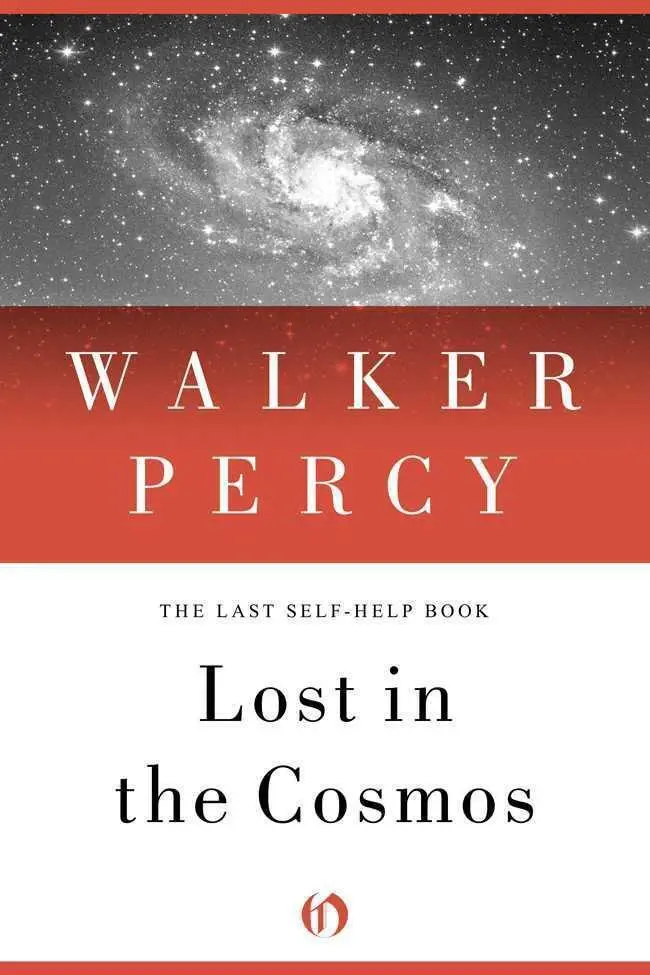
- Название:Lost in the Cosmos
- Автор:
- Издательство:Open Road Media
- Жанр:
- Год:2011
- ISBN:нет данных
- Рейтинг книги:5 / 5. Голосов: 1
-
Избранное:Добавить в избранное
- Отзывы:
-
Ваша оценка:
Lost in the Cosmos: краткое содержание, описание и аннотация
Предлагаем к чтению аннотацию, описание, краткое содержание или предисловие (зависит от того, что написал сам автор книги «Lost in the Cosmos»). Если вы не нашли необходимую информацию о книге — напишите в комментариях, мы постараемся отыскать её.
is Percy’s unforgettable riff on the trend that swept the nation. Filled with quizzes, essays, short stories, and diagrams,
is a laugh-out-loud spin on a familiar genre that also pushes readers to serious contemplation of life’s biggest questions. One part parody and two parts philosophy,
is an enlightening guide to the dilemmas of human existence, and an unrivaled spin on self-help manuals by one of modern America’s greatest literary masters.
Lost in the Cosmos — читать онлайн бесплатно полную книгу (весь текст) целиком
Ниже представлен текст книги, разбитый по страницам. Система сохранения места последней прочитанной страницы, позволяет с удобством читать онлайн бесплатно книгу «Lost in the Cosmos», без необходимости каждый раз заново искать на чём Вы остановились. Поставьте закладку, и сможете в любой момент перейти на страницу, на которой закончили чтение.
Интервал:
Закладка:
In order to understand the purpose of the exercise and be instructed by it, let us make the following assumptions which are probably more true than false but which at any rate I will not take the trouble to defend: that the present world is in some sense deranged, the center is not holding, that the plight of the self of the artist-writer is at least in part a historical phenomenon and not an essential property of being an artist-writer; that there may have been other times and other places, whether one wishes to call them an age of faith or an age of myth, in which men perceived a saving relationship to God, the Cosmos, the world, and each other. In such times the self did not feel displaced, or if it did, it understood its displacement. The artist-writer did not, presumably, feel the same compulsion to assert his individual genius-self as would the artist today. It did not, presumably, occur to the Chartres sculptor to sign his name on the toe of an apostle he had finished on the West Portal. (Or to the Lascaux Cave painter.) Though he was a sinful man like other men and subject to certain whims and antics, he would not, presumably, have understood the nineteenth-century English poet who utters a cry: “O world! O life! O time!” and sails out in the Bay of Naples to a suicide by drowning. Or the twentieth-century American novelist riding trains through the haunted towns of America and writing: “O lost, and by the wind grieved, ghost, come back again.”
Options of reentry into such a world are: (1) reentry uneventful and intact, (2) reentry accomplished through anesthesia, (3) reentry accomplished by travel (geographical), (4) reentry accomplished by travel (sexual), (5) reentry by return, (6) reentry by disguise, (7) reentry by Eastern window, (8) reentry refused, exitus into deep space (suicide), (9) reentry deferred, (10) reentry by sponsorship, (11) reentry by assault.
Object of experiment: to discover (1) which option you prefer and (2) which option is in fact open to you.
Explanation of Options:
(1) Successful and uneventful reentry, self intact. Theoretically, it is possible for the abstracted self to reenter the world as easily as a doctor leaving his office for Wednesday afternoon golf or the Chartres sculptor going home to sup with his family.
Was this not in fact the case with William Faulkner, doing a morning’s work, then strolling in the town square to talk to the farmers and have a Coke at Reed’s drugstore? Not quite. Though Faulkner went to lengths to pass himself off as a farmer among farmers, farmer he was not. A charade was being played.
Was it not the case with Sören Kierkegaard, who, every hour, would jump up from his desk, rush out into the streets of Copenhagen, and pass the time with shopkeepers? No, because, by his own admission, he was playing the game of being taken for an idler at the very time he was writing ten books a year.
Only one example comes to mind of a writer who, though performing at a very high level of twentieth-century art, nevertheless manages to live on one of the few remaining islands of a more or less intact culture, in the very house where she was born, to enter into an intercourse with the society around her as naturally as the Chartres sculptor, to appear as herself, her self, the same self, both to fellow writer and to fellow townsman: Eudora Welty. Perhaps also William Carlos Williams.
If you do not think this remarkable, imagine that you have lived your entire life in the house where you were born. For an American, an uncanny, even an unsettling fantasy. (2) Reentry accomplished through anesthesia. One can simply render the intolerable tolerable by a chemical assault on the cortex of the brain, generally by alcohol, and generally by writers. It has been observed that artists live longer and drink less than writers. Perhaps they are rescued from the ghostliness of self by the things and the doings of their art. The painter and the sculptor are the Catholics of art, the writer is the Protestant. The former have the sacramentals, the concrete intermediaries between themselves and creation — the paint, the brushes, the fruit, the bowl, the table, the model, the mountain, the handling and muscling of clay. The writer is the Protestant. He works alone in a room as bare as a Quaker meeting house with nothing between him and his art but a Scripto pencil, like God’s finger touching Adam. It is harder on the nerves.
Why Writers Drink
He is marooned in his cortex. Therefore it is his cortex he must assault. Worse, actually. He, his self, is marooned in his left cortex, locus of consciousness according to Eccles. Yet his work, if he is any good, comes from listening to his right brain, locus of the unconscious knowledge of the fit and form of things. So, unlike the artist who can fool and cajole his right brain and get it going by messing in paints and clay and stone, the natural playground of the dreaming child self, there sits the poor writer, rigid as a stick, pencil poised, with no choice but to wait in fear and trembling until the spark jumps the commissure. Hence his notorious penchant for superstition *and small obsessive and compulsive acts such as lining up paper exactly foursquare with desk. Then, failing in these frantic invocations and after the right brain falls as silent as the sphinx — what else can it do? — nothing remains, if the right won’t talk, but to assault the left with alcohol, which of course is a depressant and which does of course knock out that grim angel guarding the gate of Paradise and let the poor half-brained writer in and a good deal else besides. But by now the writer is drunk, his presiding left-brained craftsman-consciousness laid out flat, trampled by the rampant imagery from the right and a horde of reptilian demons from below.
(3) Reentry accomplished by travel (geographical). The self leaves home because home has been evacuated, not bombed out, but emptied out by the self itself. That is, home, family, neighborhood, and town have been engulfed by the vacuole of self, ingested and rendered excreta. What writer can stay in Oak Park, Illinois? One leaves for another place, but soon it too is ingested and digested. One keeps moving: from Illinois to Minnesota to Paris to Italy to Paris to Spain to Paris to Africa to Paris to Key West to Cuba to Idaho. From Nottinghamshire to Australia to Mexico to Taos to France. If one can keep moving and if the places retain sufficient form and decor, the places may not run out before one’s life runs out. Hemingway ran out of places. Lawrence did not.
An extreme case of a frantic and failed attempt to enter a habitable world, only to consume it and move on, is Kerouac in On the Road. In the course of one book he careens back and forth between New York and California six times — with one Mexican detour.
The road is better than the inn, Cervantes said. True, but he did not reckon with ghostly travelers like the Flying Dutchman.
Note, however, that reentry by travel and also exile (see below) nearly always takes place in a motion from a northern place to a southern place, generally a Mediterranean or Hispanic-American place, from a Protestant or post-Protestant place stripped by religion of sacrament and stripped by the self of all else, to a Catholic or Catholic-pagan place, a culture exotic but not too exotic (Bali wouldn’t work), vividly informed by rite, fiesta, ceremony, quaint custom, manners, and the like. This is by no means a Counter-Reformation victory because the attraction is not the Catholic faith— which is absolutely the last thing the autonomous self wants — but the decor and artifact of Catholic belief: the Pamplona festival, the Taxco cathedral, Mardi Gras, and such.
The attraction between the noughted self and the fiesta (quite literally a feast for the starved vacuole of self) exists on a continuum of affinities: at one end, say, the serious yet finally hopeless nostalgia of Henry Adams at Mont-Saint-Michel, at the other the more commonplace delectation of, say, Oppenheimer and Lawrence at a Pueblo festival in New Mexico which, with its outlandish admixture of Catholic and pagan rites, allows the self the best, it thinks, of both worlds: to keep its distance and at the same time savor the esthetic of the spectacle. *
Читать дальшеИнтервал:
Закладка:
Похожие книги на «Lost in the Cosmos»
Представляем Вашему вниманию похожие книги на «Lost in the Cosmos» списком для выбора. Мы отобрали схожую по названию и смыслу литературу в надежде предоставить читателям больше вариантов отыскать новые, интересные, ещё непрочитанные произведения.


Обсуждение, отзывы о книге «Lost in the Cosmos» и просто собственные мнения читателей. Оставьте ваши комментарии, напишите, что Вы думаете о произведении, его смысле или главных героях. Укажите что конкретно понравилось, а что нет, и почему Вы так считаете.