Walker Percy - Lost in the Cosmos
Здесь есть возможность читать онлайн «Walker Percy - Lost in the Cosmos» весь текст электронной книги совершенно бесплатно (целиком полную версию без сокращений). В некоторых случаях можно слушать аудио, скачать через торрент в формате fb2 и присутствует краткое содержание. Год выпуска: 2011, Издательство: Open Road Media, Жанр: Критика, История, Философия, на английском языке. Описание произведения, (предисловие) а так же отзывы посетителей доступны на портале библиотеки ЛибКат.
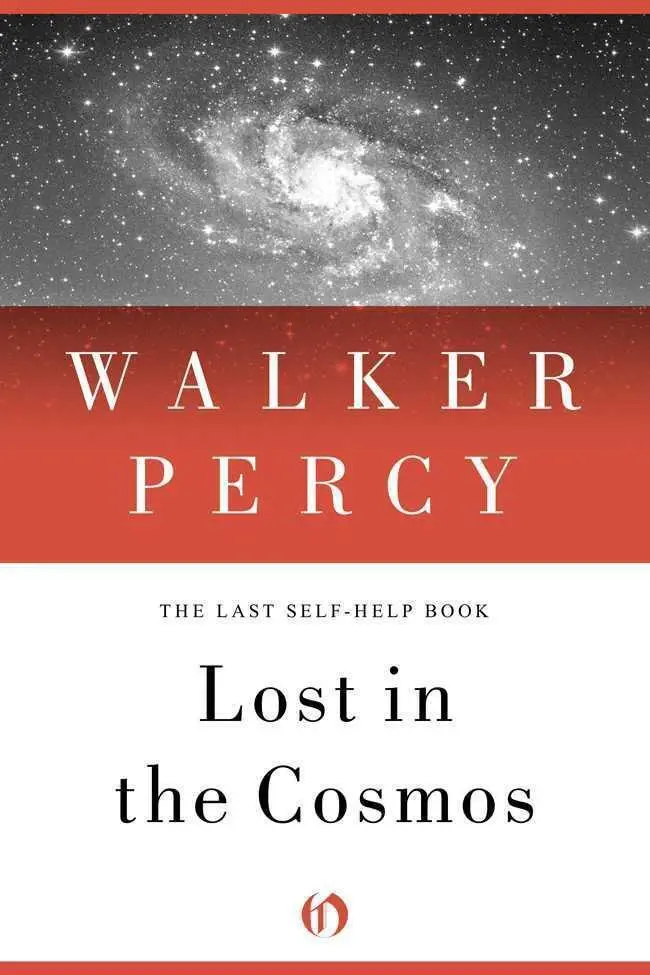
- Название:Lost in the Cosmos
- Автор:
- Издательство:Open Road Media
- Жанр:
- Год:2011
- ISBN:нет данных
- Рейтинг книги:5 / 5. Голосов: 1
-
Избранное:Добавить в избранное
- Отзывы:
-
Ваша оценка:
Lost in the Cosmos: краткое содержание, описание и аннотация
Предлагаем к чтению аннотацию, описание, краткое содержание или предисловие (зависит от того, что написал сам автор книги «Lost in the Cosmos»). Если вы не нашли необходимую информацию о книге — напишите в комментариях, мы постараемся отыскать её.
is Percy’s unforgettable riff on the trend that swept the nation. Filled with quizzes, essays, short stories, and diagrams,
is a laugh-out-loud spin on a familiar genre that also pushes readers to serious contemplation of life’s biggest questions. One part parody and two parts philosophy,
is an enlightening guide to the dilemmas of human existence, and an unrivaled spin on self-help manuals by one of modern America’s greatest literary masters.
Lost in the Cosmos — читать онлайн бесплатно полную книгу (весь текст) целиком
Ниже представлен текст книги, разбитый по страницам. Система сохранения места последней прочитанной страницы, позволяет с удобством читать онлайн бесплатно книгу «Lost in the Cosmos», без необходимости каждый раз заново искать на чём Вы остановились. Поставьте закладку, и сможете в любой момент перейти на страницу, на которой закончили чтение.
Интервал:
Закладка:
*Here might be listed all the “existentialia” of Heidegger, the inauthentic ways in which the Dasein, or self, inserts itself into its world, e.g., Gerede, talk, gossip; Neugíer, curiosity.
(13) The Transcending Self: How the Self Characteristically Places itself vis-à-vis the World, particularly through modes of Transcendence and Immanence
SCENE: A CORN DANCE at the Taos Indian pueblo in the 1940s. There has been a long dry spell. The dancers invoke the kachinas (god-ancestors) of the West who will come at the winter solstice and leave at the summer solstice. The dancers supplicate the kachinas by a monotonous and rhythmic pounding of bare feet on the hard-packed earth.
It is not a notable festival. There is not much masking or face and body-painting, nor any sign of the flamboyant buffalo and deer totemism of the hunting dances. The costumes are dark, drab kilts. The dance itself is perfunctory, more light-footed and syncopated than most Pueblo dances.
But it is a magical place.
Over there is the squat adobe church of San Francisco de Ranchos de Taos. But here in the vast open plaza there is also the sense of the mysteries conducted within the old Great Kiva, of which hardly a trace remains.
The setting sun is already reddening the upper slopes of the Sangre de Cristo Mountains. Not far away, nestled in the pines of the same Blood-of-Christ Mountains is a small shrine commemorating D. H. Lawrence, with a monstrance purporting to contain his ashes. Atop the shrine is a queer-looking epicene eagle with breasts: Lawrence as Phoenix rising from the ashes.
All manner of artists and writers, mystics, dropouts, and peyote-poppers live in the foothills. But a little farther north, at Los Alamos, an elite group of scientists is conducting an experiment which will fatefully alter the entire course of human history.
It is as if all the forces of the Cosmos had intersected here. The old cosmological gods remained even after the new God came. The new God remains after the transcending spirit of science and art has come. Even the old Brahman self-god of the East has lately arrived.
It is a haunted place, haunted by old gods and now by new people possessed by spirits all their own. Jungians from all over are drawn here as irresistibly as flies to pheromones, knowing that they can find in this enchanted sky-country the very incarnations of their archetypes and demons.
CAST OF CHARACTERS: Among those present at the Corn Dance are a nuclear physicist, his assistant, an old Pueblo Indian dancer, a young Pueblo Indian dancer, an English novelist, a divorcée, a tourist from Moline, Illinois, a Catholic priest, a radio repairman, a Marxist technician.
Some of the ten feel that they transcend the others. That is to say, he or she may feel that by virtue of a certain education, a certain wisdom, a certain talent, a certain gnosis, he stands in such a relation to the others that he can understand them and they can’t understand him.
For example, the English novelist can perhaps be said to transcend the Illinois tourist, understand him and his camera — in fact, has written about him — in a sense in which the tourist does not understand the novelist.
The physicist and his assistant, both of whom are amateur anthropologists, profess to have an understanding of both the Indian dancers and the Catholic priest which neither the priest nor the dancers profess to have of the physicist and his assistant.
The young Indian dancer believes that he transcends the old Indian dancer because he, the young Indian, has put behind him myth and superstition for a world of science and progress.
The old Indian dancer believes that he transcends the young dancer because he, the old Indian, has kept the cosmological myths by which the world, life, and time are integrated into a meaningful whole while the deranged Western society in Albuquerque goes to pieces.
A similar symmetrical relation of transcendence exists between the physicist and the novelist. The physicist believes that science — i.e., psychology — can at least in principle explain what makes the novelist tick by taking account of his early repressions, his later sublimations, and so on. Whereas the novelist, famous for his sharp eye and his knack for sizing up people and rendering them with a few deft strokes, has already “placed” the American scientist just as he has placed the tourist and the Indians.
There are three questions to keep in mind while reading the following summary of the various modes of transcendence and immanence of the ten characters.
Question (I): Is there any sense in which it can be said truthfully that this or that member of the cast does in fact transcend some other member? Or are the ten no more or less than as described, a cast of characters, and therefore no judgment of transcending superiority or immanent inferiority can be objectively arrived at?
Question (II): But in a play it is sometimes fair to say that one character is better or worse than another. There are, after all, good people and bad people. Can you say, then, that some of the ten are better or worse than the others? If so, are the best also the most transcendent?
Question (III): Which character do you most nearly identify with? Which character would you rather be?
(a) A nuclear physicist: a youngish scientist, hard at work on the Manhattan Project at Los Alamos. He is having, as Freeman Dyson put it, the best time of his life, embarked as he is on a top-secret project set down in a wilderness with an elite of an elite, the best scientific brains in the Western world, even though he knows he is making a weapon which will almost certainly kill thousands of human beings and may very well spell man’s ultimate self-destruction. Yet he is no narrowly educated scientist. His interests are far-ranging. He is by way of being an amateur ethnologist, a student of Oriental philosophy, and a member of a competent if unprofessional string quartet. He can speak as readily of Ramakrishna and Beethoven’s last quartets as he does of Planck and Fermi.
As he watches the Corn Dance, he is engaged in an animated conversation with his assistant, a handsome blond girl. It is mostly a lecture, to which she gives her rapt attention. He compares the festivals and ceremonials of the different pueblos. Taos is rather ordinary. She ought to see the Corn Dance at Santo Domingo! On the feast day of the saint, the Catholic and tribal religions converge in a nice way characteristic of the tolerant pueblos. The statue of St. Dominic is taken from the church, paraded through the streets to the accompaniment of snare drums and gunshots, then stuck up on a cottonwood branch to enjoy the native ceremonial. In his low, earnest voice, he tells her of the pueblo equivalent of the Virgin Mary: “They call her the Spider Grandmother or Thought Woman, who created all things by thinking them into existence. Rather nice, don’t you think?”
“Oh yes! Oh yes!” murmurs his assistant, leaning toward him.
(b) His assistant, a tall striking blonde, a graduate student from Berkeley who shares the scientist’s every interest but one: she is deeply and frantically in love with him and therefore is both miserable for fear he may not love her and also ecstatically transcendent toward the crowd of tourists, feeling sorry for them not only because they have been transcended but also because they are not in love.
(c) An old Pueblo Indian dancer, who has never left the pueblo, who believes the cosmological myths of the pueblo and who further believes that the Corn Dance will invoke the kachinas of the West and that rain will come to the parched fields in consequence.
(d) A young Pueblo Indian dancer, a sophomore at the University of New Mexico in Albuquerque, a major in business administration, a promising basketball forward, for whom it goes without saying that the cosmological myths of his tribe are just that, myths, to be taken no more seriously than what he considers the Judaeo-Christian myths of the Catholic Church in which he was baptized. He joined the Newman Club of U. of N.M. to meet girls and did. It is with a complex good-natured irony that he paints his body and dons the costume and enters into the Corn Dance, an irony compounded of a gentle forbearance toward his elders and a sardonic contempt for the camera-clicking Anglos and tourists. He can also use the money he’ll make from the photography fees.
Читать дальшеИнтервал:
Закладка:
Похожие книги на «Lost in the Cosmos»
Представляем Вашему вниманию похожие книги на «Lost in the Cosmos» списком для выбора. Мы отобрали схожую по названию и смыслу литературу в надежде предоставить читателям больше вариантов отыскать новые, интересные, ещё непрочитанные произведения.



Обсуждение, отзывы о книге «Lost in the Cosmos» и просто собственные мнения читателей. Оставьте ваши комментарии, напишите, что Вы думаете о произведении, его смысле или главных героях. Укажите что конкретно понравилось, а что нет, и почему Вы так считаете.