Walker Percy - Lost in the Cosmos
Здесь есть возможность читать онлайн «Walker Percy - Lost in the Cosmos» весь текст электронной книги совершенно бесплатно (целиком полную версию без сокращений). В некоторых случаях можно слушать аудио, скачать через торрент в формате fb2 и присутствует краткое содержание. Год выпуска: 2011, Издательство: Open Road Media, Жанр: Критика, История, Философия, на английском языке. Описание произведения, (предисловие) а так же отзывы посетителей доступны на портале библиотеки ЛибКат.
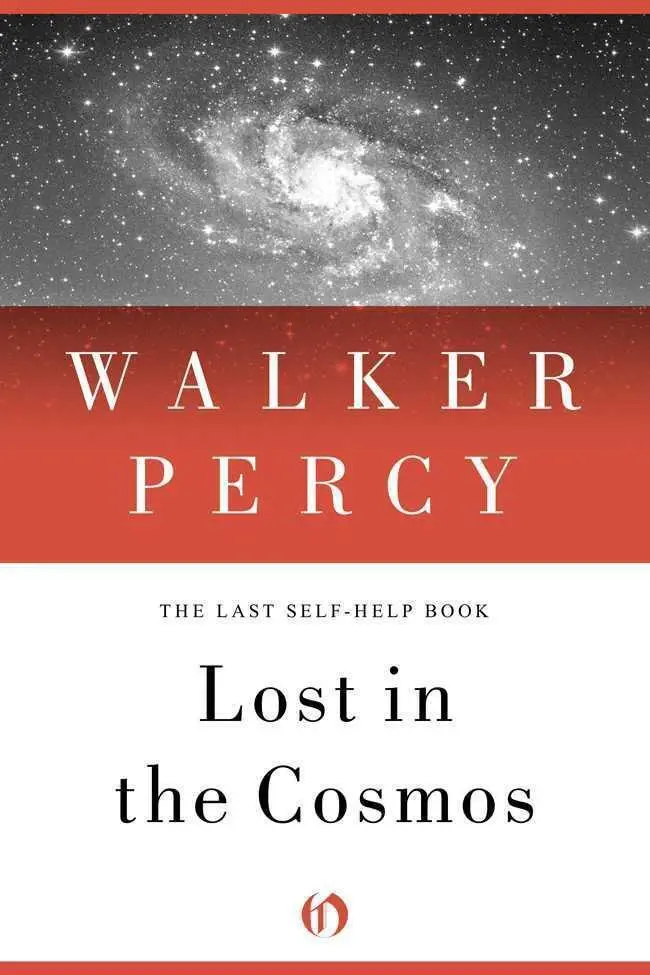
- Название:Lost in the Cosmos
- Автор:
- Издательство:Open Road Media
- Жанр:
- Год:2011
- ISBN:нет данных
- Рейтинг книги:5 / 5. Голосов: 1
-
Избранное:Добавить в избранное
- Отзывы:
-
Ваша оценка:
Lost in the Cosmos: краткое содержание, описание и аннотация
Предлагаем к чтению аннотацию, описание, краткое содержание или предисловие (зависит от того, что написал сам автор книги «Lost in the Cosmos»). Если вы не нашли необходимую информацию о книге — напишите в комментариях, мы постараемся отыскать её.
is Percy’s unforgettable riff on the trend that swept the nation. Filled with quizzes, essays, short stories, and diagrams,
is a laugh-out-loud spin on a familiar genre that also pushes readers to serious contemplation of life’s biggest questions. One part parody and two parts philosophy,
is an enlightening guide to the dilemmas of human existence, and an unrivaled spin on self-help manuals by one of modern America’s greatest literary masters.
Lost in the Cosmos — читать онлайн бесплатно полную книгу (весь текст) целиком
Ниже представлен текст книги, разбитый по страницам. Система сохранения места последней прочитанной страницы, позволяет с удобством читать онлайн бесплатно книгу «Lost in the Cosmos», без необходимости каждый раз заново искать на чём Вы остановились. Поставьте закладку, и сможете в любой момент перейти на страницу, на которой закончили чтение.
Интервал:
Закладка:
the human sign as the union of the signifier (signifiant) and the signified ( signifié); Hans Werner, who systematically explored the process in which the signified is articulated within the form of the signifier; Susanne K. Langer, who, from the posture of behavioral science, clearly set forth the qualitative difference between animal’s use of signals and man’s use of symbols.
*I am grateful for the important distinction, clearer in the German language and perhaps for this reason first arrived at by German thinkers, between Well and Umwelt, or, roughly, world and environment, e.g., von Uexkull’s Unwelt as, roughly, the significant environment within which an organism lives, and Heidegger’s Welt, the “world” into which the Dasein or self finds itself “thrown”; also, Eccles’ “World 3,” the public domain of signs and language within which man — uniquely, according to Eccles — lives.
The foes? If there are foes, it is not because they have not made valuable contributions in their own disciplines, but because in this particular context, that of a semiotic of the self, they are either of no use or else hostile by their own declaration.
The first is the honorable tradition of American behaviorism, once so influential, and latterday behaviorist semioticists like Charles Morris — honorable because of their rigorous attempt as good scientists to deal only with observables and so to bypass the ancient pitfalls of mind, soul, consciousness, and self which have bogged down psychologists for centuries. I start from the same place, looking at signs and the creatures which use them.
My difficulty with the behaviorists is that they rule out mind, self, and consciousness as inaccessible either on the doctrinal grounds that they do not exist or on methodological grounds that they are beyond the reach of behavioral science.
It is not necessarily so. The value of Charles Peirce and social psychologists like George Mead is that they underwrite the reality of the self without getting trapped in the isolated autonomous consciousness of Descartes and Chomsky. They do this by showing that the self becomes itself only through a transaction of signs with other selves — and does so, moreover, without succumbing to the mindless mechanism of the behaviorists.
The other semiotic foe is French structuralism — some of its proponents, at least — and its whimsical stepchild “deconstruction.” The structuralists, in high fashion — at least until recently — seek to apply the methods of structural linguistics to such diverse matters as literature, myth, fashion, even cooking. Whatever the virtues of structuralism as a method of linguistics, ethnology, and criticism, it is the self-proclaimed foe, on what seem to be ideological grounds, of the very concept of the human subject. Lévi-Strauss boasts of the dehumanization which his structuralism implies. Michel Foucault argues that with the coming of semiotics the concept of the self has vanished from our new view of reality.
But this may not be the case.
I do not feel obliged to speak of the deconstructionists.
Finally, a terminological confusion needs to be straightened out. There is an almost intractable confusion about the terms sign and symbol. We may know what we mean when we say there is a difference between my dog’s understanding of the word ball —to go and look for it — and your understanding of the same utterance — you may say “Ball? What about it?”—but we need to agree on what words to use to express the difference. Some writers (e.g., Peirce and Langer) would call the former ball a sign and the latter ball a symbol. Others would call the former a signal, the latter a sign. Though I have followed Peirce’s usage in earlier writings, I propose here to use the word signal for the former and, following Saussure, the word sign for the latter, and to avoid symbol as much as possible. This usage seems advisable for two reasons. One is that symbol for most people seems to connote something emblematic like the flag or the cross and not the radical sense in which the common nouns of language are understood as symbols by Peirce, Cassirer, and Langer. The other reason is that the latter usage will be easier to reconcile with Saussure’s valuable dissection of the sign into its two elements, signifier (signifiant) and signified (signifié).
* Helen Keller, The Story of My Life (New York: Airmont Publishing Co., 1965), p. 187.
† New Directions in the Study of Language, ed. Eric H. Lenneberg (Cambridge: The M.I.T. Press, 1964), p. 131.
*Philip E. L. Smith in Cro-Magnon Man, ed. by Tom Prideaux (New York: Time-Life Books, 1973), p. 7.
*I will not try to decide here whether what the word apple conjures up in your mind, its signifié, is a percept or a concept, because it is somewhere in between, A percept refers to an individual apple. A concept is an abstraction from all apples, a definition of apple. But the signifié of apple is both and nejther. What comes to mind when I hear apple, what in fact the word articulates within itself, is neither an individual apple nor a definition of apple but a quality of appleness, such as John Cheever intended in his title, World of Apples. Perhaps it should be called a “concrete concept” or an “abstract percept,” or what Gerard Manley Hopkins called inscape.
Let us take note of a notorious philosophical farrago without attempting to resolve it: Why is it that when we look at an apple, we believe we are looking at an apple out there, and not at sensory impression, a picture, in our brain? This puzzle can hardly be addressed here, since it is nothing less than the main source of the troubles which have dogged solipsist philosophers from Descartes and Locke to the present day. My own conviction is that semiotics provides an escape from the solipsist prison by its stress on the social origins of language — you have to point to an apple and name it for me before I know there is such a thing — and the existence of a world of apples outside ourselves.
*The semioticist most acutely aware of this devolution of the sign and its renewal through the “defamiliarization” of art is the Russian formalist, Victor Schklovsky.
*Does ontogenesis shed any light here?
The two-year-old comes bursting into the world of signs like a child on Christmas morning. There are goodies everywhere. For him, signifying the signified is like unwrapping a gift.
What about a four-year-old? By now he should be a sovereign and native resident of his world, concelebrant with his family, at home in Eden. Listen to Gesell and his colleagues describe him: “The typical 4-year-old.. tends to be rather a joy. His enthusiasm, his exuberance, his willingness to go more than halfway to meet others in a spirit of fun are all extremely refreshing… He is basically highly positive, enthusiastic, appreciative. This makes him fun to be with, an engaging, amusing, ever-challenging friend. You have to be on your toes to keep up with spirited, fanciful FOUR, but at least you have an even chance of success… With other children, things as a rule go rather well. FOURS enjoy each other; they appreciate the challenge that other children offer. This is an age at which children interest and admire each other most…” [Louise Bates Ames et al., The Gesell Institute’s Child from One to Six (New York: Harper and Row, 1979).]
The four-year-old is a concelebrant of the world and even of his own peers.
The seven-year-old? Something has happened in the interval.
“More aware of and withdrawn into self… Seems to be in ‘another world'… Self-conscious about own body. Sensitive about exposing body. Does not like to be touched. Modest about toileting … Protects self by withdrawal. May be unwilling to expose knowledge, for fear of being laughed at or criticized.. Apt to expect too much of self.” [Arnold Gesell and Frances ilg. The Child from Five to Ten (New York: Harper and Row, 1946).]
Читать дальшеИнтервал:
Закладка:
Похожие книги на «Lost in the Cosmos»
Представляем Вашему вниманию похожие книги на «Lost in the Cosmos» списком для выбора. Мы отобрали схожую по названию и смыслу литературу в надежде предоставить читателям больше вариантов отыскать новые, интересные, ещё непрочитанные произведения.








Обсуждение, отзывы о книге «Lost in the Cosmos» и просто собственные мнения читателей. Оставьте ваши комментарии, напишите, что Вы думаете о произведении, его смысле или главных героях. Укажите что конкретно понравилось, а что нет, и почему Вы так считаете.