Walker Percy - Lost in the Cosmos
Здесь есть возможность читать онлайн «Walker Percy - Lost in the Cosmos» весь текст электронной книги совершенно бесплатно (целиком полную версию без сокращений). В некоторых случаях можно слушать аудио, скачать через торрент в формате fb2 и присутствует краткое содержание. Год выпуска: 2011, Издательство: Open Road Media, Жанр: Критика, История, Философия, на английском языке. Описание произведения, (предисловие) а так же отзывы посетителей доступны на портале библиотеки ЛибКат.
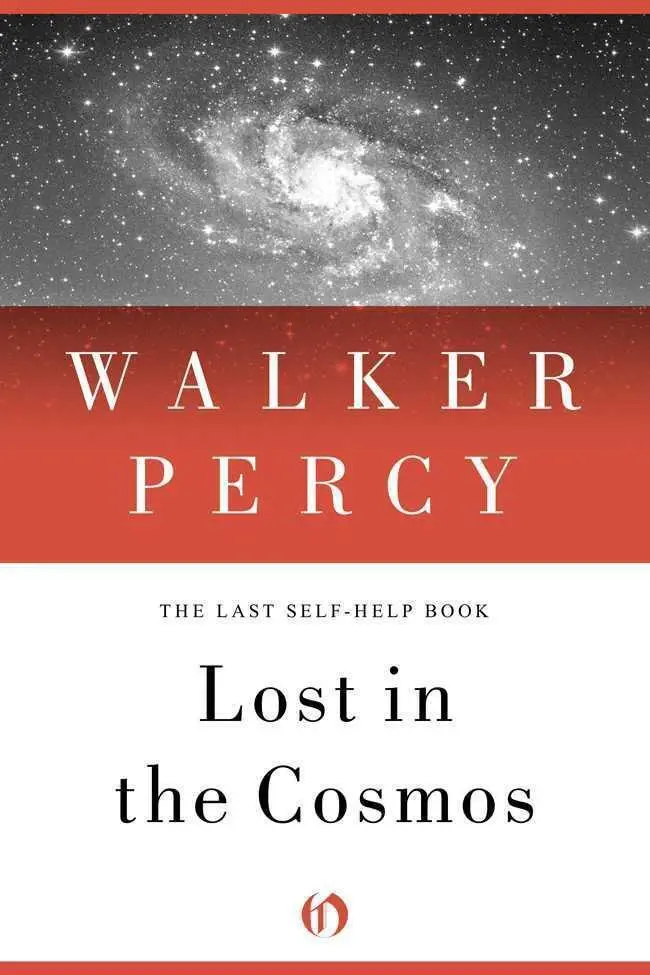
- Название:Lost in the Cosmos
- Автор:
- Издательство:Open Road Media
- Жанр:
- Год:2011
- ISBN:нет данных
- Рейтинг книги:5 / 5. Голосов: 1
-
Избранное:Добавить в избранное
- Отзывы:
-
Ваша оценка:
Lost in the Cosmos: краткое содержание, описание и аннотация
Предлагаем к чтению аннотацию, описание, краткое содержание или предисловие (зависит от того, что написал сам автор книги «Lost in the Cosmos»). Если вы не нашли необходимую информацию о книге — напишите в комментариях, мы постараемся отыскать её.
is Percy’s unforgettable riff on the trend that swept the nation. Filled with quizzes, essays, short stories, and diagrams,
is a laugh-out-loud spin on a familiar genre that also pushes readers to serious contemplation of life’s biggest questions. One part parody and two parts philosophy,
is an enlightening guide to the dilemmas of human existence, and an unrivaled spin on self-help manuals by one of modern America’s greatest literary masters.
Lost in the Cosmos — читать онлайн бесплатно полную книгу (весь текст) целиком
Ниже представлен текст книги, разбитый по страницам. Система сохранения места последней прочитанной страницы, позволяет с удобством читать онлайн бесплатно книгу «Lost in the Cosmos», без необходимости каждый раз заново искать на чём Вы остановились. Поставьте закладку, и сможете в любой момент перейти на страницу, на которой закончили чтение.
Интервал:
Закладка:
Now, imagine that you yourself are present at the Taos Corn Dance, where the old gods are still remembered, plus the new God, plus the competing spirits of transcendence of the modern age — something new in the Cosmos — plus the acceptance of the demotion to the pure spirit of immanence — also something new.
Chart your own semiotic profile.
(14) The Orbiting Self: Reentry Problems of the Transcending Self, or Why it is that Artists and Writers, Some Technologists, and indeed Most People have so much Trouble Living in the Ordinary World
IN THE AGE OF science, scientists are the princes of the age. Artists are not. So that even though both scientists and artists achieve transcendence over the ordinary world in their science and art, only the scientist is sustained in his transcendence by the exaltation of the triumphant spirit of science and by the community of scientists.
It is perhaps no accident that at the high tide of physics in the nineteenth and early twentieth centuries, the great revolutionary physicists — e.g., Faraday, Maxwell, Bohr, Einstein — were also men of remarkable integrity and exultant wholeness of character, of generosity and benignity. Compare the lives and characters of the comparably great in literature at the same time: Dostoevsky, Baudelaire, Kafka, Joyce, Lawrence, Hemingway.
With the disappearance of the old cosmological myths and the decline of Judaeo-Christianity and the rise of the autonomous self, science and art, one the study of secondary causes, the other the ornamental handmaiden of rite and religion, were seized upon and elevated to royal highroads of transcendence in their own right. Such transcendence was available not only to the scientists and artists themselves but to a community of fellow scientists and students, and to the readers and listeners and viewers to whom the “statements” of art, music, and literature were addressed.
But what is not generally recognized is that the successful launch of self into the orbit of transcendence is necessarily attended by problems of reentry. What goes up must come down. The best film of the year ends at nine o’clock. What to do at ten? What did Faulkner do after writing the last sentence of Light in August? Get drunk for a week. What did Dostoevsky do after finishing The Idiot? Spend three days and nights at the roulette table. What does the reader do after finishing either book? How long does his exaltation last?
The only exception to this psychic law of gravity seems to be not merely the great physicists at the high tide of modern physics but any scientist absorbed in his science when the exaltation of science sustains one in a more or less permanent orbit of transcendence — or perhaps the rare Schubert who even during meals wrote lieder on the tablecloth or the Picasso in a restaurant who instead of eating bread molded it into statuettes.
But the most spectacular problems of reentry seem to be experienced by artists and writers. They, especially the latter, seem subject more than most people to estrangement from the society around them, to neurosis, psychosis, alcoholism, drug addiction, epilepsy, florid sexual behavior, solitariness, depression, violence, and suicide.
Question: Is this the case because
(a) Genius is close to madness (Plato)?
(b) Modern society, especially American, is crass, materialistic, money-grubbing, and status-seeking, a nation of Yahoos and Babbitts, and the artist who is in pursuit of truth and beauty is entitled to be alienated (Gauguin, Flaubert, Lewis, et al.)?
(c) Art is an expression of sublimated libidinal energies (Freud)? Since the artist is presumably either oversupplied with such energies or overly repressed, it is only to be expected that he or she might also be subject to the various maladies attendant upon repressed sexuality.
(d) Art, unlike science, is a kind of play (Dewey)? Therefore, artists are expected to behave like children.
(e) Both art and science are ways of knowing and as such are the greatest pleasures of which man is capable (Aristotle, Aquinas)? So great, in fact, that the ordinary pursuits of life are spoiled by contrast and so the artist must go to heroic lengths to render life intolerable outside his art. What Einstein said of science might be said of art: I went into science to escape the intolerable dreariness of everyday life.
(CHECK ONE)
Art, like science, entails a certain abstraction from its subject matter, albeit a different order of abstraction. And the better the artist, the greater the distance of abstraction. Thus, writers like Sidney Sheldon and Harold Robbins are as much in the marketplace as any other producer or seller. But writers like Joyce, Faulkner, Proust are able to write about the marketplace and society only in the degree that they distance themselves from it — whether by exile, alcohol, or withdrawal to a cork-lined room.
Like scientists, artists make general statements about the world, not about forms of energy exchange but what it is like to live in the world — statements which reader or viewer confirms by his assent and pleasure (where else does the reader’s pleasure come from but the reader’s recognition of and identification with the artist’s work?), just as the scientist confirms scientific statements by tests and reading pointers.
Although science and art are generally taken to be not merely different but even polar opposites — the one logical, left-brained, unemotional, Apollonian, analytical, discursive, abstract; the other intuitive, playful, concrete, Dionysian, emotional — the fact is that both are practiced at a level of abstraction, both entail transactions with symbols and statements about the world, both are subject to confirmation or disconfirmation. The pleasure of reading Dostoevsky derives from a recognition and a confirmation. The dismay of looking at a bad painting or reading a bad poem is a disconfirmation.
For a writer to reenter the world he has written about is no small feat. At the least, it is a peculiar exercise, even uncanny — like Kierkegaard going out into the street every hour during work and blinking at the shopkeepers. At the worst, it proves impossible, issuing in the familiar catastrophes to which writers fall prey.
Thought Experiment: A deductive-empirical exercise, something like Mendeleev’s project of deducing the periodic table of the elements, then looking around to see if there are actual elements which fit in the table.
This enjoyable exercise is the deduction of the various possible reentry modes of the artist-writer or reader-viewer from the semiotic options theoretically available to any person so abstracted from the world.
The experiment: Start with the world, that is, the same somewhat deranged place which everyone experiences in more or less the same degree. The world is the aggregate of your perceived environment encoded by signs: other people, family, house, marketplace, culture, myth, TV, past, future, and God as more or less real depending on whether you are an unbeliever or a believer, and even if the latter, then God as more or less problematical.
Next, there is the self, the individual conscious artist-writer reader-viewer self, the movable piece in the world, like a token in a Monopoly game.
The problem for the movable piece: How do you go about living in the world when you are not working at your art, yet still find yourself having to get through a Wednesday afternoon?
Note: This game can be played by artists and writers or by non-artists and non-writers, in fact by all true denizens of the age, that is, any person in the culture who feels himself orbiting the world, out of the here-and-now, out of life in a place and a time, and experiencing difficulty with reentry into such a life.
Читать дальшеИнтервал:
Закладка:
Похожие книги на «Lost in the Cosmos»
Представляем Вашему вниманию похожие книги на «Lost in the Cosmos» списком для выбора. Мы отобрали схожую по названию и смыслу литературу в надежде предоставить читателям больше вариантов отыскать новые, интересные, ещё непрочитанные произведения.




Обсуждение, отзывы о книге «Lost in the Cosmos» и просто собственные мнения читателей. Оставьте ваши комментарии, напишите, что Вы думаете о произведении, его смысле или главных героях. Укажите что конкретно понравилось, а что нет, и почему Вы так считаете.