Walker Percy - Lost in the Cosmos
Здесь есть возможность читать онлайн «Walker Percy - Lost in the Cosmos» весь текст электронной книги совершенно бесплатно (целиком полную версию без сокращений). В некоторых случаях можно слушать аудио, скачать через торрент в формате fb2 и присутствует краткое содержание. Год выпуска: 2011, Издательство: Open Road Media, Жанр: Критика, История, Философия, на английском языке. Описание произведения, (предисловие) а так же отзывы посетителей доступны на портале библиотеки ЛибКат.
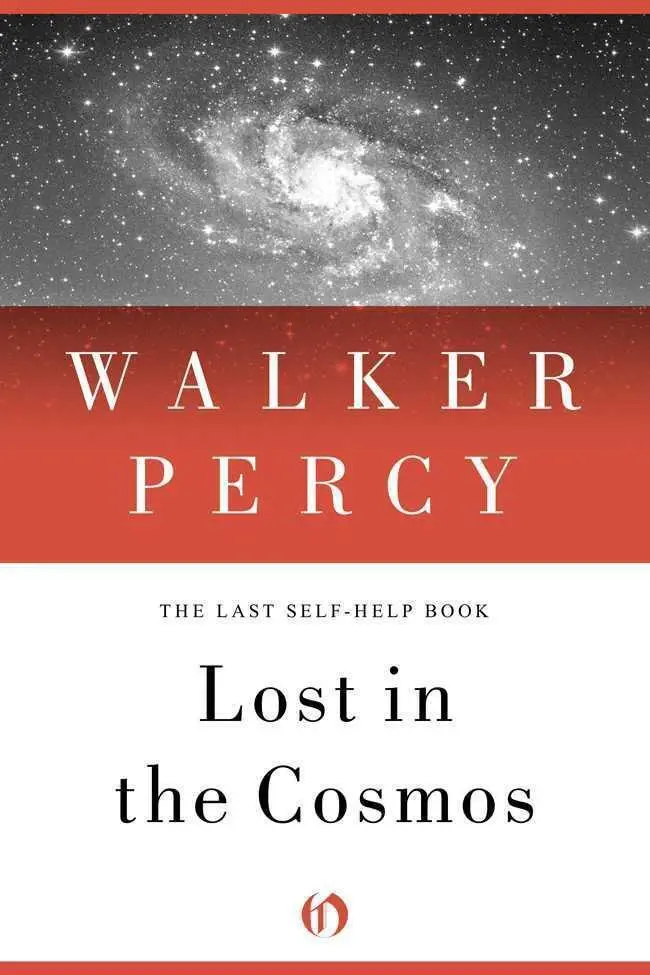
- Название:Lost in the Cosmos
- Автор:
- Издательство:Open Road Media
- Жанр:
- Год:2011
- ISBN:нет данных
- Рейтинг книги:5 / 5. Голосов: 1
-
Избранное:Добавить в избранное
- Отзывы:
-
Ваша оценка:
Lost in the Cosmos: краткое содержание, описание и аннотация
Предлагаем к чтению аннотацию, описание, краткое содержание или предисловие (зависит от того, что написал сам автор книги «Lost in the Cosmos»). Если вы не нашли необходимую информацию о книге — напишите в комментариях, мы постараемся отыскать её.
is Percy’s unforgettable riff on the trend that swept the nation. Filled with quizzes, essays, short stories, and diagrams,
is a laugh-out-loud spin on a familiar genre that also pushes readers to serious contemplation of life’s biggest questions. One part parody and two parts philosophy,
is an enlightening guide to the dilemmas of human existence, and an unrivaled spin on self-help manuals by one of modern America’s greatest literary masters.
Lost in the Cosmos — читать онлайн бесплатно полную книгу (весь текст) целиком
Ниже представлен текст книги, разбитый по страницам. Система сохранения места последней прочитанной страницы, позволяет с удобством читать онлайн бесплатно книгу «Lost in the Cosmos», без необходимости каждый раз заново искать на чём Вы остановились. Поставьте закладку, и сможете в любой момент перейти на страницу, на которой закончили чтение.
Интервал:
Закладка:
(4) Reentry by travel (sexual). One has a succession of lovers of the opposite sex, the same sex, or both. It is difficult to imagine the self of the autonomous artist in his singular and godlike abstraction from the ordinary world of men settling down with a wife and family any more than Jove settling down with Juno. Juno — yuck! Wife, children, home, fireside, TV, patio, Medicare in Florida, growing old together, John Anderson, my jo, John — yuck! Better to grow old alone in the desert, sit on a rock like a Navajo. But how lovely are the daughters of men! Indeed, heterosexual inter course is the very paradigm of the reentry of the ghost-self back into the incarnate world whence it came. Not cogito ergo sum —God, how sick is the self of three hundred years of that cogitation, a very bad French connection — but rather: If I enter you, I am alive, even human.
Further exercises: Why are so many artist-writers homosexual? Because the estrangement of the self can be so extreme that not even the welcoming woman can be used as a portal of reentry — on the contrary, she becomes the voracious vagina, the pure negativity which, risking nothing, maliciously requires performance and therefore threatens to expose one’s noughtness. If so, better to cast one’s lot with one’s own kind, own sex.
And why are artist-writers more promiscuous than scientists? Because science works better, this is the age of science, scientists are the princes of the age, while artist-writers are the frantic Lazaruses at the feast, hungering for crumbs like the dogs, the while scratching and screwing around under the table.
(5) Reentry by return. The options of travel and exile may be exhausted, yet instead of despairing, the traveler may hit upon one last alternative: the return. Why not go back to the very place one left, as a kind of deliberate exercise of freedom? Not only is it not the case that you can’t go home again, you may have to — back to the evacuated, bombed-out homeplace, a ruin which by the very fact of its abandonment has in the long interval of one’s absence magically acquired a certain solidity and integrity of its own. The Southern writer who put Valdosta behind him as fast and far as Doc Holliday and roamed the world from Martha’s Vineyard to Cuernavaca now at last gets a hankering for home. And goes home — for a while. It’s one thing to develop a nostalgia for home while you’re boozing with Yankee writers in Martha’s Vineyard or being chased by the bulls in Pamplona. It’s something else to go home and visit with the folks in Reed’s drugstore on the square and actually listen to them. The reason you can’t go home again is not because the down-home folks are mad at you — they’re not, don’t flatter yourself, they couldn’t care less — but because once you’re in orbit and you return to Reed’s drugstore on the square, you can stand no more than fifteen minutes of the conversation before you head for the woods, head for the liquor store, or head back to Martha’s Vineyard, where at least you can put a tolerable and saving distance between you and home. Home may be where the heart is but it’s no place to spend Wednesday afternoon.
(6) Reentry by disguise. The writer-artist cloaks his noughted self not by wrapping himself in bandages like H. G. Wells’s invisible man but by donning the persona-plus-costume worn by those persons who strike him as having most successfully entered the world — or never left it. A more respectable word for such a disguise is role-playing. A hundred years ago, artists, would-be artists, writer-types on the Left Bank wore workers’ smocks and berets. More recently, it is jeans, beards, bandit mustaches, denim jackets, tank tops, longhorn belt buckles, and such. But what to do if the crassest members of the marketplace, car salesman, account executive, go cowboy? That is to say, what to do if one’s chosen mode of reentry has been co-opted by those very persons who had driven one into outer space to begin with?
The disguise may be behavioral as well as sartorial. Not celebrated in past times for their pugnacity or womanizing, American writers have turned into real cutups, the Southern subspecies often taking the old-fashioned form of the hell-raising passed-out-drunk-in-the-whorehouse good-ol'-boy, the Northern more political: the cocktail-party nose-to-nose you’re-deep-down-a-fascist-son-of-a-bitch confrontation, or throwing a punch at the critic who bad-mouthed you in Time —though seldom with much effect — or beating up your wife in the kitchen. Poets from all over feel obliged to become more florid sexually. Straight poets on the lecture circuit exchange a black book listing the best lays in the universities where they read. Other poets (male) are noted for flashing and feeling up male graduate students. No more shy Swinburnes or pale Dante Gabriel Rossettis or closet Housmans.
The main difference between latter-day Southern writers and latter-day Northern writers: both are aware of the necessity to shock the reader out of self-unawareness and into recognition of the advanced derangement of the world, but the Southern writer does it by having a character offend against a decayed but still extant ethos — a twin ethos, the Biblical tradition and the honor code. That is, he sins, usually sexually, or commits a Gothic atrocity against a backdrop of faded Jeffersonian splendor — and sometimes does both at once, like Temple Drake getting corncobbed by Popeye at the old Frenchman place in Faulkner’s Sanctuary. The latter-day Northern writer, lacking either tradition and having nothing to offend against, must rely on an act of gratuitous and comedic violence — like Michael Milton getting his penis bitten off by Helen Garp in Irving’s The World According to Garp.
An observation about disguises: The New Orleans French Quarter has long attracted artists and writers and homosexuals for the good and understandable reasons given above: Latinity, quaintness, moderate exoticness, Mardi Gras, the usual para-Catholic aura — and the easiest way to get out of Mississippi and Ohio. But it is also a para-creative aura. Just as the denizens of the Vieux Carré live in the penumbra of the cathedral, they also live in the penumbra of art. Surprisingly little first-class art has come out of the French Quarter, even though it rather self-consciously imitates the decor of the Left Bank, habitat of many great artists years ago. This life style, as it is called, reminds one of the urban cowboy who secretly believes that if he dresses and walks like a cowboy, he may be a cowboy. Faulkner, never one to do things halfway, made extravagant use of standard modes of reentry in New Orleans, not merely geographical and perhaps sexual modes, not merely alcohol, but also a regular repertory of disguises. In the Vieux Carré he made appearances as a wounded veteran with swagger stick and a bogus steel plate in his head, a hard-drinking pre-hippie vagrant Left-Bank type — and wrote Mosquitoes, a not very good novel. It took the ultimate reentry, the return — he had to go home — to write The Sound and the Fury. Even then, he had to “be” a farmer on the side. Later he made the grandest Southern reentry of all, as a Virginia horseman.
A prediction: What with artist types and writer types and homosexuals (who must be applauded for their good taste in cities: New Orleans, San Francisco, Key West) taking over such places as the French Quarter, and business types and lawyer types going cowboy, I predict that working artists and writers will revert to the vacated places. In fact, they’re already turning up in ordinary houses and ordinary streets long since abandoned by the Hemingways and Agees. Soon they’ll be wearing ordinary shirts and pants and Thorn McAn shoes, not altogether unconsciously, but as a kind of exercise in the ordinary. What else? Where would you rather be if you were James Agee now and alive and well: stumbling around Greenwich Village boozed to the gills, or sitting on the front porch of a house on a summer evening in Knoxville?
Читать дальшеИнтервал:
Закладка:
Похожие книги на «Lost in the Cosmos»
Представляем Вашему вниманию похожие книги на «Lost in the Cosmos» списком для выбора. Мы отобрали схожую по названию и смыслу литературу в надежде предоставить читателям больше вариантов отыскать новые, интересные, ещё непрочитанные произведения.


Обсуждение, отзывы о книге «Lost in the Cosmos» и просто собственные мнения читателей. Оставьте ваши комментарии, напишите, что Вы думаете о произведении, его смысле или главных героях. Укажите что конкретно понравилось, а что нет, и почему Вы так считаете.