Walker Percy - Lost in the Cosmos
Здесь есть возможность читать онлайн «Walker Percy - Lost in the Cosmos» весь текст электронной книги совершенно бесплатно (целиком полную версию без сокращений). В некоторых случаях можно слушать аудио, скачать через торрент в формате fb2 и присутствует краткое содержание. Год выпуска: 2011, Издательство: Open Road Media, Жанр: Критика, История, Философия, на английском языке. Описание произведения, (предисловие) а так же отзывы посетителей доступны на портале библиотеки ЛибКат.
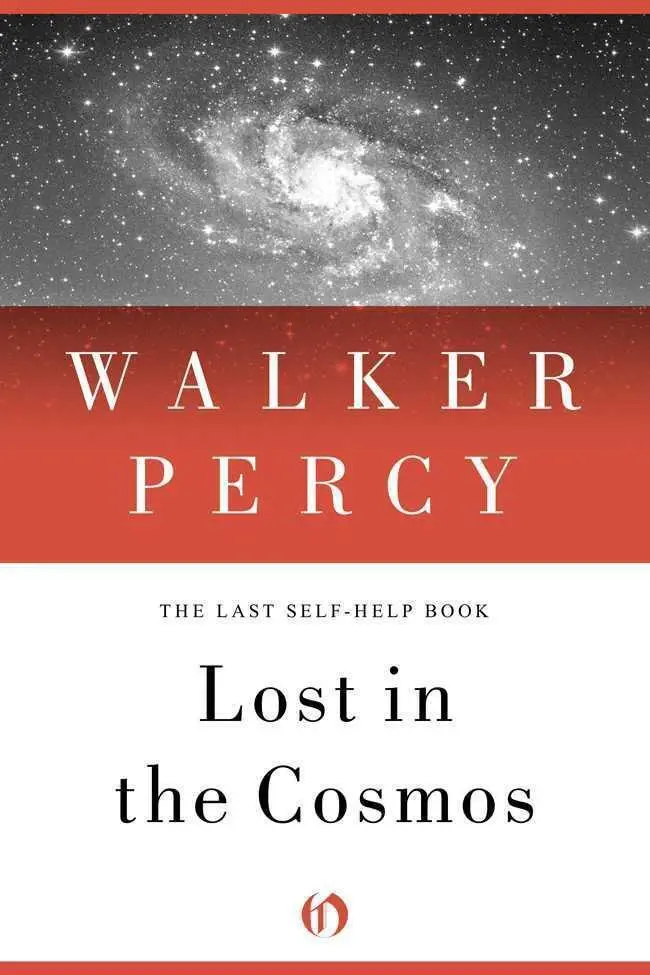
- Название:Lost in the Cosmos
- Автор:
- Издательство:Open Road Media
- Жанр:
- Год:2011
- ISBN:нет данных
- Рейтинг книги:5 / 5. Голосов: 1
-
Избранное:Добавить в избранное
- Отзывы:
-
Ваша оценка:
Lost in the Cosmos: краткое содержание, описание и аннотация
Предлагаем к чтению аннотацию, описание, краткое содержание или предисловие (зависит от того, что написал сам автор книги «Lost in the Cosmos»). Если вы не нашли необходимую информацию о книге — напишите в комментариях, мы постараемся отыскать её.
is Percy’s unforgettable riff on the trend that swept the nation. Filled with quizzes, essays, short stories, and diagrams,
is a laugh-out-loud spin on a familiar genre that also pushes readers to serious contemplation of life’s biggest questions. One part parody and two parts philosophy,
is an enlightening guide to the dilemmas of human existence, and an unrivaled spin on self-help manuals by one of modern America’s greatest literary masters.
Lost in the Cosmos — читать онлайн бесплатно полную книгу (весь текст) целиком
Ниже представлен текст книги, разбитый по страницам. Система сохранения места последней прочитанной страницы, позволяет с удобством читать онлайн бесплатно книгу «Lost in the Cosmos», без необходимости каждый раз заново искать на чём Вы остановились. Поставьте закладку, и сможете в любой момент перейти на страницу, на которой закончили чтение.
Интервал:
Закладка:
As unsatisfactory as the battle lines, as presently drawn, may be, one must nevertheless throw in with the modern evolutionist, if only for the reason that his position, if wrong, is in the end self-correcting, whereas that of the scientific creationist is not.
The battle is, in fact, a marvelous waste of energy.
The Christians need not have got in such a sweat. The evolutionary facts about the emergence of man, e.g., the sudden appearance of Homo sapiens sapiens (Cro-Magnon man) no more than 35 thousand years ago, are as spectacular as the account in Genesis and allow hardly less room for theology.
Scientists should be less worried about overt intrusions by religion upon science, which never succeed, and more worried about covert scientific dogma, e.g., that we triadic scientists require that only dyadic events be admissible to scientific theory. For example, scientists have never seriously addressed themselves to the phenomenon of language, considered as a natural phenomenon and not as a formal structure, that salient triadic property of man. It is only when science is willing to focus on what Sebeok calls “the intersection of nature and culture” that the full import of man’s emergence in the evolutionary scheme can be calculated.
Question: Why does it make scientists uneasy that it appears to be the case that Homo sapiens sapiens, a conscious languaged creature, appeared suddenly and lately — when scientists profess to be interested in what is the case, that is, the evidence?
(a) Because scientists are understandably repelled by the theory of the special creation of man by God, in Biblical time, say 6004 B.C. at 11 a.m. on a Wednesday morning.
(b) Because scientists find it natural to deal with matter in interaction and with energy exchanges and don’t know what to make of such things as consciousness, self, and symbols and even sometimes deny that there are such things, even though they, the scientists, act for all the world as if they were conscious selves and spend their lives transacting with symbols.
(c) Because scientists are uneasy with discontinuities, even when there is evidence of such discontinuity in the appearance of man in all his contrarieties. Revealed religion has its dogmas, e.g., thou shalt not kill. But so does science: thou shalt not tolerate discontinuities. The question is which is the more entitled.
(d) Because scientists in the practice of the scientific method, a non-radical knowledge of matter in interaction, often are not content with the non-radicalness of the scientific method and hence find themselves located in a posture of covert transcendence of their data, which is by the same motion assigned to the sphere of immanence. Hence, scientists operate in the very sphere of transcendence which is not provided for in their science. Given such a posture, it is not merely an offense if a discontinuity turns up in the sphere of immanence, the data, but especially if the discontinuity seems to allow for the intervention of God. A god is already present. A scientist is a god to his data. And if there is anything more offensive to him than the suggestion of the existence of God, it is the existence of two gods.
(CHECK ONE)
How can an immanent theory of evolution mounted from the transcending posture of science account for the appearance in the Cosmos of a triumphant, godlike, murderous alien, the only alien in the Cosmos, Homo sapiens sapiens, e.g., the scientist himself?
Which is to say only that Darwin was a very great scientist, that Wallace was a little nutty, sometimes obnoxiously occult, but in the end may have been closer to the truth about man.
Thought Experiment: You are a high-school student. In school, you attend biology class where you are taught modern evolutionary theory. On Sunday, you go to church, where you hear the story of creation from a fundamentalist preacher. Then you go to college and hear a liberal professor-theologian who teaches a class on Science and the World’s Great Religions. You speak to the professor-theologian about the dispute between the preacher and the biology teacher. The professor-theologian smiles and says: Both are right. Genesis is a mythical account of the origin of the Cosmos, the origin of life and the origin of man. There is a certain truth in this myth. There are other cosmological myths, each valid in its own way. There is such a thing as mythical truth. Indeed, the neo-Darwinian theory of evolution through mutations and natural selection is in fact more impressive evidence of God’s majesty than the notion that God created the millions of species by separate and arbitrary acts of creation like a child modeling a menagerie out of clay.
The student says: None of you is satisfactory. All of you are unconvincing — and you, the professor-theologian, may be the worst of the lot, satisfying nobody and papering over everything in the name of nothing. How can a myth which you say is untrue in the scientific sense be true in another sense? What is the truth? What I want to know is this, and it doesn’t seem to be too much to ask: whatever the time and place of the appearance of man, whether it was the Late Pleistocene, the Upper Paleolithic, whether in the caves of the Dordogne or the Neander River — please tell me, leaving God aside, apart from Darwin and Wallace, please tell me, not in detail, but only in the most general and schematic way — please tell me how it came to pass that matter in interaction, a sequence of energy exchanges, neurones firing other neurones like a binary computer, can result in my being conscious, having a self, being able to utter sentences which are more or less true and which you can understand. Please excuse my stupidity, but would someone draw me a picture? Or just tell me in principle how this could happen. Or, if there is a soul, please tell me what evidence there is that it exists, and if it does, how it is connected with this compact mass of billions of neurones which is my brain.
How do you think his three elders, the scientist, the preacher, the professor-theologian, each of whom claims knowledge of a certain species of truth, would answer him?
How would you answer him?
(a) Stick with current scientific theory. It is more reliable than religion. Indeed, there may not be any such thing as soul, self, consciousness, and the rest.
(b) God comes first, above all else, therefore above science. Believe in the Bible, and all else follows.
(c) I don’t know the answer. Why don’t you stop complaining and become an anthropologist, a psycholinguist, or a neurobiologist and try to find out for yourself?
(CHECK ONE)
Question (II): The anomaly of objectivism. In view of the proclaimed neutrality of the scientific method toward God and its openness to evidence, how do you account for the objectivist’s dislike of God, even when the possibility of God’s existence is raised by a scientist with the highest credentials?
The following incident occurred at Harvard University, presumably a citadel of objective knowledge. I quote from an article by Charles Krauthammer (The New Republic, July 25, 1981): “Several years ago the great Australian neurobiologist, Sir John Eccles, ended a Harvard lecture on brain organization by admitting that although evolution could account for the brain, it could not, in his view, account for the mind, with its mysterious capacity for consciousness and thought: only something transcendent could account for that. The audience began hissing.”
The anomaly lies in the fact that the Harvard audience, presumably endowed with mind, consciousness, and thought, and presumably with more intellectual curiosity than most, might have been expected to welcome the views of a famous neurobiologist on the subject — particularly in view of the failure of academic psychology even to address itself to these matters.
Читать дальшеИнтервал:
Закладка:
Похожие книги на «Lost in the Cosmos»
Представляем Вашему вниманию похожие книги на «Lost in the Cosmos» списком для выбора. Мы отобрали схожую по названию и смыслу литературу в надежде предоставить читателям больше вариантов отыскать новые, интересные, ещё непрочитанные произведения.








Обсуждение, отзывы о книге «Lost in the Cosmos» и просто собственные мнения читателей. Оставьте ваши комментарии, напишите, что Вы думаете о произведении, его смысле или главных героях. Укажите что конкретно понравилось, а что нет, и почему Вы так считаете.