Walker Percy - Lost in the Cosmos
Здесь есть возможность читать онлайн «Walker Percy - Lost in the Cosmos» весь текст электронной книги совершенно бесплатно (целиком полную версию без сокращений). В некоторых случаях можно слушать аудио, скачать через торрент в формате fb2 и присутствует краткое содержание. Год выпуска: 2011, Издательство: Open Road Media, Жанр: Критика, История, Философия, на английском языке. Описание произведения, (предисловие) а так же отзывы посетителей доступны на портале библиотеки ЛибКат.
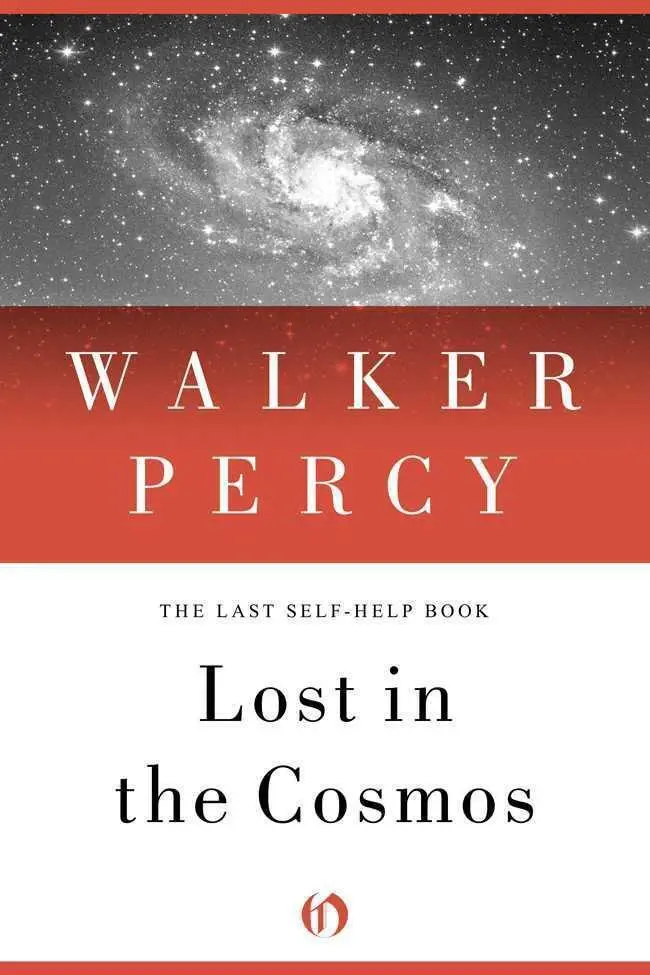
- Название:Lost in the Cosmos
- Автор:
- Издательство:Open Road Media
- Жанр:
- Год:2011
- ISBN:нет данных
- Рейтинг книги:5 / 5. Голосов: 1
-
Избранное:Добавить в избранное
- Отзывы:
-
Ваша оценка:
Lost in the Cosmos: краткое содержание, описание и аннотация
Предлагаем к чтению аннотацию, описание, краткое содержание или предисловие (зависит от того, что написал сам автор книги «Lost in the Cosmos»). Если вы не нашли необходимую информацию о книге — напишите в комментариях, мы постараемся отыскать её.
is Percy’s unforgettable riff on the trend that swept the nation. Filled with quizzes, essays, short stories, and diagrams,
is a laugh-out-loud spin on a familiar genre that also pushes readers to serious contemplation of life’s biggest questions. One part parody and two parts philosophy,
is an enlightening guide to the dilemmas of human existence, and an unrivaled spin on self-help manuals by one of modern America’s greatest literary masters.
Lost in the Cosmos — читать онлайн бесплатно полную книгу (весь текст) целиком
Ниже представлен текст книги, разбитый по страницам. Система сохранения места последней прочитанной страницы, позволяет с удобством читать онлайн бесплатно книгу «Lost in the Cosmos», без необходимости каждый раз заново искать на чём Вы остановились. Поставьте закладку, и сможете в любой момент перейти на страницу, на которой закончили чтение.
Интервал:
Закладка:
Method: Score yourself by checking those avenues of reentry which you find peculiarly, even compulsively, attractive.
Reentry by
(1) _________anesthesia (alcohol, pot, cocaine, etc.)
(2) _________travel (geographical, e.g., Appalachian Trail,
Greek Islands, etc.)
(3) _________travel (sexual)
(4) _________return (back to Valdosta, back to downtown
Philadelphia, etc.)
(5) _________disguise (e.g., Southern male writer as good ol’ boy, Northern male writer as Brooklynite turned Connecticut Yankee with L. L. Bean boots)
(6) _________Eastern window (pilgrimage to Katmandu or to Trungpa’s commune in Colorado)
(7) _________deep space (suicide)
(8) _________reentry deferred, permanent orbit (Salinger in the woods, Boo Radley holed up in Alabama house for forty years)
(9) _________sponsorship (conversion)
(10) ________assault (murderous political hatreds, fantasies of assassination or taking vicarious pleasure in same)
(CHECK APPROPRIATE OPTIONS, ADD SCORE)
NOTE: A high score measures the apogee of your orbit but is not necessarily bad. Faulkner might have scored a 5 (see reentry options 1, 2, 3, 4, 5), Malcolm Lowry a 6, William Burroughs a 7, and Erle Stanley Gardner, for all I know a 0.
A high score does no more than measure without prejudice the apogee of one’s orbit of transcendence with its attendant triumphs and miseries.
*Graham Greene, albeit a Christian, was observed by Evelyn Waugh to perform a curious rite before he could get to work. He went out to the street and watched the stream of traffic. When asked what he was doing, he replied that he was waiting for a particular combination of numbers to turn up on a license plate—777. When it did, he went cheerfully to his writing desk.
*It is a nice ambiguity that Catholics have the least use for the very thing, if not the only thing, for which they are admired, the artifacts, the accidentals, of Catholicism, e.g., the buildings, folkways, music, and so on. Thus, a trivial by-product of New Orleans Catholicism, Mardi Gras, has been seized on by tourists, appropriated by local Protestants, promoted by the Chamber of Commerce, as the major cultural attraction. Nice ambiguity, I say, because each party is content to have it so. Nobody is offended.
The Catholic is content to practice his faith in a dumpy church in York, while the tourists gape at the great nacreous pile of the York minster, an artifact of a former Catholic culture, as beautiful as the shell of a chambered nautilus and as empty. It is not argumentative, I think, to note the niceness of the ambiguity because, if the Catholic is content to have it so, so is the unbeliever. Thus, the esthetic delight of, say, Hemingway in the Catholic decor of Pamplona would perhaps be matched by his contempt for actual Catholic practice in Oak Park, Illinois. It is an ambiguity because it can be given two equally plausible interpretations, Catholic and non-Catholic. The Catholic: what matters to me is faith and practice; the cathedrals and fiestas are incidental. The non-Catholic: what is attractive to me is the Catholic decor, cathedrals, and fiestas; what I want no part of is the belief and practice, which is often in bad taste, if not vulgar. Both are right. Catholic practice is often drab or outlandish, drab in Oak Park, Illinois, outlandish in Chichicastanango. And yet the beautiful York minster is empty. It is a nice ambiguity because each party is content that the other have it his own way.
(15) The Exempted Self: How Scientists Don’t Have to Take Account of Themselves and Other Selves in their Science and Some Difficulties that Arise when they have to
WHY DO SCIENTISTS DISLIKE what is apparently the case, that Homo sapiens appeared very recently and very suddenly, in a few hundred thousand years more or less of the Late Pleistocene, perhaps even less — in a word, in less time, cosmologically speaking, than it takes to tell the Biblical story of creation; that the peculiar characteristics of man, the explosive growth of the cortex and 60 percent increase in brain volume, emergence of language, consciousness, self, art, religion, science, occurred in cosmic time in the wink of an eye; that though it is Darwin, not Wallace, who gets the credit for the theory of evolution, it was Wallace, not Darwin, who seems to be right in saying that all men, even the most primitive, come fully equipped with the same neo-cortex and that all men have made the same unprecedented crossover into language and culture; that the brain of the most “primitive” man is not discernibly different from the brain of Beethoven and therefore cannot be accounted for by Darwin’s theory of the gradual adaptation of a species to its environment by the natural selection of those traits which best equip it for survival?
Two dogmas:
One, neo-Darwinian theory: Man arose through the chance encounter of molecules and the survival of those aggregations of molecules, i.e., organisms which through the gradual accumulation of random mutations are best equipped to live in changing environments. If Darwin was right, asked Wallace, why does the Tierra del Fuegan possess a brain not discernibly different from, say, Einstein’s or Beethoven’s, which he does not need?
Two, so-called scientific creationism: The origin of the species did not occur through evolution over millions of years but through separate acts of God.
Both appear to be unlikely.
Darwin was right about the fact of evolution, and his contribution was unprecedented. Evolution is not a theory but a fact. For a fact, the dinosaurs were here 75 million years ago and were supplanted by mammals. For a fact, man arose from more primitive hominids.
Current evolutionary theory, however, has trouble accounting for the facts of evolution. So unsatisfactory is neo-Darwinism that some scientists have gone far afield for explanations. Francis Crick, co-winner of the Nobel Prize for the discovery of the structure of DNA, believes that DNA could only have arrived from space, sent in the form of bacteria from more advanced civilizations. Sir Fred Hoyle suggests the bacteria might have arrived through encounters with the tails of comets. As fanciful as such notions are, they seem to these scientists less inadequate than the current evolutionary theory.
Difficulties arise when triadic creatures (scientists) try to explain evolution through exclusively dyadic events. Neo-Darwinian theory has trouble accounting for the strange, sudden, and belated appearance of man, the conscious self which speaks, lies, deceives itself, and also tells the truth. It gives an admirable account of the variations in the beaks of Galapagos finches, but what does it have to say about Darwin himself, sitting by his fireside in Kent and hitting on a theory which assigns all of life into a sphere of interaction and immanence while covertly elevating himself into the sphere of transcendence, and worrying about whether he or Wallace was going to publish first?
The current heated controversy between evolutionists and “scientific creationists” is one of the most peculiar in the history of science, peculiar in the way in which dogma is concealed and smuggled in by both sides.
Scientific creationist: there is scientific evidence of a historical deluge, the Biblical flood, of the separateness of the species, and little or no evidence of intermediate forms. (Concealed dogma: as a fundamentalist Christian, I believe literally in the Genesis account of creation and require that scientific theory be harmonized accordingly.)
Neo-Darwinian: the overwhelming evidence is that evolution occurred through the natural selection of those organisms which through the accumulation of random mutations are best adapted to a changed environment. (Concealed dogma: I, the scientist, a triadic creature possessed of a transcending objective consciousness and a desire to write papers which will be confirmed or disconfirmed by my colleagues, also require that my data conform to the dyadic principles of interaction which obtain in physics, chemistry, and the biology of lower organisms.)
Читать дальшеИнтервал:
Закладка:
Похожие книги на «Lost in the Cosmos»
Представляем Вашему вниманию похожие книги на «Lost in the Cosmos» списком для выбора. Мы отобрали схожую по названию и смыслу литературу в надежде предоставить читателям больше вариантов отыскать новые, интересные, ещё непрочитанные произведения.


Обсуждение, отзывы о книге «Lost in the Cosmos» и просто собственные мнения читателей. Оставьте ваши комментарии, напишите, что Вы думаете о произведении, его смысле или главных героях. Укажите что конкретно понравилось, а что нет, и почему Вы так считаете.