Hugh Mills - Low Level Hell
Здесь есть возможность читать онлайн «Hugh Mills - Low Level Hell» весь текст электронной книги совершенно бесплатно (целиком полную версию без сокращений). В некоторых случаях можно слушать аудио, скачать через торрент в формате fb2 и присутствует краткое содержание. Город: Novato, CA, Год выпуска: 2009, ISBN: 2009, Издательство: Presidio Press, Жанр: Биографии и Мемуары, military_history, на английском языке. Описание произведения, (предисловие) а так же отзывы посетителей доступны на портале библиотеки ЛибКат.
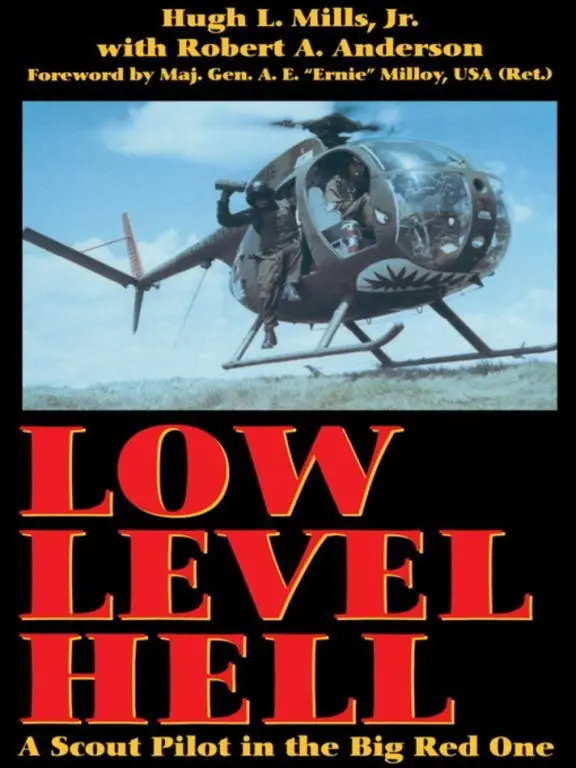
- Название:Low Level Hell
- Автор:
- Издательство:Presidio Press
- Жанр:
- Год:2009
- Город:Novato, CA
- ISBN:978-0-307-53792-8
- Рейтинг книги:4 / 5. Голосов: 1
-
Избранное:Добавить в избранное
- Отзывы:
-
Ваша оценка:
Low Level Hell: краткое содержание, описание и аннотация
Предлагаем к чтению аннотацию, описание, краткое содержание или предисловие (зависит от того, что написал сам автор книги «Low Level Hell»). Если вы не нашли необходимую информацию о книге — напишите в комментариях, мы постараемся отыскать её.
Low Level Hell — читать онлайн бесплатно полную книгу (весь текст) целиком
Ниже представлен текст книги, разбитый по страницам. Система сохранения места последней прочитанной страницы, позволяет с удобством читать онлайн бесплатно книгу «Low Level Hell», без необходимости каждый раз заново искать на чём Вы остановились. Поставьте закладку, и сможете в любой момент перейти на страницу, на которой закончили чтение.
Интервал:
Закладка:
I got on FM and dialed up our friendlies. “Drac Three Two, this is Darkhorse One Six. Have you swept your perimeter since the firefight last night?”
“Darkhorse, this is Dracula Three Two. Roger. We have done some sweeping. Why? Have you found something?”
“Roger, Drac. I’ve got an enemy soldier down here. He’s lying on the ground about forty yards off the backside of one of your ACAVs. Do you see where I’m circling?”
There was a moment’s delay while he looked, then he came back. “Roger, Darkhorse, I see you. How about dropping a smoke on the body and we’ll police it up later.”
“That’s negative, Dracula. This is not a body. This is one live NVA soldier. Looks like he’s been hit in the leg but his eyes are wide open and the little son of a bitch is staring straight up at me!”
Drac must have thought that I was seeing things. “Darkhorse One Six, this is Dracula Three Two. Confirm the enemy soldier in our vicinity is alive”
“Roger, Drac Three Two. He’s alive. He’s watching me. His head is moving and he looks like he’s trying to wave. He appears injured and he does have a weapon. If you can send somebody over here on foot, I’ll cover your man. Over.”
“Roger, Darkhorse,” Drac responded. “We’ll be right there.”
I came to about a forty-foot hover over the trees and keyed the intercom to Parker. “Watch that guy, Jimbo. If he moves toward his weapon, if he even looks like he’s goin’ for that weapon, blast him with the 60. We’ve got troops coming over here from the NDP, so watch for them, but if that bad guy moves, blast him!”
In a few minutes, an ACAV came rumbling up and a couple of our friendlies jumped out of the back. The two American troopers didn’t look as though they were quite ready for combat that morning. They had on jungle fatigue pants, boots, and T-shirts. They were carrying their M-16s but didn’t have any web gear on. One of our soldiers appeared to be an NCO and the other a specialist.
Because of the vegetation they couldn’t see exactly where the enemy soldier was, but they could see me hovering over the trees nearby. The guys didn’t have a radio, so I told Parker that I was going to guide them in with hand signals. I put the Loach over on her right side so I could see beneath me and hovered to a spot directly over the wounded enemy soldier. I steadied the collective with my knee, flew with my left hand on the cyclic, and started motioning with my right hand.
The two infantrymen finally got close enough to see the NVA lying on the jungle floor. They crept toward him, covering each other with their M-16s. I backed away to get the rotor wash and noise off them while they took him prisoner.
As I continued on with my VR, I began to hear reports on the radio about the NVA soldier. Though wounded badly by one of our .50-caliber machine guns—his leg was shattered and just barely hanging onto his body—he was hustled back to Dau Tieng for medical attention and interrogation by the 3d Brigade’s S-2. The S-2 learned from the unusually cooperative prisoner that he was a member of the infamous and elusive Dong Nai Regiment. He had moved out of the Fishhook area in Cambodia with the regiment, gone on into the Michelin rubber plantation, then on down into the western Trapezoid.
The 1st Division had more bones to pick with the Dong Nai Regiment than a dog had fleas. We had been looking for that unit: We wanted desperately to know where it was, what it was doing, and what its tactical intentions were. This was the first good link to the Dong Nai’s recent whereabouts and activities—an intelligence windfall. The wounded POW turned out to be a noncommissioned officer. Because of his rank, he was privy to a lot of planning and, during his debriefing, revealed considerable information about the movements and activities of the Dong Nai. Afterward, the prisoner indicated strong willingness to join our Hoi Chon program and convert to one of our Kit Carson scouts.
Back at Phu Loi that evening, I was given a mission for the next morning to fly up to 3d Brigade HQ at Dau Tieng. I was to attend a briefing by the brigade S-3 on what the POW had said, then plan some scout team VRs in the sectors that the prisoner had designated as Dong Nai Regiment operational areas.
From Phu Loi, it was a straight-shot flight up northwest to 3d Brigade HQ. The route—without artillery firing path deviations—would normally take us up over the heart of the Iron Triangle, on to the north of the Mushroom, then right on across the western edge of the Trap-ezoid to Dau Tieng. From my standpoint, staying at altitude always made for a boring flight, so before we got started that morning I asked my snake driver, Paul Fishman (Three Four), if he had any objection to me going down low for the course of the flight instead of camping on his wing at fifteen hundred feet. Realizing that with his scout down on the deck, there was always the chance of scaring up a little enemy activity, Fishman had no problem with my plan.
As soon as we cleared the base boundary, I flipped my weapons system to “arm” and the fire selector switch to “fire norm,” then settled in for the flight at an altitude of about twenty feet off the ground. After a couple of minutes I heard Three Four check in with Lai Khe artillery. They reported that they were firing 105 s into the northern area of the Iron Triangle, meaning that we would have to either detour up north around Lai Khe or head south to the Saigon River and follow it on up to Dau Tieng. Rather than go north, which was farther out of our way, Paul gave me a heading for the river. We turned west, picked up the Saigon River, and started following its general course around the southwestern edge of the Iron Triangle. I was cruising along right on top of the trees and holding airspeed at a consistent ninety knots.
I was relaxed. So was Parker. He was sitting on his little jump seat just watching the scenery go by. The collective control was resting on my left knee; I had hold of the cyclic and was flying the airplane with my left hand. With my right hand I was leisurely puffing on a cigarette. My right foot was dangling outside the cockpit door. It was another beautiful morning in sunny Vietnam.
We came up on the vicinity of our FSB Kien. It was just a few more minutes from there to Dau Tieng, and I was having so much fun that I thought I would play a little “pop-up” for the rest of the way. I dropped the bird down to an altitude of about two feet and moved the airspeed up to a hundred knots, then up to one hundred and ten. As we ripped along, I would yank back on the cyclic, which tilted the rotor disk to the rear, and pop the bird up and over the rice dikes and tree lines. Then I’d shove the cyclic stick forward again, which tilted the blades sharply forward and pushed the nose down, and drop to two feet. I was just plain hotdoggin’ it, and I loved it!
My antics didn’t escape my gun pilot, however. As always, Paul was carefully watching me. “Hey, One Six, what the hell are you doing down there?”
“I’m having a ball,” I answered. Then I warned Parker to hang on for the next pop-up as yet another tree line loomed ahead through my bubble.
It was still early in the morning, and the semidarkness made it difficult for me to see really well. But the approaching tree line looked clear of obstacles on the other side, making it a piece of cake to pop up over the trees and then right back down again without missing a beat. I could just barely make out a rice paddy on the other side with a dike going through the middle of it. No sweat.
I closed in fast on the tree line, waited until the very last split second, then jerked back a chest full of cyclic stick. The little OH-6 jumped straight up about forty feet as though she had suddenly been kicked in the tail boom by a Missouri mule.
Читать дальшеИнтервал:
Закладка:
Похожие книги на «Low Level Hell»
Представляем Вашему вниманию похожие книги на «Low Level Hell» списком для выбора. Мы отобрали схожую по названию и смыслу литературу в надежде предоставить читателям больше вариантов отыскать новые, интересные, ещё непрочитанные произведения.












Обсуждение, отзывы о книге «Low Level Hell» и просто собственные мнения читателей. Оставьте ваши комментарии, напишите, что Вы думаете о произведении, его смысле или главных героях. Укажите что конкретно понравилось, а что нет, и почему Вы так считаете.