Hugh Mills - Low Level Hell
Здесь есть возможность читать онлайн «Hugh Mills - Low Level Hell» весь текст электронной книги совершенно бесплатно (целиком полную версию без сокращений). В некоторых случаях можно слушать аудио, скачать через торрент в формате fb2 и присутствует краткое содержание. Город: Novato, CA, Год выпуска: 2009, ISBN: 2009, Издательство: Presidio Press, Жанр: Биографии и Мемуары, military_history, на английском языке. Описание произведения, (предисловие) а так же отзывы посетителей доступны на портале библиотеки ЛибКат.
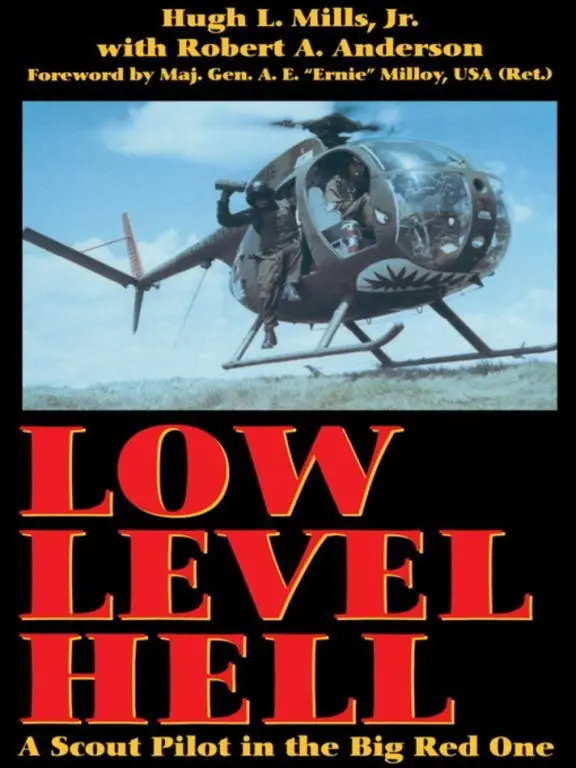
- Название:Low Level Hell
- Автор:
- Издательство:Presidio Press
- Жанр:
- Год:2009
- Город:Novato, CA
- ISBN:978-0-307-53792-8
- Рейтинг книги:4 / 5. Голосов: 1
-
Избранное:Добавить в избранное
- Отзывы:
-
Ваша оценка:
Low Level Hell: краткое содержание, описание и аннотация
Предлагаем к чтению аннотацию, описание, краткое содержание или предисловие (зависит от того, что написал сам автор книги «Low Level Hell»). Если вы не нашли необходимую информацию о книге — напишите в комментариях, мы постараемся отыскать её.
Low Level Hell — читать онлайн бесплатно полную книгу (весь текст) целиком
Ниже представлен текст книги, разбитый по страницам. Система сохранения места последней прочитанной страницы, позволяет с удобством читать онлайн бесплатно книгу «Low Level Hell», без необходимости каждый раз заново искать на чём Вы остановились. Поставьте закладку, и сможете в любой момент перейти на страницу, на которой закончили чтение.
Интервал:
Закладка:
Colonel Allen’s idea of getting more air cavalry assets in the field was a good one for several reasons. The first was that Outcast scout crews were flying 130 or more combat hours a month and were still not covering all the ground. Plus, our scout platoon was never up to its full complement of pilots. So the prospect of having more qualified aeroscouts in the air was welcomed. Bravo Company had pilots who had already been in country for six to eight months, they were flying the same types of aircraft we had in D Troop, and they were operating over much the same Vietnam countryside. We all, therefore, were enthusiastic about the cross-training of 1st Aviation Battalion pilots to Darkhorse tactics. Creation of a new mini-cav “Lighthorse” organization promised to put even more pressure on the enemy in the field.
Overall, the scout pilot training went fine. There were a few areas of disagreement, however. Even though their pilots were experienced in the OH-6 aircraft, normal liaison missions for the 1st Aviation Battalion were generally flown at altitude, fifteen hundred feet or more. Pony pilots simply weren’t used to flying on the deck, down low and slow, where the working aeroscout spent most of his time. And there was sometimes a reluctance from the guys from B Company to accept our combat scout tactics.
For instance, while out on recon, if a Pony pilot discovered a ground object, such as a bunker, he would rein up, hover in circles around the point of interest, and study the situation. It was not even uncommon for him to come to a dead hover over the scene while he examined his find. Of course, an experienced scout knew that that kind of flying could get you killed… in a hurry.
On every occasion, we tried to impress on the Pony pilots—DON’T hover, DON’T return to the target area twice from the same direction or at the same speed, and DON’T give Charlie the chance to anticipate your movement, or lack of it, or he will set you and shoot you out of the sky. That advice came from the aeroscout school of hard knocks.
Either forgetting or choosing not to follow that advice, Pony One Six took a dose of enemy AK medicine and was shot down on 23 August 1969. “Red” Hayes, one of our experienced Outcasts crew chiefs, was flying with Pony One Six that day. Phil Carriss (Darkhorse Three Eight), a very experienced Cobra driver, was his gun. While searching an area that showed some fresh traffic, Pony One Six became more or less fixated on a particular detail that he was studying below. Hayes became concerned and spoke to his pilot over the intercom. “Sir, don’t slow down. We’re getting too slow, sir… we’re getting too slow.”
Pony One Six’s scouting technique, however, had not developed enough at that point to quickly identify what he had on the ground. So he felt that he must slow down and stay in the area long enough to read the signs. It was his misfortune. His slow, lazy, easy-to-figure-out circles made him an easy target for the enemy gunners. Charlie’s rounds came up in a fury.
The Pony platoon leader took one bullet through the leg. Another enemy round bit into the fuel line of his OH-6. The engine quit and the Loach went down in a sheet of flames fed by the spewing jet fuel.
Carriss, in the Cobra above, was shocked to see his scout suddenly engulfed in flames and heading for impact in a tree line below. He called Phu Loi for assistance, then went down dangerously low to circle the area and try to determine if the crew had survived.
Three Eight couldn’t tell whether anybody in the burning wreck was still alive, so he had a real dilemma: wait for the scrambled scout team to arrive and get to the wreck, or take the terrible risk of landing his own Cobra. One thing was for sure: somebody had to get to the downed Loach in a hurry. If the crew didn’t get out within seconds, the flames would have them.
Realizing that the scrambled scout team from Phu Loi was still ten to fifteen minutes away, Carriss made a quick and gutsy decision. He decided to put his Cobra down in a rice paddy near the crash and send his front-seater, Jon Gregory, through the tree line to try and get the scout crew out of the ship and bring any survivors back to the clearing, where they could be extracted.
Carriss eased his big, heavy bird down into the water of the rice paddy. As the Cobra’s skids settled onto the bottom, Jon threw back his front canopy and jumped down into the foul water. He immediately went ass-deep into the muck, while Carriss’s rotor wash drove him like a nail even deeper.
With his pistol held above his head to keep it dry, Gregory struggled through the rice paddy water. By the time he reached the bank of the paddy and hauled himself ashore near the tree line, Carriss had lifted off again to cover the people on the ground. With the front seat now vacant, all Carriss could do was throw the override switch for the M-28 gun turret, lock it into a straight-ahead position, and make low-level firing passes to deter any enemy drawn to the crash site.
As anybody in his right mind would have been, Gregory was scared. Cobra crews didn’t make a practice of being out of their aircraft and alone on the ground in hostile territory. But as he ran through the trees, slowed by his wet and foul-smelling flight suit, his thoughts were on getting to the burning wreck and helping Hayes and Pony One Six.
When he got there, the ship was still flaming, but the crew was nowhere to be seen. “Thank God,” Gregory mumbled to himself. “But where in the hell are they?”
Then he spotted Hayes about fifty feet away—on his feet but doubled over and holding his groin. Pony One Six was on the ground trying to nurse his wounded leg. Hayes was obviously in pain. When the Loach hit the ground at about 2 g’s, the impact had shoved the shoulder stock extension of his M-60 machine gun up into his crotch.
Finally, Gregory was able to lead both injured men back to the edge of the clearing to await assistance.
At that moment, Carriss was still trying to cover the friendlies on the ground with his firing runs, but he had no idea how Gregory was faring or whether he had found anybody alive in the crash.
Just then, the scrambled scout team arrived on the scene. The new Cobra went to work shooting with Carriss while Joe Vad (Nine) dropped his Loach down to the tree line to look for Gregory. Niner soon spotted the three men waiting at the edge of the clearing. He could see that the Pony platoon leader was wounded and that Hayes was bent over in agony. Gregory was frantically waving and jumping up and down to make sure that Vad saw them.
What to do next was answered rather quickly. Both Koranda (Three Nine) and Carriss had begun to take ground fire on their firing passes. They had to get back up to altitude fast or risk the danger of having their Cobras shot out from under them. Besides, a snake didn’t have room to carry anybody except a pilot and gunner. This meant that Joe Vad, in his scout ship, would have to go in and pick up Gregory, Hayes, and Pony One Six.
For a split second, Vad pondered the fact that there were three men on the ground and two already in his bird. Besides all that potential weight, he was just fresh out of base and was still carrying a full load of fuel and ammo. Another impossible job for the incredible little OH-6.
In order to quickly lighten his ship, Vad hovered directly over the guys on the ground and began to expend minigun ammunition. He kicked left and right pedal and arbitrarily sprayed fifteen hundred rounds of 7.62 into the countryside. Niner’s crew chief began emptying his box of belts with long, chattering bursts from his M-60. He couldn’t just dump his machine gun ammunition out the door because the enemy looked for that kind of stuff, and when they found it they cleaned it up and shot it right back at you.
Читать дальшеИнтервал:
Закладка:
Похожие книги на «Low Level Hell»
Представляем Вашему вниманию похожие книги на «Low Level Hell» списком для выбора. Мы отобрали схожую по названию и смыслу литературу в надежде предоставить читателям больше вариантов отыскать новые, интересные, ещё непрочитанные произведения.











Обсуждение, отзывы о книге «Low Level Hell» и просто собственные мнения читателей. Оставьте ваши комментарии, напишите, что Вы думаете о произведении, его смысле или главных героях. Укажите что конкретно понравилось, а что нет, и почему Вы так считаете.