Dan Brown - Origin
Здесь есть возможность читать онлайн «Dan Brown - Origin» весь текст электронной книги совершенно бесплатно (целиком полную версию без сокращений). В некоторых случаях можно слушать аудио, скачать через торрент в формате fb2 и присутствует краткое содержание. Город: London, Год выпуска: 2017, ISBN: 2017, Издательство: Bantam Press, Transworld, Penguin Random House, Жанр: Триллер, на английском языке. Описание произведения, (предисловие) а так же отзывы посетителей доступны на портале библиотеки ЛибКат.
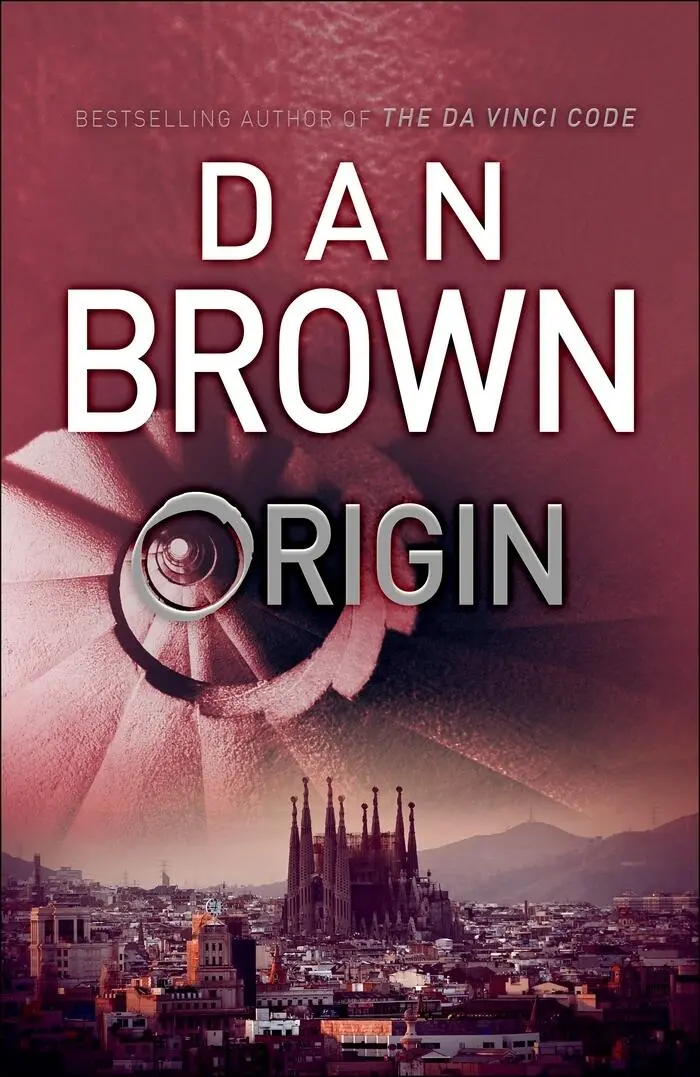
- Название:Origin
- Автор:
- Издательство:Bantam Press, Transworld, Penguin Random House
- Жанр:
- Год:2017
- Город:London
- ISBN:978-0-593-07875-4
- Рейтинг книги:5 / 5. Голосов: 1
-
Избранное:Добавить в избранное
- Отзывы:
-
Ваша оценка:
Origin: краткое содержание, описание и аннотация
Предлагаем к чтению аннотацию, описание, краткое содержание или предисловие (зависит от того, что написал сам автор книги «Origin»). Если вы не нашли необходимую информацию о книге — напишите в комментариях, мы постараемся отыскать её.
But Langdon and several hundred other guests are left reeling when the meticulously orchestrated evening is blown apart before Kirsch’s precious discovery can be revealed. With his life under threat, Langdon is forced into a desperate bid to escape, along with the museum’s director, Ambra Vidal. Together they flee to Barcelona on a perilous quest to locate a cryptic password that will unlock Kirsch’s secret.
In order to evade a tormented enemy who is one step ahead of them at every turn, Langdon and Vidal must navigate labyrinthine passageways of hidden history and ancient religion. On a trail marked only by enigmatic symbols and elusive modern art, Langdon and Vidal uncover the clues that will bring them face-to-face with a world-shaking truth that has remained buried — until now.
Origin — читать онлайн бесплатно полную книгу (весь текст) целиком
Ниже представлен текст книги, разбитый по страницам. Система сохранения места последней прочитанной страницы, позволяет с удобством читать онлайн бесплатно книгу «Origin», без необходимости каждый раз заново искать на чём Вы остановились. Поставьте закладку, и сможете в любой момент перейти на страницу, на которой закончили чтение.
Интервал:
Закладка:
The star-filled sky above was a projection, complete with a moon, scudding clouds, and distant rolling hills. The rustling trees and grasses were truly there — either superb fakes or a small forest of living plants in concealed pots. This nebulous perimeter of vegetation cleverly disguised the enormous room’s hard edges, giving the impression of a natural environment.
Langdon crouched down and felt the grass, which was soft and lifelike, but entirely dry. He’d read about the new synthetic turfs that were fooling even professional athletes, and yet Kirsch had gone a step further and created slightly uneven ground, with small swales and mounds as in a real meadow.
Langdon recalled the first time he had been fooled by his senses. He was a child in a small boat drifting through a moonlit harbor where a pirate ship was engaged in a deafening cannon battle. Langdon’s young mind had been incapable of accepting that he was not in a harbor at all, but in fact he was in a cavernous underground theater that had been flooded with water to create this illusion for the classic Disney World ride Pirates of the Caribbean.
Tonight, the effect was staggeringly realistic, and as the guests around him took it in, Langdon could see that their wonder and delight mirrored his own. He had to give Edmond credit — not so much for creating this amazing illusion, but for persuading hundreds of adults to kick off their fancy shoes, lie down on the lawn, and gaze up at the heavens.
We used to do this as kids, but somewhere along the way, we stopped.
Langdon reclined and placed his head on the pillow, letting his body melt into the soft grass.
Overhead, the stars twinkled, and for an instant, Langdon was a teenager again, lying on the lush fairways of the Bald Peak golf course at midnight with his best friend, pondering the mysteries of life. With a little luck , Langdon mused, Edmond Kirsch might solve some of those mysteries for us tonight.
At the rear of the theater, Admiral Luis Ávila took one final survey of the room and moved silently backward, slipping out unseen through the same curtain through which he had just entered. Alone in the entry tunnel, he ran a hand along the fabric walls until he located a seam. As quietly as possible, he pulled apart the Velcro closure, stepped through the wall, and resealed the cloth behind him.
All illusions evaporated.
Ávila was no longer standing in a meadow.
He was in an enormous rectangular space that was dominated by a sprawling oval-shaped bubble. A room built within a room. The construction before him — a domed theater of sorts — was surrounded by a towering exoskeleton of scaffolding that supported a tangle of cables, lights, and audio speakers. Pointing inward, a shimmering array of video projectors glowed in unison, casting wide beams of light downward onto the translucent surface of the dome, and creating the illusion within of a starlit sky and rolling hills.
Ávila admired Kirsch’s knack for drama, although the futurist could never have imagined just how dramatic his night would soon turn out to be.
Remember what is at stake. You are a soldier in a noble war. Part of a greater whole.
Ávila had rehearsed this mission in his mind numerous times. He reached into his pocket and pulled out the oversized rosary beads. At that moment, from an overhead bank of speakers inside the dome, a man’s voice thundered down like the voice of God.
“Good evening, friends. My name is Edmond Kirsch.”
Chapter 16
In Budapest, Rabbi Köves paced nervously in the dim light of his házikó study. Clutching his TV remote, he flipped anxiously through the channels as he awaited further news from Bishop Valdespino.
On television, several news channels had interrupted their regular programming during the past ten minutes to carry the live feed coming out of the Guggenheim. Commentators were discussing Kirsch’s accomplishments and speculating about his mysterious upcoming announcement. Köves cringed at the snowballing level of interest.
I have seen this announcement already.
Three days ago, on the mountain of Montserrat, Edmond Kirsch had previewed an alleged “rough-cut” version for Köves, al-Fadl, and Valdespino. Now, Köves suspected, the world was about to see the same exact program.
Tonight everything will change , he thought sadly.
The phone rang and jolted Köves from his contemplation. He seized the handset.
Valdespino began without preamble. “Yehuda, I’m afraid I have some more bad news.” In a somber voice, he conveyed a bizarre report that was now coming out of the United Arab Emirates.
Köves covered his mouth in horror. “Allamah al-Fadl... committed suicide ?”
“That is what the authorities are speculating. He was found a short time ago, deep in the desert... as if he had simply walked out there to die.” Valdespino paused. “All I can guess is that the strain of the last few days was too much for him.”
Köves considered the possibility, feeling a wave of heartbreak and confusion. He too had been struggling with the implications of Kirsch’s discovery, and yet the idea that Allamah al-Fadl would kill himself in despair seemed wholly unlikely.
“Something is wrong here,” Köves declared. “I don’t believe he would do such a thing.”
Valdespino fell silent for a long time. “I’m glad you said that,” he finally agreed. “I have to admit, I too find it quite difficult to accept that this was a suicide.”
“Then... who could be responsible?”
“Anyone who wanted Edmond Kirsch’s discovery to remain a secret,” the bishop replied quickly. “Someone who believed, as we did, that his announcement was still weeks away.”
“But Kirsch said nobody else knew about the discovery!” Köves argued. “Only you, Allamah al-Fadl, and myself.”
“Maybe Kirsch lied about that too. But even if the three of us are the only ones he told, don’t forget how desperately our friend Syed al-Fadl wanted to go public. It’s possible that the allamah shared information about Kirsch’s discovery with a colleague in the Emirates. And maybe that colleague believed, as I do, that Kirsch’s discovery would have dangerous repercussions.”
“Implying what?” the rabbi demanded angrily. “That an associate of al-Fadl killed him in order to keep this quiet? That’s ridiculous!”
“Rabbi,” the bishop replied calmly, “I certainly don’t know what happened. I’m only trying to imagine answers, as you are.”
Köves exhaled. “I’m sorry. I’m still trying to absorb the news of Syed’s death.”
“As am I. And if Syed was murdered for what he knew, then we need to be careful ourselves. It is possible that you and I are also targeted.”
Köves considered this. “Once the news goes public, we are irrelevant.”
“True, but it is not yet public.”
“Your Grace, the announcement is only minutes away. Every station is carrying it.”
“Yes...” Valdespino let out a tired sigh. “It seems I’ll have to accept that my prayers have gone unanswered.”
Köves wondered if the bishop had literally prayed for God to intervene and change Kirsch’s mind.
“Even when this goes public,” Valdespino said, “we are not safe. I suspect Kirsch will take great pleasure in telling the world that he consulted with religious leaders three days ago. I’m now wondering if an appearance of ethical transparency was his true motive for calling the meeting. And if he mentions us by name, well, you and I will become the focus of intense scrutiny and perhaps even criticism from our own flocks, who might believe we should have taken action. I’m sorry, I’m just...” The bishop hesitated as if he had something more he wanted to say.
Читать дальшеИнтервал:
Закладка:
Похожие книги на «Origin»
Представляем Вашему вниманию похожие книги на «Origin» списком для выбора. Мы отобрали схожую по названию и смыслу литературу в надежде предоставить читателям больше вариантов отыскать новые, интересные, ещё непрочитанные произведения.

Обсуждение, отзывы о книге «Origin» и просто собственные мнения читателей. Оставьте ваши комментарии, напишите, что Вы думаете о произведении, его смысле или главных героях. Укажите что конкретно понравилось, а что нет, и почему Вы так считаете.