Jason Elliot - The Network
Здесь есть возможность читать онлайн «Jason Elliot - The Network» весь текст электронной книги совершенно бесплатно (целиком полную версию без сокращений). В некоторых случаях можно слушать аудио, скачать через торрент в формате fb2 и присутствует краткое содержание. Жанр: Триллер, на английском языке. Описание произведения, (предисловие) а так же отзывы посетителей доступны на портале библиотеки ЛибКат.
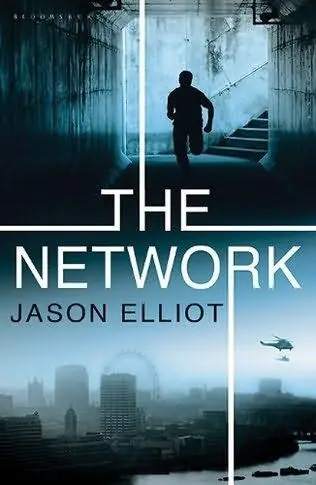
- Название:The Network
- Автор:
- Жанр:
- Год:неизвестен
- ISBN:нет данных
- Рейтинг книги:4 / 5. Голосов: 1
-
Избранное:Добавить в избранное
- Отзывы:
-
Ваша оценка:
The Network: краткое содержание, описание и аннотация
Предлагаем к чтению аннотацию, описание, краткое содержание или предисловие (зависит от того, что написал сам автор книги «The Network»). Если вы не нашли необходимую информацию о книге — напишите в комментариях, мы постараемся отыскать её.
The Network — читать онлайн бесплатно полную книгу (весь текст) целиком
Ниже представлен текст книги, разбитый по страницам. Система сохранения места последней прочитанной страницы, позволяет с удобством читать онлайн бесплатно книгу «The Network», без необходимости каждый раз заново искать на чём Вы остановились. Поставьте закладку, и сможете в любой момент перейти на страницу, на которой закончили чтение.
Интервал:
Закладка:
‘You bastard. You absolute bastard,’ I say. ‘Didn’t anyone ever teach you how to stay in touch?’
‘Sent you a postcard,’ he says as we walk towards each other. We embrace, and I feel his chest trembling, as he does mine, with the breathless rush of feeling somewhere beyond laughter and tears that expresses all the long-awaited relief of deliverance.
Sometimes, just sometimes, your hopes are exceeded beyond all measure. What you dared to hope for is not only granted but heaped up with unexpected dividends you haven’t been able to imagine. It’s akin to falling in love with someone whom it seems likely will never glance at you, and then finding that your feelings are reciprocated with even greater intensity.
I had thought Manny dead, or at best imprisoned or gone mad. But I’ve seen him in the flesh now, and I still can’t really believe that he’s alive. It’s not only that. He’s sane. His sense of humour is intact. My greatest fear, worse than the fear that he’d been killed, was that he might have become like the men he’d been living among.
‘We have our way and they have theirs,’ he says when I share this fear with him. ‘They are human too,’ he adds. And though he has the odd habit of speaking in Pashtu when he gets excited and cursing in his prison Chechen, his mind seems whole and healthy.
‘It’s time to come home,’ I tell him.
‘Home,’ he repeats, as if dimly recalling an old friend. ‘Yes. I need to come home.’
‘When we’re back from the op I’ll get you out.’
He looks at me and shakes his head as if I haven’t understood.
‘I can’t just disappear.’
‘Why not?’
‘I need to die,’ he says, and for a moment I’m full of dread.
‘You don’t need to die,’ I tell him.
‘Why are you so stupid? I need to be seen to die. If I just disappear I’ll be considered compromised. All the plans I know will be changed. All this will be useless.’
From his pocket he produces a memory disk the size of a cigarette lighter. I’ve never seen one like this before.
‘What is it?’ I ask.
He holds it up solemnly between us with the fingers of both hands, in the manner of a priest about to administer the sacrament.
‘Unless we stop it,’ he says, ‘it’s the future.’ The light is fading now. ‘Can you get the contents to London, flash priority?’
‘What’s on it?’
‘It’s better I don’t tell you. There’s no time to explain now. It’s everything I know. They’ve got plans you can’t imagine. Huge attacks. New York, London.’ He shakes his head. ‘The Sheikh wants a war, a global war. This is how he’s going to get it.’
I can’t help thinking as he speaks that perhaps he’s grown too enthused by the ambitions of the men whose world he’s managed to infliltrate. I doubt whether Islamic militants, especially those living in a remote corner of Afghanistan, have either the means or know-how to provoke what he calls a global war.
‘I can’t stay here much longer,’ he says.
I tell him about the operation, unfolding the silk map and pointing out the location of the fort and the route we’re planning to take there.
‘Are you sure it’s there?’ he asks emphatically. ‘My firqat was in Sangin until a month ago. I know the men in that area.’ He strokes his beard thoughtfully. ‘The Stingers,’ he says quietly. ‘I’ve been wondering where they were being kept. They’ve got plans for those.’
‘So have I,’ I say.
His finger swerves over the map as he studies it closely. Then he looks up at me, his finger still tapping the map where it’s come to rest.
‘We need to make a plan,’ he says.
It’s dusk when I leave. I walk for a long way before finding a taxi, which drops me at the Shirpur crossroads. No one pays any attention to me as I walk the quarter-mile to Wazir. The entire city seems to be hurrying home to safety as darkness falls. I experience a sense of bemusement that no one can detect the torrent that’s racing through my head as I endlessly repeat to myself the details of my recent encounter. As I walk I’m making a list of the things I’ve talked about with Manny, linking them against mental images that rhyme with the numbers one to ten, which I’ll write up more fully when I’m back at the house.
With one hand I’m turning over the flash disk in my pocket, hardly daring to believe the significance of its contents. I don’t have the software to examine it myself but I can email it from the trust’s office and wait for a reply. I run my hand absent-mindedly against the stone wall beside me and feel its warmth, even though the sun has set. Then I reach the roundabout in Wazir and cross into the grid of streets beyond.
Up ahead I see the fruit stall that I pass in the daytime. There’s a tall Talib who looks like he’s buying fruit, and parked on the opposite side of the street is a signature Toyota pickup. For a moment I think of turning around and taking a different street because I don’t want to tangle with anyone. But the moment the thought takes shape I dismiss it because I’m just an invisible Afghan peasant and I must act as if I’m just that and not a fugitive.
As I draw nearer I realise there’s something going on between the Talib and the boy who runs the stall. The Talib has said something to him in Pashtu and now repeats it, but the boy doesn’t respond, so he asks again but this time he yells it. I’m close enough now to see the boy’s expression. He’s just looking down at his feet, scared as hell and not daring to answer.
So the Talib hits him. His right hand flies up and slaps the boy violently on the side of his head. The boy winces and holds his hand to his ear and mumbles what I take to be an apology. That’s probably the end of it, but the scene has caught my eye, and without realising it I’ve stopped.
Mistake.
In the greater context of things a man slapping a boy is not much to be concerned about. Especially in Afghanistan. It’s a tough country and the boy has probably been dealt worse punishments. And it’s none of my business. But it’s an unprovoked act and I feel a disproportionate sense of outrage at the sight of someone being bullied, and I’m allowing it to show.
In another place at another time it wouldn’t matter. I’d say, ‘Pick on someone your own size,’ and the other man would say, ‘Get lost,’ and that would be the end of it. But this is Afghanistan and its people are at war and the Taliban have come to Kabul to show who’s in charge.
The Talib notices me a few yards away and his head turns. He has a huge black turban and a thick black beard, and the strange thing is he’s strikingly handsome. But his expression tells me he’s an arrogant belligerent bastard, and for the second or two that our eyes meet I want him to know that’s exactly what I think of him. I realise that I’ve let my gaze linger an instant too long, issuing thereby a silent challenge. I’ve unwittingly threatened his pride, and the pride of an Afghan is not a thing to underestimate. I look away but it’s too late.
‘What are you looking at?’ He’s speaking Pashtu, which I don’t understand, but the question is obvious.
I walk past him, and his body turns to face mine.
‘I’m talking to you,’ he says.
I raise a hand in a gesture of dismissal, to indicate that I meant nothing and that I’m leaving him in peace. My back is turned to him now. He calls after me but I keep walking because it’s not a moment for confrontation. With a military map in my underwear, encrypted computer files and a weapon on my waist, it’ll be a challenge to pass myself off as a passer-by. But he’s not letting it go.
Behind me I hear his boots on the ground. He’s running towards me. I turn around and raise my hands to my throat and make a strangling noise to let him know I can’t talk properly. He stops just short of me and he’s staring at me with a look of both anger and curiosity. I pull desperately at my throat to convince him I can’t talk and turn away again, and it’s just as I turn that I feel the first blow.
Читать дальшеИнтервал:
Закладка:
Похожие книги на «The Network»
Представляем Вашему вниманию похожие книги на «The Network» списком для выбора. Мы отобрали схожую по названию и смыслу литературу в надежде предоставить читателям больше вариантов отыскать новые, интересные, ещё непрочитанные произведения.






Обсуждение, отзывы о книге «The Network» и просто собственные мнения читателей. Оставьте ваши комментарии, напишите, что Вы думаете о произведении, его смысле или главных героях. Укажите что конкретно понравилось, а что нет, и почему Вы так считаете.