Jason Elliot - The Network
Здесь есть возможность читать онлайн «Jason Elliot - The Network» весь текст электронной книги совершенно бесплатно (целиком полную версию без сокращений). В некоторых случаях можно слушать аудио, скачать через торрент в формате fb2 и присутствует краткое содержание. Жанр: Триллер, на английском языке. Описание произведения, (предисловие) а так же отзывы посетителей доступны на портале библиотеки ЛибКат.
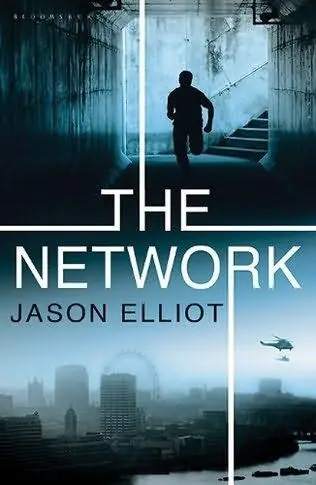
- Название:The Network
- Автор:
- Жанр:
- Год:неизвестен
- ISBN:нет данных
- Рейтинг книги:4 / 5. Голосов: 1
-
Избранное:Добавить в избранное
- Отзывы:
-
Ваша оценка:
The Network: краткое содержание, описание и аннотация
Предлагаем к чтению аннотацию, описание, краткое содержание или предисловие (зависит от того, что написал сам автор книги «The Network»). Если вы не нашли необходимую информацию о книге — напишите в комментариях, мы постараемся отыскать её.
The Network — читать онлайн бесплатно полную книгу (весь текст) целиком
Ниже представлен текст книги, разбитый по страницам. Система сохранения места последней прочитанной страницы, позволяет с удобством читать онлайн бесплатно книгу «The Network», без необходимости каждый раз заново искать на чём Вы остановились. Поставьте закладку, и сможете в любой момент перейти на страницу, на которой закончили чтение.
Интервал:
Закладка:
‘How will I know if you’ve delivered it?’
‘You just wait,’ he says.
So I wait. The weekend passes. H and I visit the famous walled gardens of the sixteenth-century ruler Babur, who despite conquering much of Afghanistan and India expressed the wish to be buried in his beloved Kabul. Once the most popular venue in the city, the park is deserted but for an elderly guardian, and his shrine is peppered with bullet marks. We also pay a visit to the former British embassy, once the grandest foreign residence in Kabul. It’s a burned-out shell now, and the emerald lawns have turned to dust.
On the Monday I take a taxi to a suburb in the south of the city called Deh Qalandar and walk the final stretch alone to the ruined palace. The giant rooms have long ago been stripped of their furniture and fittings and are strewn with smashed masonry, plaster and glass. I wait an hour, but no one comes. I return again at the same time the following day. There are a few children playing in the rubble, but there is no one to meet me. Realising how slim the chances are of re-establishing contact with Manny in this way, and dwelling on the many factors that make it unlikely, my sense of expectation begins to waver.
‘Don’t let it get to you,’ says H, who spent a good deal of his time in Northern Ireland waiting in unmarked cars for informers who never showed up. He knows I’m hoping to meet a source useful to London, but he knows nothing of my history with Manny and can’t know how disappointed I am.
On the Thursday a message comes from Mr Raouf. Our supplies are ready, which means it’s time to get the operation underway. We drive to the trust’s headquarters, where Mr Raouf is waiting for us, beaming mischieviously. He leads us to a storeroom and throws aside a dusty tarpaulin to reveal several metal trunks.
‘Befarmaid.’ He grins, stretching out his hand. ‘Be my guest.’
We unpack the trunks with a feeling of awe. There are several wooden boxes of plastic explosive, each containing half a dozen blocks the size of small bricks wrapped in brown waterproof paper to keep out moisture. I recognise the type. It’s Iranian Composition 4, C4 for short, made from the high explosive RDX with a small percentage of non-explosive plasticiser which allows it to be cut or shaped. It has a detonation velocity of nearly 30,000 feet per second, which makes it more powerful than dynamite and an ideal demolition charge.
There’s a long roll of waterproof blasting fuse resembling thin black rope, which H calls time fuse. The design hasn’t changed much since Guy Fawkes’ time. It’s a modified form of gunpowder, wrapped in a waterproof fabric sheath to enable it to burn underwater if necessary. It’s this that will give us our time delay, though we’ll have to test its burning rate to see what length we’ll eventually need.
H lifts out what look like two rolls of bright orange electrical extension lead. It’s detonating cord, filled with the high explosive PETN and sealed in plastic. There are different strengths of detcord but a six-inch length has about the same power as a military blasting cap and a few turns will sever a telephone pole when detonated. We’ll use it to link the charges so that they detonate simultaneously. Then there’s a further box of lesser but essential accessories: masking tape for securing detonators to the detcord, a pair of crimping tools, some old-fashioned time-delay explosive pencils and non-electric ignitors. H takes out a block of the plastic, sniffs and squeezes it, and fits it back into its box.
‘Let’s see the dets,’ he says to Mr Raouf.
For safety, detonators are always stored separately from the charges they will eventually initiate. Mr Raouf has put them in a safe in his office, from which he returns bearing a small red metal case with a black and yellow sticker on the front depicting a skull and crossbones. There are twelve cigarette-sized detonators inside, six in each half of the case, separated by individual clips. H nods approvingly.
‘We can blow up a small town with this lot,’ he says. ‘You need to thank your mate. What about the other stuff?’
Mr Raouf leads us across the storeroom to another pile of equipment. There are some camping supplies and tarpaulins, several military-looking sleeping bags, a length of steel towing cable and half a dozen jerrycans for our extra fuel.
‘Khub ast?’ Asks Mr Raouf. ‘Alright?’
He’s supplied everything we need for a minor expedition.
Very khub indeed, I’m thinking. From my map pocket I take out a fat packet of hundred-dollar bills and press it into Mr Raouf’s hand. He makes a brief effort to refuse it, saying the whole thing is a gift to me as a friend, but we both know this is a ritual. Then he tucks it away into his jacket because he’s too polite to count it in front of me, but I know what he’ll be doing a few minutes after we’ve left.
He sends three men to the house that afternoon so that we can meet and talk over the general plan. H and I like them all at once. The oldest is called Sher Del, and has worked as a mine clearer for several years. His name means Lion Heart. He’s in his forties but looks at least a decade older and served as a soldier in the Afghan army before defecting to the mujaheddin during the Soviet occupation. He has dark hair but his beard is nearly white, and he has the indestructible look of a seasoned warrior. His swift physical reactions are allied to a habit of directness which, tempered by long experience, lends him a quality of charm and worldly reassurance.
His colleagues are younger men, in their late twenties or early thirties, though they have the old-fashioned civility of an earlier generation. Aref is one of the trust’s managers and speaks passable English. He’s tall and thin, has a hawkish nose and a thick black beard, but his voice is soft and almost feminine. His mind enjoys details and concepts, and he translates for me, with both care and precision, into Pashtu for the others. Momen is another mine clearer, and reminds me of an Afghan version of Friar Tuck. He is stocky and always seems to be smiling, and his beard is dyed orange with henna. ‘I could have been a doctor,’ he complains with a rueful grin, ‘or an engineer. But in Afghanistan there is nothing but war. Afghans are all donkeys,’ he jokes, and the others laugh. ‘They are too stupid to stop fighting each other.’
We look at maps. Our destination is in the south-west of the country and most easily reached from the southern city of Kandahar. But there will be checkpoints along the way, around the city and beyond it, and our convoy will not escape attention. Sooner or later we’ll be searched and the purpose of our mission will fall under scrutiny. It’s a risk we can’t take. We’ll travel through the remote centre of the country, and although it will take much longer, we’ll be much lower on anyone’s radar.
All the men agree that, given the military situation, it’s probably a good idea to travel via Bamiyan and get onward permission from the local Taliban commander there. We’ll take the southern route from Kabul through Wardak province, because to the north there’s fighting and the environment is more dangerous. There’s some discussion about the famous Buddhas, which were destroyed earlier in the year.
‘It was wrong to destroy them,’ says Sher Del. I ask him why. ‘Because no other Afghan rulers destroyed them before, and before our time the people were better Muslims than now. So what right did the Taliban have to destroy them?’
‘All the rich countries were unhappy that the idols were destroyed,’ says Momen. ‘But they didn’t care about all the Afghans who were being killed.’
He has a point. Before their destruction, most outsiders didn’t even know the Buddhas existed, much less that their faces had been removed hundreds of years ago. Now nearly everyone has heard of the Buddhas of Bamiyan, but few know of the Taliban’s massacre of thousands of Hazaras at roughly the same time, of the levelling of southern Kabul by Hekmatyar a few years earlier along with the loss of perhaps 20,000 human lives, or the carnage unleashed on the Afghans by the Soviet army and its communist underlings.
Читать дальшеИнтервал:
Закладка:
Похожие книги на «The Network»
Представляем Вашему вниманию похожие книги на «The Network» списком для выбора. Мы отобрали схожую по названию и смыслу литературу в надежде предоставить читателям больше вариантов отыскать новые, интересные, ещё непрочитанные произведения.





Обсуждение, отзывы о книге «The Network» и просто собственные мнения читателей. Оставьте ваши комментарии, напишите, что Вы думаете о произведении, его смысле или главных героях. Укажите что конкретно понравилось, а что нет, и почему Вы так считаете.