Elizabeth George - Just One Evil Act
Здесь есть возможность читать онлайн «Elizabeth George - Just One Evil Act» весь текст электронной книги совершенно бесплатно (целиком полную версию без сокращений). В некоторых случаях можно слушать аудио, скачать через торрент в формате fb2 и присутствует краткое содержание. Год выпуска: 2013, ISBN: 2013, Издательство: Dutton, Жанр: Детектив, на английском языке. Описание произведения, (предисловие) а так же отзывы посетителей доступны на портале библиотеки ЛибКат.
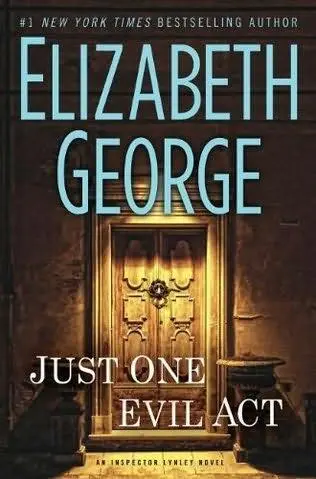
- Название:Just One Evil Act
- Автор:
- Издательство:Dutton
- Жанр:
- Год:2013
- ISBN:978-0-698-13828-5
- Рейтинг книги:5 / 5. Голосов: 1
-
Избранное:Добавить в избранное
- Отзывы:
-
Ваша оценка:
Just One Evil Act: краткое содержание, описание и аннотация
Предлагаем к чтению аннотацию, описание, краткое содержание или предисловие (зависит от того, что написал сам автор книги «Just One Evil Act»). Если вы не нашли необходимую информацию о книге — напишите в комментариях, мы постараемся отыскать её.
bestselling author Elizabeth George offers the latest in her Inspector Lynley series: a gripping child-in-danger story featuring fan favorite Barbara Havers. Detective Sergeant Barbara Havers is at a loss: The daughter of her friend Taymullah Azhar has been taken by her mother, and Barbara can't really help—Azhar had never married Angelina, and his name isn't on Hadiyyah's, their daughter's, birth certificate. He has no legal claim. Azhar and Barbara hire a private detective, but the trail goes cold.
Azhar is just beginning to accept his soul-crushing loss when Angelina reappears with shocking news: Hadiyyah is missing, kidnapped from an Italian marketplace. The Italian police are investigating, and the Yard won't get involved, until Barbara takes matters into her own hands. As she attempts to navigate the complicated waters of doing anything for the case against her superior's orders, her partner, Inspector Thomas Lynley, is dispatched to Italy as the liaison between the Italian police and Hadiyyah's distraught parents.
In time, both Barbara and Lynley discover that the case is far more complex than just a kidnapping, revealing secrets about Angelina; her new lover, Lorenzo; and even Azhar—secrets Barbara may not be willing to accept. With both her job and the life of a little girl on the line, Barbara must decide what matters most and how far she's willing to go to protect it.
Just One Evil Act — читать онлайн бесплатно полную книгу (весь текст) целиком
Ниже представлен текст книги, разбитый по страницам. Система сохранения места последней прочитанной страницы, позволяет с удобством читать онлайн бесплатно книгу «Just One Evil Act», без необходимости каждый раз заново искать на чём Вы остановились. Поставьте закладку, и сможете в любой момент перейти на страницу, на которой закончили чтение.
Интервал:
Закладка:
At this, the poor man’s voice wavered. Barbara’s hands and her feet went completely dead. She said, “What? Azhar, what ?”
“They think Hadiyyah was with this man,” he said. “They have gone to Angelina’s home for her fingerprints, for DNA samples, for . . . I do not know what else.”
Barbara could tell he was trying not to weep. She said, “Azhar.”
“I could not just remain in Lucca and wait for news. They will compare the car—what they find in it and on it—and they will then know, but I . . . To hear she might have been with him and then to know . . .” A silence, then a barely controlled gasp. Barbara knew how humiliating it would be for him to be heard weeping by anyone. He said at last, “Forgive me. This is unseemly.”
“Bloody hell,” she said in a fierce whisper. “Azhar, this is your daughter we’re talking about. There is no ‘I should not’ between you and me when it comes to Hadiyyah, okay?”
This appeared to make matters worse, for then he sobbed, managing only “Thank you” and nothing more.
She waited. She wished she were there, wherever he was in the Alps, because she would have taken him into her arms for what comfort she could offer in this situation. But it would have been a cold comfort indeed. When a child went missing, each day that passed was a day that lessened the possibility of that child’s ever being found alive.
Azhar finally managed to give her more details as well as a name: Roberto Squali. He was at the heart of what had happened to Hadiyyah. He was the driver of the crashed car, who was dead.
“A name is a starting place,” Barbara told him. “A name, Azhar, is a good starting place.”
Which brought her, of course, to the pet name khushi and the reason for her call. But she couldn’t find it in herself to mention this to Hadiyyah’s father just now. He was already upset enough with this turn of events. Asking him about khushi or making insinuations about his putative Berlin alibi or requiring of him definitive proof that he wasn’t the mastermind behind the disappearance of a most beloved child as claimed by the private investigator he’d hired . . . Barbara realised she couldn’t do this to him. For the very idea that he would set off to Berlin and establish an alibi while someone he’d hired in Italy was snatching his daughter from a public market . . . It didn’t make sense. Not when one put Angelina Upman into the picture. Unless, of course, the plan was to hold Hadiyyah somewhere until her mother came to believe she was dead. But what mother of a missing child ever gave up hope? And even if this was the plan and Azhar intended somehow to spirit his daughter back to England sans passport at some point six or eight or ten months from now, what was Hadiyyah supposed to do then? Never contact her mother again?
None of these conjectures made sense to Barbara. Azhar was innocent. He was in intolerable pain. And what she didn’t need to do at the moment was to make things worse with pointed questions about Dwayne Doughty’s claims and his declaration of khushi , as if a word in Urdu held the key to a life-and-death puzzle that seemed to enlarge with every day that passed.
LUCCA
TUSCANY
By late morning, Salvatore had the confirmation for his suspicions. The missing child’s fingerprints were, indeed, in the red convertible. Forensic officers in the company of DI Lynley had gone to Fattoria di Santa Zita to obtain samples from the little girl’s bedroom: fingerprints as well as DNA from her hairbrush and toothbrush. The DNA results would not come in for some time. But the fingerprints had been a matter of a few hours only, to collect them, to take them to the laboratory, and to compare them to what had been found in the car, on the sides of the leather passenger seat, on the seatbelt’s buckle, and on the fascia. DNA was hardly necessary after that, but since DNA results had long since become de rigueur during trials, appropriate tests would be made.
For his own work, however, Salvatore didn’t need those results. What he needed was an interview with anyone who knew Roberto Squali, and he began with the man’s home address. This was in Via del Fosso, a north-south lane through the walled city. This route was, most unusually, cut down its centre by a narrow canal from which fresh ferns sprang between crevices on its edges, and Squali’s residence was on the west side of this canal, through a heavy door that hid one of Lucca’s fine private gardens.
Most men of Squali’s age in Italy did not live alone. Rather, they lived at home with their parents, generally waited upon by their doting mammas until such a time as they married. But this did not prove true for Roberto Squali. As things turned out, Squali was from Rome and his parents still lived there. The young man himself had a residence at the home of his paternal aunt and her husband, and upon questioning them, Salvatore discovered that such had been the case since Roberto’s adolescence.
The aunt and uncle—surnamed Medici (alas, no relation)—met with Salvatore in the garden, where beneath the branches of a fig tree, they sat on the edges of their chairs as if to spring away from him at the least provocation. From an earlier visit made by the police, they’d learned of their nephew’s death via automobile accident; his parents in Rome had been informed; there the family were devastated; a funeral was even now being arranged.
No tears were shed in the garden for Roberto’s unexpected passing. Salvatore thought this strange. Considering the length of time that Squali had lived with his aunt and uncle, it seemed to him that they would have come to consider him something of a son. But they had not, and some careful probing on his part turned up the reason.
Roberto had not been a source of pride to his family. Indeed, just the opposite was the case. At fifteen years old and enterprising well beyond his years, he’d found easy money available in running a minor prostitution ring featuring the services of immigrant women from Africa. His parents had got him out of Rome one step ahead of being arrested not only for this but also for having enjoyed the pleasures of the flesh offered—at least to hear Roberto’s account of the interlude—by the twelve-year-old daughter of a family acquaintance. The parents of the violated girl agreed to a hefty financial settlement for her deflowering, and the public prosecutor had been cajoled into accepting an arrangement that guaranteed Roberto’s absence from the Eternal City well into subsequent decades. Hence, an arrest and a trial associated with either matter were avoided and familial disgrace had been buried by means of the boy’s removal to Lucca. There he’d remained for the past ten years.
“He is not a bad boy,” Signora Medici avowed to Salvatore, less with passion than with the habit of repetition. “It is just that . . . for Roberto . . .” She glanced at her husband. It seemed a wary look.
He went on. “ Vuole una vita facile ” was how the signore put it. And to Roberto, the easy life had been defined as working as little as possible since there were pickings aplenty in their society and he’d been determined from childhood to be ready with a basket whenever something was hanging low enough on the tree. When he worked at all, it was as a waiter in one fine restaurant or another, either in Lucca or in Pisa or occasionally in Firenze. Charming as he was, he never had trouble finding employment. Keeping it, however, had always been another matter.
“We pray for him,” Signora Medici murmured. “Since he is fifteen years old, all of us pray that he will perhaps grow into a man like his father or like his brother.”
The fact that Roberto had a brother was a subject worth exploring, but the topic was dispatched fairly quickly. Cristoforo Squali, as things turned out, was the blue-eyed boy in the family, an architetto in Rome, married three years, and producing a grandchild for his proud parents eleven months after the I dos were said. With another child on the way, he was everything Roberto was not, this Cristo. He’d never put a foot wrong since the day of his birth. While Roberto . . . ? Signora Medici crossed herself. “We pray for him,” she repeated. “Weekly novenas, his mother and I. But God has never heard our prayers.”
Читать дальшеИнтервал:
Закладка:
Похожие книги на «Just One Evil Act»
Представляем Вашему вниманию похожие книги на «Just One Evil Act» списком для выбора. Мы отобрали схожую по названию и смыслу литературу в надежде предоставить читателям больше вариантов отыскать новые, интересные, ещё непрочитанные произведения.











Обсуждение, отзывы о книге «Just One Evil Act» и просто собственные мнения читателей. Оставьте ваши комментарии, напишите, что Вы думаете о произведении, его смысле или главных героях. Укажите что конкретно понравилось, а что нет, и почему Вы так считаете.