Elizabeth George - Just One Evil Act
Здесь есть возможность читать онлайн «Elizabeth George - Just One Evil Act» весь текст электронной книги совершенно бесплатно (целиком полную версию без сокращений). В некоторых случаях можно слушать аудио, скачать через торрент в формате fb2 и присутствует краткое содержание. Год выпуска: 2013, ISBN: 2013, Издательство: Dutton, Жанр: Детектив, на английском языке. Описание произведения, (предисловие) а так же отзывы посетителей доступны на портале библиотеки ЛибКат.
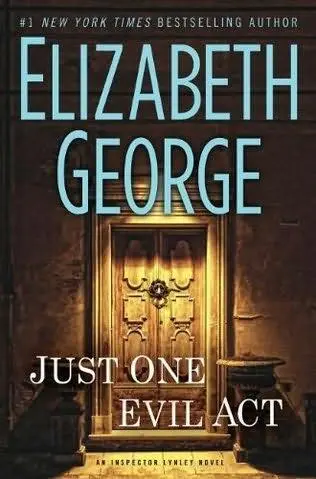
- Название:Just One Evil Act
- Автор:
- Издательство:Dutton
- Жанр:
- Год:2013
- ISBN:978-0-698-13828-5
- Рейтинг книги:5 / 5. Голосов: 1
-
Избранное:Добавить в избранное
- Отзывы:
-
Ваша оценка:
Just One Evil Act: краткое содержание, описание и аннотация
Предлагаем к чтению аннотацию, описание, краткое содержание или предисловие (зависит от того, что написал сам автор книги «Just One Evil Act»). Если вы не нашли необходимую информацию о книге — напишите в комментариях, мы постараемся отыскать её.
bestselling author Elizabeth George offers the latest in her Inspector Lynley series: a gripping child-in-danger story featuring fan favorite Barbara Havers. Detective Sergeant Barbara Havers is at a loss: The daughter of her friend Taymullah Azhar has been taken by her mother, and Barbara can't really help—Azhar had never married Angelina, and his name isn't on Hadiyyah's, their daughter's, birth certificate. He has no legal claim. Azhar and Barbara hire a private detective, but the trail goes cold.
Azhar is just beginning to accept his soul-crushing loss when Angelina reappears with shocking news: Hadiyyah is missing, kidnapped from an Italian marketplace. The Italian police are investigating, and the Yard won't get involved, until Barbara takes matters into her own hands. As she attempts to navigate the complicated waters of doing anything for the case against her superior's orders, her partner, Inspector Thomas Lynley, is dispatched to Italy as the liaison between the Italian police and Hadiyyah's distraught parents.
In time, both Barbara and Lynley discover that the case is far more complex than just a kidnapping, revealing secrets about Angelina; her new lover, Lorenzo; and even Azhar—secrets Barbara may not be willing to accept. With both her job and the life of a little girl on the line, Barbara must decide what matters most and how far she's willing to go to protect it.
Just One Evil Act — читать онлайн бесплатно полную книгу (весь текст) целиком
Ниже представлен текст книги, разбитый по страницам. Система сохранения места последней прочитанной страницы, позволяет с удобством читать онлайн бесплатно книгу «Just One Evil Act», без необходимости каждый раз заново искать на чём Вы остановились. Поставьте закладку, и сможете в любой момент перейти на страницу, на которой закончили чтение.
Интервал:
Закладка:
“Oh, for God’s sake, Em.” Dwayne did his best to hide his desperation. Without Em Cass at the helm of his computer system—not to mention on the phones acting the part of whatever official was needed to glean information from sources who’d be less than cooperative faced with someone with little talent for hoodwinking them—he was sunk and he knew it. “I called in the cavalry,” he told her. “I told them the truth.”
She was unimpressed. “There is no bloody cavalry. I tried to tell you that right from the first, didn’t I, but you wouldn’t listen. Oh no. You were far too clever for that.”
“Stop being dramatic. I gave them the professor. All right? Are you hearing me? I gave them the professor. Full stop. That’s what you’ve wanted, isn’t it? Well, it’s been done and you and I are on our way to being in the clear.”
“And they’re going to believe you?” she scoffed. “You name a name and that’s all there is to it?” She raised her head heavenward and spoke to some deity on the ceiling, saying, “Why didn’t I see what an idiot he is? Why didn’t I get out when this whole thing started?”
“Because you knew I’d never go into something without an exit strategy planned. And I have one for this. So d’you want to run off or do you want to unpack your boxes and help me set it in motion?”
LUCCA
TUSCANY
Lynley located Taymullah Azhar in the Cathedral of San Martino, which stood enormously in a large piazza along with a palazzo and the traditional, separate battistero. It was an elaborate Romanesque building not dissimilar to a wedding cake, with a façade comprising four tiers of arches, and mounted upon it was a marble depiction of the eponymous saint performing his act of kindness with garment and sword upon a mendicant at the side of his horse. Lynley wouldn’t have thought to find Azhar inside this building. As a Muslim, he didn’t seem like a man who’d seek a Christian church in order to pray. But when Lynley rang his mobile, Azhar’s hushed voice said he was with the Holy Face inside the Duomo. Lynley wasn’t certain what this meant, but he asked the Pakistani man to wait for him there.
“You have news?” Azhar asked hopefully.
“Wait for me please” was Lynley’s reply.
Inside the cathedral, a tour was ongoing: A young woman with an official badge round her neck was shepherding some dozen or so people to stand at the foot of a Last Supper, the work of Tintoretto brightly lit to show angels above, apostles below, and the Lord in the midst of feeding a piece of bread to St. Peter as his companions managed to look suitably impressed with the goings on. Midway down the right aisle, a partition kept unticketed visitors away from the beauties of the sacristy, while to the left an octagonal temple was the centre of attention of ten elderly women who looked like pilgrims come specifically to the spot.
It was at this temple that Lynley found Azhar, standing respectfully back from the pilgrims but gazing upon a huge and severely stylised crucified Christ rendered in wood. The Christ had on his face an expression that looked more surprised than suffering, as if he couldn’t quite come to terms with what had put him into the position in which he found himself.
“It’s called the Holy Face,” Azhar said to Lynley quietly as Lynley joined him next to one of the Duomo’s pillars. “It’s supposed to . . .” He cleared his throat. “Signora Vallera told me of it.”
Lynley glanced at the other man. Here was anguish, he thought, a mental and spiritual crucifixion. He wanted to put an end to Azhar’s suffering. But there was a limit to what he could tell him while so much of what they needed to know was still floating out there, waiting to be discovered.
“She said,” Azhar murmured, “that the Holy Face works miracles for people, but this is something I find I cannot believe. How can a piece of wood—no matter how lovingly carved—do anything for anyone, Inspector Lynley? And yet, here I am, standing in front of it, ready to ask it for my daughter. And yet unable to ask for anything because to ask such a thing of a piece of wood . . . This means to me that hope is gone.”
“I don’t think that’s the case,” Lynley told him.
Azhar looked at him. Lynley saw how dark the skin beneath his eyes had become, acting as a stark contrast to the whites of his eyes, which were themselves sketched with red. Every day that Lynley had been in Italy, the man had looked worse than the day before. “Which part of it?” Azhar asked him. “The wood performing a miracle or the hope?”
“Both,” he said. “Either.”
“You’ve learned something,” Azhar guessed. “You would not have come otherwise.”
“I’d prefer to speak to you with Angelina.” And when he saw the momentary terror of every parent whose child is missing shoot across Azhar’s face, Lynley went on. “It’s neither good nor bad,” he said hastily. “It’s just a development. Will you come with me?”
They set off for the hospital. It was outside the great wall of Lucca, but they went on foot as the route was not overly long and their use of the wall itself for part of the walk—sheltered by the great trees upon it—made the way both pleasant and shorter. They descended from one of the diamond-shaped baluardi , and from that point they made their way to Via dell’Ospedale.
When they reached the hospital, they were in time to see Lorenzo Mura and Angelina Upman together leaving the place. Angelina was in a wheelchair being pushed by an attendant. Grim-faced, Lorenzo walked at her side. He caught sight of Lynley and Azhar approaching, and he spoke to the attendant, who halted.
At least, Lynley thought, this appeared to be a piece of good news: Angelina sufficiently well to return to her home. She was very pale, but that was the extent of things.
When she saw Lynley and Azhar approaching her together, she pressed herself back in the wheelchair as if she could stop whatever news was coming. Lynley understood at once. He and Azhar arriving as one to see her . . . She would be terrified that the worst had occurred.
He said hastily, “It’s information only, Ms. Upman,” and he saw her swallow convulsively.
Lorenzo was the one to speak. “She wishes it. Me, I do not.”
For an insane moment, Lynley thought he was referring to her daughter’s death at the hands of a kidnapper. But when Lorenzo went on, his meaning became clear.
“She says she is better. This I do not believe.”
Apparently, she’d checked herself out of the hospital. She had good reason, she said. The chance of infection in a hospital was greater than the benefit of being under the care of nursing staff for what amounted to morning sickness. At least, this was Angelina’s belief, and she turned to her former lover for corroboration, saying, “Hari, will you explain to him how dangerous it is for me to stay here any longer?”
Azhar didn’t look like a man ready to embrace a position as intermediary between the mother of his child and the father of her next child, but he was a microbiologist, after all, and he did know something about the transmission of sickness and disease. He said, “There are risks everywhere, Angelina. While there is truth in what you say—”
“ Capisci? ” she cut in, speaking to Lorenzo.
“—there is also truth in the dangers of illnesses associated with pregnancy if you don’t attend to them.”
“Well, I have attended to them,” she said. “I’m keeping food down now—”
“ Solo minestra ,” Lorenzo muttered.
“Soup is something,” Angelina told him. “And I’ve no other symptoms any longer.”
“She does not listen to me,” Lorenzo said to them.
Читать дальшеИнтервал:
Закладка:
Похожие книги на «Just One Evil Act»
Представляем Вашему вниманию похожие книги на «Just One Evil Act» списком для выбора. Мы отобрали схожую по названию и смыслу литературу в надежде предоставить читателям больше вариантов отыскать новые, интересные, ещё непрочитанные произведения.










Обсуждение, отзывы о книге «Just One Evil Act» и просто собственные мнения читателей. Оставьте ваши комментарии, напишите, что Вы думаете о произведении, его смысле или главных героях. Укажите что конкретно понравилось, а что нет, и почему Вы так считаете.